
Facebook Marketing 2026 (Ad Prices Up 12%, Meta's Own Numbers)
Facebook still has the audience. Meta reported 3.60 billion daily active people across its apps in June 2026. It is also getting more expensive: Meta's own Q2 2026 results show ad impressions up 14% year on year and average price per ad up 12%. Organic reach is the cheap route and the slow one.
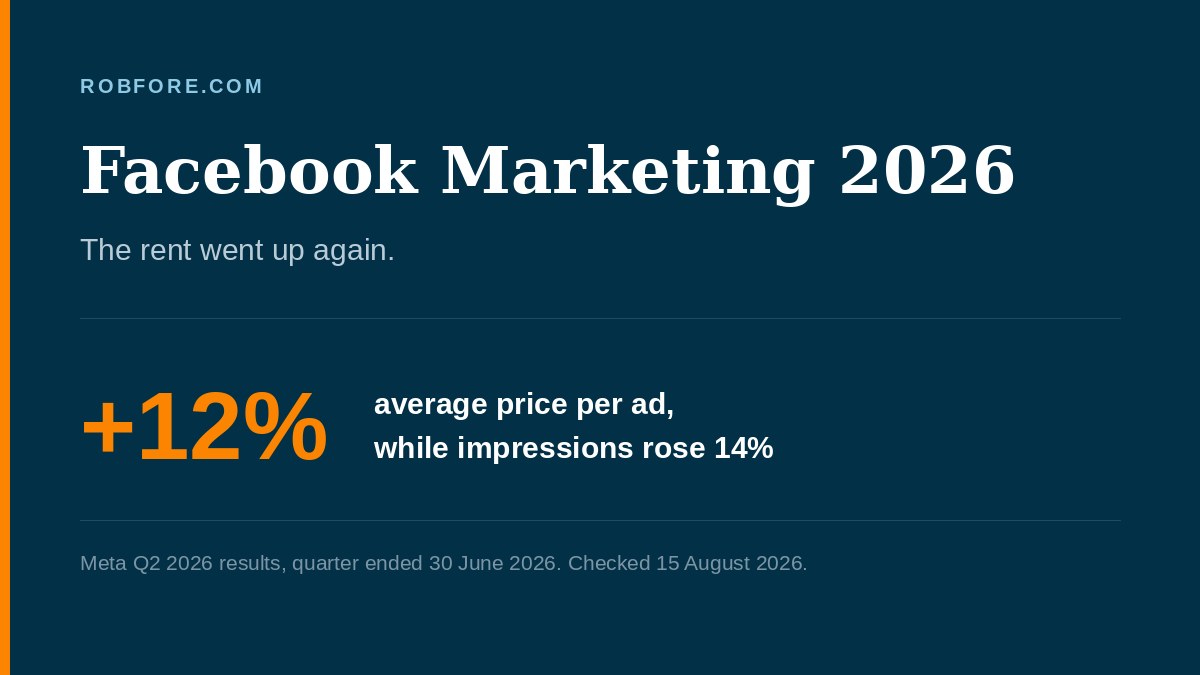
Two numbers from Meta’s own quarterly filing tell you most of what you need to know about Facebook in 2026, and they point in opposite directions.
The audience is still enormous.
The price of reaching it went up again.
Everything else here is detail hanging off those two facts…
Is Facebook Still Worth It For Marketing?
The audience question is settled. The cost question is the real one.
From Meta’s Q2 2026 results, for the quarter ended 30 June 2026:
| Meta, Q2 2026 | Figure |
|---|---|
| Family daily active people | 3.60 billion, up 3% year on year |
| Total revenue | $60,801 million, up 28% |
| Advertising revenue | $59,363 million |
| Ad impressions | Up 14% year on year |
| Average price per ad | Up 12% year on year |
Read the last two rows together, because that is the whole story of Facebook as a marketing channel right now.
More inventory. Higher prices anyway.
Impressions grew 14% and the price still rose 12%. Demand is outrunning supply.
Advertisers are bidding harder for the same attention and the auction reflects it. That is not a platform in decline - it is a platform getting more expensive to use, which is a different and far more manageable problem.
The category matches.
Social advertising in the US was a $117.7 billion business in 2025, growing 32.6%, according to the IAB and PwC revenue report published 16 April 2026. Social passed search that year.
The money went where the attention already was.
Can Anyone Tell You What Facebook Ads Cost?
Nobody outside Meta can tell you honestly, and that includes every page ranking for this question.
Meta does not publish an average cost per click or cost per thousand impressions.
Every “average Facebook ad cost” figure you have read traces back to an agency counting the accounts it happens to run. Those samples are real data about those accounts. They are NOT a market rate.
Your cost depends on your industry, audience, creative and objective far more than on any published average.
What Meta does publish is the direction of travel, and it is up 12% year on year.
So the honest answer to “what do Facebook ads cost” is: more than last year, and the only figure that matters is what they cost YOU, which you find out by spending money.
Which brings me to the part I have to say plainly.
The Thing I Cannot Teach You
I have no meaningful paid advertising experience.
None worth charging for. None worth writing a guide from.
That gap matters more here than almost anywhere, because roughly a third of the search demand on this topic is about ads specifically, and ads are the part I have not bought.
I could write that guide. There is enough public material to assemble something that reads authoritatively, and I would never have to spend a dollar doing it.
Where I can show you my own numbers is the channel I have actually run for eighteen years, unflattering ones included.
EXACTLY the kind of page this site exists not to publish.
If you want to learn Facebook ads, learn them from somebody who will show you their own ad account. Ask to see the spend, the cost per result and the months it did not work. Anybody unwilling to show you that is teaching from the same public material I would have been.
What follows is the part I can actually speak to.
Does Organic Facebook Still Work?
It does. Slowly, and mostly not where people expect.
The pattern I have seen hold for years is that conversations move on personal profiles and in groups, not on business pages.
A page is a noticeboard. A profile is a person.
People in this industry buy from people, and the platform’s own mechanics reward whatever format generates replies.
Nobody outside Meta has a reliable organic reach percentage, and I would rather leave the gap visible than fill it. Meta does not publish it, so every number you have seen for “average page reach” is somebody’s sample.
The trade is real, though, and worth stating.
A personal profile is not a business asset.
You cannot sell it, hand it to a team, or build ad infrastructure on it the way you can with a page. So the thing that works best socially is also the thing you own least. That tension does not resolve - you just pick which side of it you would rather live on.
Which is the same argument as everywhere else on this site. Rented ground moves people faster.
Owned ground keeps them. The list and the site are the only two things nobody can take, and internet marketing basics makes that case in full.
What The FTC Says About Your Facebook Posts
This is the section that matters most for this audience and gets skipped everywhere else.
A photo of a car is an earnings claim.
When the FTC came after high-level MLM participants in April 2026, the order it obtained names photographs alongside figures: houses, cars, purchases and travel are all listed there as ways of misrepresenting earnings.
Not just numbers. Pictures.
That is a description of a Facebook feed in this industry, and it is now enforcement history rather than theory. The action was against individual participants, not the company above them, which I covered in the FTC rules for affiliates.
So the rules that apply to a blog post apply to a story, a reel and a group post.
Same claims. Same burden. Smaller character count and no excuse.
No source and date beside a figure?
Don’t post the figure. If you cannot put what people typically earn beside a result, do not post the result. The whole compliance layer, and it fits in two sentences.
What Meta Won’t Tell Either Of Us
Start with the gap that will annoy a third of the people who found this page.
No ad costs, no ad tactics, no ad case studies. Deliberate, because I have not bought Facebook ads at any scale, and a page that pretended otherwise would cost you money rather than mine.
Then the numbers themselves, which are Meta’s and not mine. The 3.60 billion counts Family daily active people across all Meta apps, not Facebook alone, and the ad figures cover the whole Family of Apps the same way. Facebook-only numbers do not exist in that filing.
Not estimating them for you.
Organic reach is undocumented by design, too. Everything above about profiles versus pages comes from pattern-matching across my own network and thirty years of watching it, not from measurement. Treat it as a hypothesis worth testing.
And it all dates fast. The quarter ended 30 June 2026, and the next release moves every figure on this page.
One more, for completeness. Reels, marketplace, and whatever launches next quarter sit outside anything I have used seriously enough to have a view on.
“But Everyone Says Facebook Is Dead”
They have been saying it since 2014, and Meta’s own filing says 3.60 billion people opened one of its apps yesterday.
Dead is the wrong word.
Expensive is the right one, and the two get confused constantly by people who quit a channel and needed a reason.
So this page is for you if you want to know whether the channel is still worth your time before you commit. The audience answer is yes and it is documented. The cost answer is rising and it is documented too.
It is also for you if you have been posting income screenshots and have not thought about the FTC. Go back to that section first. Cheapest problem on this page to fix, most expensive to ignore.
Two people should go somewhere else.
One came to learn Facebook ads.
Wrong person, wrong page. Go and find somebody who will open their ad account in front of you.
The other came for a number to plan against. The confident ones circulating are single samples wearing the costume of a standard, and I would rather hand you nothing at all than hand you that.
Facebook is a rented field on good soil. Enormous, fertile, and somebody else sets the rent every year. Meta’s own filing says the rent went up 12% this year, and there is no version of this where it goes down.
Plant on it. Just do not build the barn there.
Bless and be blessed,

Sources
- Meta Platforms, Second Quarter 2026 Results - checked Aug 15, 2026
- IAB and PwC Internet Advertising Revenue Report, Full Year 2025 - checked Aug 15, 2026
- FTC action against high-level MLM participants (Merritt / LifeWave) - checked Aug 15, 2026