
Business Holiday Cards for Clients: What 200 Really Cost
Want every client to get a real card from you this year?
Good. A card in the hand beats one more email in the inbox.
The card isn’t the hard part. The evening is. Two hundred signatures, two hundred envelopes, two hundred stamps, and a kitchen table you won’t see again until Friday.
So let’s price that evening honestly. Three ways, real numbers, and the one most people skip.
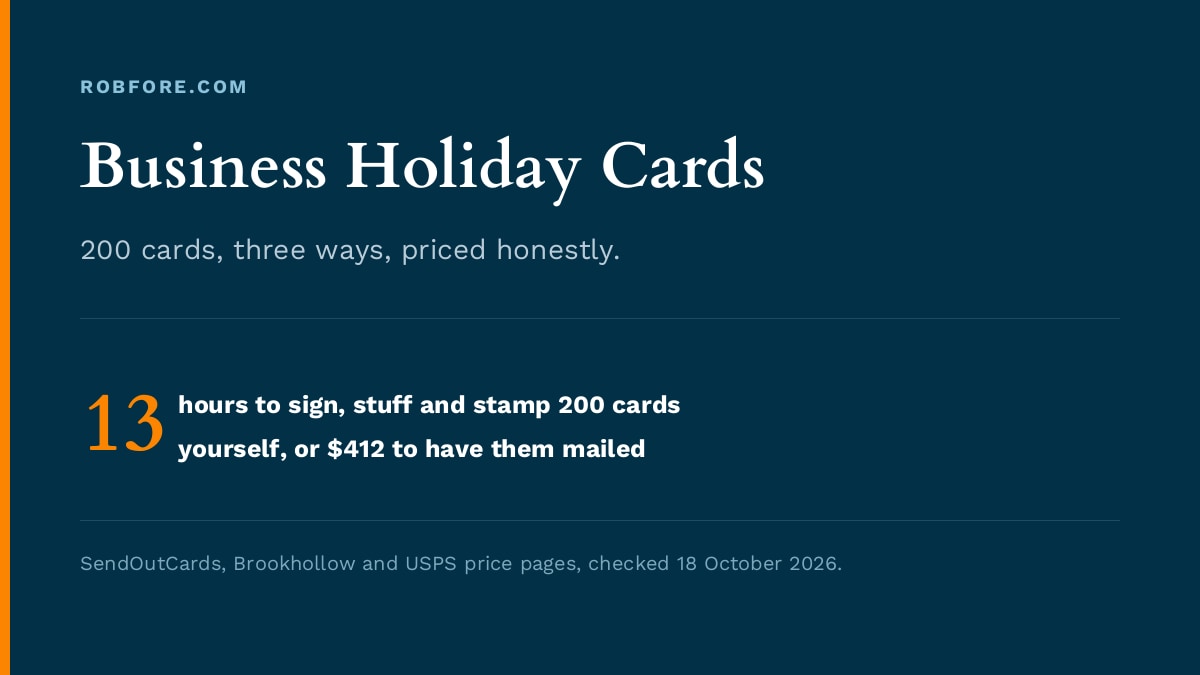
Business holiday cards for clients run about $1.90 to $4 each once you count the card and the 82-cent stamp. Buy a box and mail it yourself, pay a print shop to address and stamp it, or send each card online with postage included. Either way, mail First-Class by December 17.
What Do Business Holiday Cards for Clients Really Cost?
About $1.90 to $4 a card, once the stamp is in. That’s the honest range for 200 cards in 2026, and where you land depends on two things: the card you pick, and how much of the work you hand off.
The stamp went up this summer. The Postal Service’s own April announcement put it in one line: “The new rates include a 4-cent increase in the price of a First-Class Mail Forever stamp from 78 cents to 82 cents.”
Eighty-two cents. On 200 cards that’s $164 before you’ve bought a single card.
Here’s what 200 cards cost, using each company’s own price page:
| How you send them | 200 cards | Per card | Who does the work |
|---|---|---|---|
| Budget box, you mail them (Brookhollow “starting at” $1.07 card) | $214 + $164 stamps = $378 | $1.89 | You sign, stuff, address and stamp all 200 |
| Premium box, you mail them (Gallery Collection foil card, 40% and $75 off) | $549 + $164 stamps = $713 | $3.57 | Same work, fancier card |
| Print shop addresses and stamps them (Brookhollow “starting at” $1.07 card) | $214 + $100 mailing + $164 stamps = $478 | $2.39 and up | You upload a list. Every card says the same thing |
| Online, postage included (SendOutCards, one Pro month) | $112 for 50 + 150 x $2 = $412 | $2.06 | You type a line per person. They print, stamp and mail |
| Online, no membership (SendOutCards pay-as-you-go) | 200 x $4 = $800 | $4.00 | Same, at the highest price |
Look at what those numbers actually say. In cash, the cheapest way is a budget box you mail yourself. Sending online costs $34 more for 200 cards. The print shop costs $100 more, and every card says the same thing.
But the cheap box is the only way where you do every job by hand.
The cheapest way to send 200 holiday cards in cash is the one that costs you the most hours.
Brookhollow’s $1.07 is a “starting at” price, so a 200-card order may cost more per card, in the budget box row and the print shop row alike. Time yourself on five cards before you trust any time estimate, including mine. At four minutes a card, 200 cards is more than 13 hours.
Why Most Business Holiday Cards Get Tossed
Most business holiday cards end up in the trash because nothing in them is about the person holding them. A logo, a printed “Season’s Greetings,” a signature stamp. The client reads it in two seconds and drops it in the recycling with the rest.
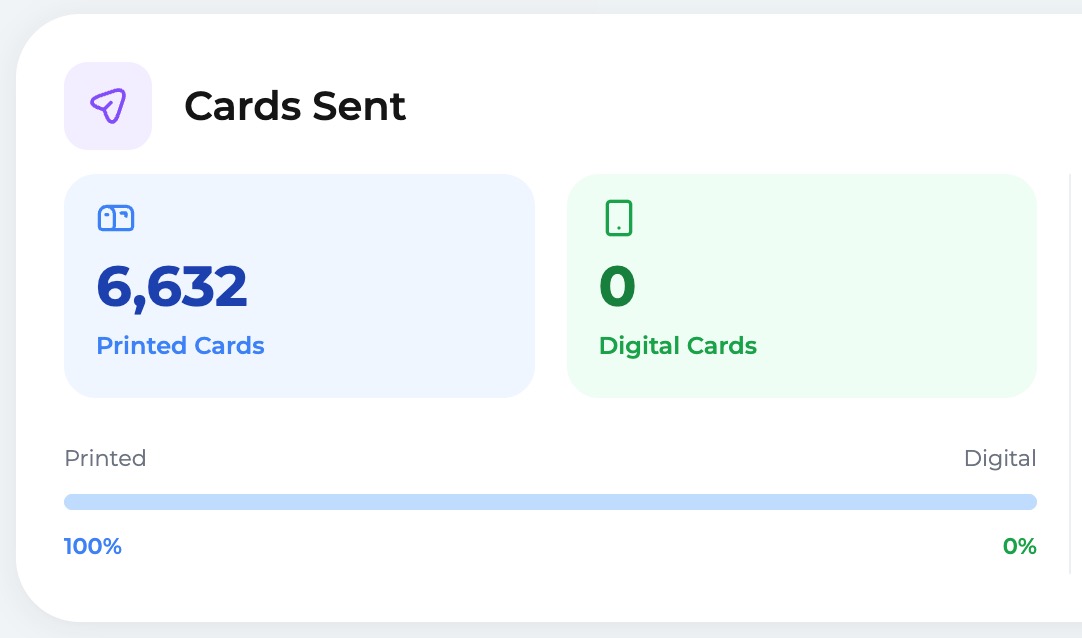
I’ve been on the sending side of this for years. My own SendOutCards account shows 6,632 printed cards sent, and not one digital card. I mail paper.
That’s not just my opinion. Researchers at the University of Chicago had people write gratitude letters, then asked the recipients how they felt. Amit Kumar and Nicholas Epley published the result in Psychological Science in 2018: “Expressers significantly underestimated how surprised recipients would be about why expressers were grateful, overestimated how awkward recipients would feel, and underestimated how positive recipients would feel.”
Read the middle of that again. Senders think a thank-you will feel awkward. Recipients don’t feel awkward at all.
And paper beats a screen for staying power. The Postal Service’s Inspector General paid Temple University to put people in brain scanners and show them ads on paper and on screens. The 2015 report found: “When viewing physical ads, participants had a stronger emotional response and remembered them better.” That study measured ads, not greeting cards, so take it as a direction, not proof.
Here’s what it means for you. A card works when it carries one line that could only be about that one client. The paper gets it kept. The line gets it remembered.
One specific line per client beats a better design every time.
Three Ways to Get Business Holiday Cards to Every Client
There are three ways to do this, and each one is the right call for somebody.
One: buy a box and mail it yourself. The Gallery Collection, Brookhollow, Hallmark Business and Vistaprint all sell imprinted cards with your logo, envelopes included. You sign them, write a line, stuff, seal, address and stamp. It’s the most personal option if you actually write in each one, and the slowest. For 25 cards, it’s a pleasant evening. For 200, it’s a week of evenings.
Two: let the print shop mail them. This one surprised me. Brookhollow lists it right on the page: “Mail For Me, Address + Stamp,” at “$.50 ea. + Stamp.” You upload your list, they print, address, stamp and drop them in the mail. It’s cheap and it’s fast. The catch is that every card is the same card. Your top client and the guy who bought once in 2023 read the same words.
Three: send each card online, postage included. I’ll tell you up front, I’m a SendOutCards consultant, so I earn a commission if you buy. My own grading site, Opportunity Grade, gives the SendOutCards business opportunity a C-, and you can read the full SendOutCards report there. This page is about the cards, not the business.
Here’s how SendOutCards works. SendOutCards and Promptings are the same company, so you’ll see both names on its pages. You pick a card design, upload your list once, and write a line for each person. The company prints the card, puts a real stamp on it and mails it. The company’s 2026 plan sheet says it plainly: “All cards include US stamps, international stamps will incur a $1 fee.”
You can send one card free, postage included. Send it to someone in your own house, your spouse or one of your kids, with a real line about them. You get to hold the card and judge the paper. And you get to watch somebody open a card that’s about them. Then decide.
Does Sending Cards Online Actually Save You Anything?
Yes on time, sometimes on money, no on the hard part. Here’s sending 200 cards online, measured against buying a box and mailing it yourself:
| Lever | Verdict | How, mechanically | What it costs you |
|---|---|---|---|
| Cost | About the same, or far less | One Pro month is $112 with 50 cards, then $2 a card, stamp included. 200 cards comes to $412, against $378 for a budget box and $713 for a premium one, stamps included | $34 more than the cheapest box, and a monthly membership you have to keep or cancel |
| Conversion | Lifts, if you write the line | Each card carries the client’s name and your own sentence about them, not a printed verse | Nothing, if you do the writing. If you skip it, you’ve bought a nicer logo card |
| Time | Saves | Signing, stuffing, sealing, addressing and stamping all disappear. What’s left is typing one line per person | You still have to build the address list, and that’s the slow part |
| Edge | Real, but not the tool | Your competitors can buy the same service tonight. They won’t write 200 specific sentences | The edge is your habit, not the software |
Bottom line - it costs about what the cheapest box costs, wipes out the envelope work, and leaves the list and the sentences to you.
That last row matters most. Anybody can buy the card. Almost nobody sits down and writes “Thanks for trusting us with your daughter’s first house, Linda” two hundred times.
That’s your edge. The card just carries it. Software can mail the card, but it can’t write the line, which is the same wall I hit testing network marketing automation.
What to Write in a Business Holiday Card
Write four things, in this order: their name, one thing you remember about working with them, a plain thank-you, and a wish for next year. Leave out the pitch. A holiday card with an offer in it is a flyer, and the offer belongs in your follow-up emails instead.
Here’s the shape:
“Linda, closing on the Maple Street house in that August heat wave is still my favorite day of the year. Thank you for trusting me with it. Wishing you and the girls a peaceful holiday and a great first winter in the new place.”
Forty words. Nobody else on earth could have sent that card.
Some lines to start from, by who’s getting the card:
- A long-time client: “Five years now, Tom. Thank you for sticking with us through every change. Here’s to a quiet, happy holiday.”
- A new client: “You took a chance on us this year, Maria. We don’t take that lightly. Happy holidays from all of us.”
- A referral partner: “Every great client we met this year seems to have come through you, Dave. Thank you. Have a wonderful season.”
- Your team: “You carried this place in a hard year. I see it, and I’m grateful. Rest up and enjoy the holidays.”
- A client who left: “We miss working with you, Jen, and we’re glad we got to. Wishing you a great holiday.”
Not sure of a client’s holiday? Say “holiday” or “season.” Save “Merry Christmas” for the people you know celebrate it.
Name, one memory, thank you, a wish. No pitch.
When to Mail Business Holiday Cards in 2026
Mail First-Class cards by Thursday, December 17, for delivery before Christmas. That’s the date the Postal Service published for the lower 48 states. Cards going to Canada, Mexico or overseas should go by December 9.
Hanukkah starts early this year, on December 4, and USPS calls that out on its own deadline page. If a client celebrates it, mail around Thanksgiving.
Here’s the move most people miss. Send a Thanksgiving card instead. Thanksgiving is Thursday, November 26, and in mid-November the holiday card pile hasn’t started yet. Your card arrives alone. A thank-you card in a month built around giving thanks needs no excuse.
December cards land in a stack. November cards land by themselves.
Either way, put a date on your calendar now. The person who plans to “do cards in December” is the person writing a New Year’s card on January 3rd.
If you’re sending online, the deadline still applies to the mail truck. Send them into the system with a week to spare.
Where This Falls Short
Sending online fixes the envelopes. It doesn’t fix everything, and four things are worth knowing before you spend a dollar.
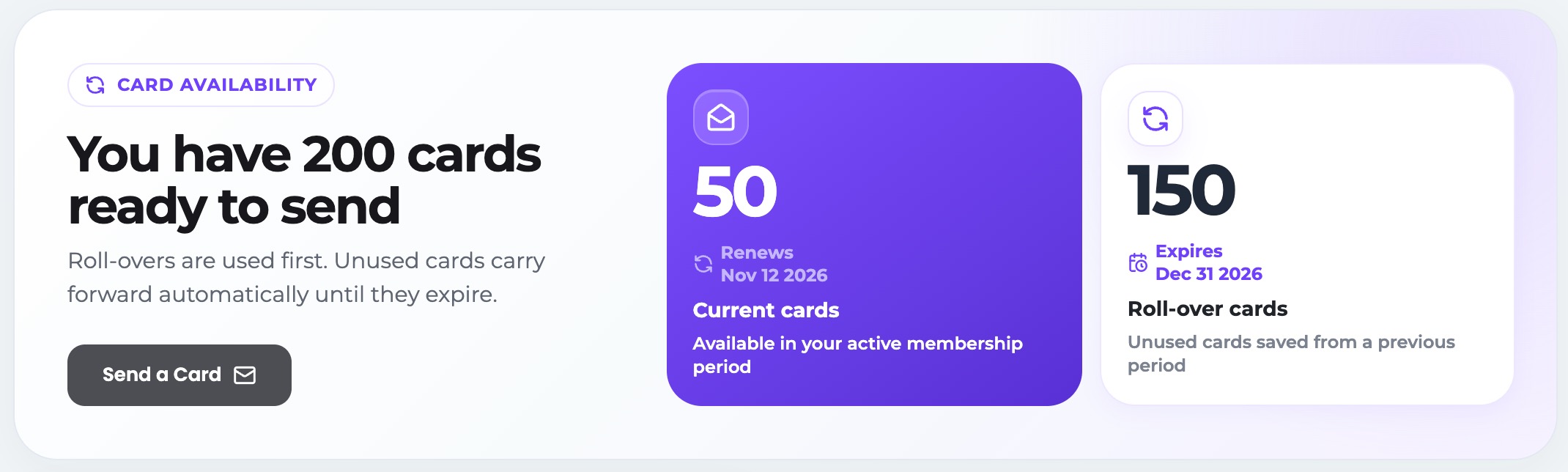
The cheapest price is a membership, and the rollover has a deadline. That $2 card comes with the $112 Pro membership, which bills monthly and gives you 50 cards a month. Unused cards roll over, but only until December 31. My own account shows it: 50 current cards that renew November 12, and 150 rolled-over cards that expire December 31. If you’re already a member, check your balance before you buy anything. Holiday cards are the place to spend those.
A Gratitude Pack avoids the subscription: 200 cards for $520, or $2.60 each, and the company’s plan sheet says pack benefits are “good for 90 days.” Either way, read the cancellation terms before you join.
A huge identical mailing is cheaper at the print shop. If you want the same logo card on 1,000 desks, Brookhollow’s mail-for-me service will likely beat any online card price. Online sending wins when each card says something different.
It’s printed, not inked. Your signature and even your handwriting can be turned into a font, and it looks good. But it’s printed. A client who looks closely can tell it isn’t your pen. If your top ten clients deserve real ink, give them real ink.
You still need the list. No service fixes a missing address. Your CRM, your closing files and your invoices are where those addresses live, and digging them out is the slowest part of this whole job, whichever way you send.
Who This Is For, and Who It Isn’t
Sending online fits anyone with 25 to 500 clients who wants each card to sound like them: real estate agents, financial advisors, insurance agents, contractors, salon owners, coaches. It fits even better if you’ll use the same list for birthdays and home anniversaries the rest of the year, because the list and the habit carry over to January.
It’s the wrong choice in three cases:
- Under 25 cards. Buy a nice box, put on music, write them by hand. It’s one evening and it’s the most personal option there is.
- A corporate mailing with no personal line. Use a print shop’s mail-for-me service and save the money.
- Clients in regulated industries with gift rules. A card is almost always fine, but if you plan to send a gift with it, check your firm’s compliance policy first.
Your Holiday Card Plan for This Week
Seven steps. Number one costs nothing and takes ten minutes.
- Count your list today. Write three numbers: clients you’d hate to lose, clients from this year, and referral partners. That total is your card count.
- Pull the addresses. Export from your CRM, your email list, or your closing files into one spreadsheet with first name, last name and mailing address. This is the step everybody skips, and it’s why the cards go out on January 3rd.
- Pick your date. Thanksgiving card by November 20, or Christmas card by December 10, a week ahead of the December 17 deadline.
- Write one line per person in a column next to the address. Use the four parts: name, one memory, thank you, a wish. Keep it short for most people, and take a full minute on your top twenty.
- Price it three ways with your real count. Run the numbers on a box, a print shop and online.
- Send one test card home. The free card is a good test. Address it to your spouse or one of your kids and write a real line about them. Check the paper, the color and how your line reads in print, then watch their face when they open it.
- Send the batch, then add birthdays. While the list is open, add a birthday column. Next year you’ll be the only person who remembered.
You’re already ahead, because you’re planning. Most people never plan their cards. They just wish they’d sent them.
Which Way Should You Send Them?
For 25 to 500 clients, send them online with SendOutCards. For 200 cards, one Pro month comes to $412, or about $2.06 a card with the stamp, at the prices on its page when I checked in October 2026. It’s the one I pay for myself.
Here’s why it’s my pick: it’s the only one of the three ways where every card can say something different without you touching an envelope.
It isn’t the cheapest. A budget box you mail yourself runs about $378 for 200, which is $34 less. That $34 buys back about 11 hours of signing, stuffing and stamping.
About $3 an hour.
Pass on it if you’re sending fewer than 25, or one identical logo card to a big list. For the first, buy a box and write by hand. For the second, the runner-up is a print shop’s mail-for-me service, like Brookhollow’s, at about $478 for 200 with no membership, as long as every card can say the same thing.
So what’s the extra money buying? Not cheaper cards. It buys those 11 hours, and you spend a few of them on the one thing nobody else will do: the line that’s about them.
Run your own count with my holiday card cost calculator. It prices all three ways with your own time per card, and it has a line ready for every kind of client.
Bless and be blessed,

Sources
- USPS Newsroom, U.S. Postal Service Recommends New Prices for July (Forever stamp 78 to 82 cents), 9 April 2026 - checked Oct 18, 2026
- USPS, 2026 Holiday Shipping Deadlines (First-Class Mail by 17 December; international 9 December) - checked Oct 18, 2026
- SendOutCards (Promptings, the same company), pricing page: memberships, Gratitude Packs, Full Impact $349 - checked Oct 18, 2026
- Promptings, Gratitude Plans Overview v1.2.5, updated 15 January 2026 (card prices, stamp and international fee) - checked Oct 18, 2026
- Promptings, FAQ: 2026 Kickoff Enhancements, effective 10 January 2026 (printed card price cuts) - checked Oct 18, 2026
- The Gallery Collection, Christmas and Calendar Card Pricing (200 cards, 40% and $75 off) - checked Oct 18, 2026
- Brookhollow, Business Christmas Cards (starting prices) and Addressing and Mailing Services - checked Oct 18, 2026
- Kumar and Epley, Undervaluing Gratitude, Psychological Science 29(9), 2018 - checked Oct 18, 2026
- USPS Office of Inspector General with Temple University, Enhancing the Value of Mail: The Human Response, RARC-WP-15-012, June 2015 - checked Oct 18, 2026
- Opportunity Grade, SendOutCards report (C-, 6.34) - checked Oct 18, 2026