
Email Marketing For Affiliates: Tools, AI And What To Send
Yes, email measurably helps, but not for the reason most people quote. The famous ROI stats fail on inspection. What holds up is mechanism: a lead who never returns to your page can still be reached, and one sequence answers the same objections once instead of in every conversation.
Wondering whether email marketing is still worth the trouble, or whether it went out with the fax machine?
Fair question. Everybody tells you to build a list. Almost nobody tells you what the evidence actually says.
So I checked, and the three numbers everyone quotes at you turned out to be junk.
The Three Numbers Everybody Quotes, And Why I Stopped
You have seen them. Forty-two dollars back for every dollar spent. Thirty-six dollars back. Email converts forty times better than social.
I used to repeat two of those.
Not anymore.
The “42 to 1” comes from the DMA in the UK, whose own methodology page, opened 22 August 2026, says the research “was conducted in January 2019 via an online survey of 197 respondents.” Then the DMA’s 2021 edition revised the figure DOWN to £38.33 and the series stopped.
The “$36 to $1” is worse. It sits on a Litmus page, read the same day, as a survey of roughly 500 marketing professionals, and $36 is not an average. The figure is a boundary between two answer buckets, laundered into a headline. Same page, same read: 21% of those marketers say they do not measure email ROI at all.
The “40x better than social” traces to one McKinsey exhibit published 1 January 2014, built on consumer panel data from 2008 through 2012, with no footnote and no sample size. It measured acquisition, not conversion, about a platform that has since changed its name.
Three numbers. One survey of 197 people, one bucket edge, and one unfootnoted chart older than TikTok.
If the case for email needs a fake number, the case is weak.
It does not need one.
So Is Email Worth Building?
Yes. For one reason that has nothing to do with ROI multiples.
A lead who never comes back to your page can still be reached. The whole thing.
Everything else is decoration.
It costs you before it pays you, and that is the part nobody puts in the pitch. A tool bill of $0 to $25 a month, plus three to five hours a week, all of it spent before a single sale. Cost per sale only starts dropping once a list actually exists. That gap is where most people quit.
Then it lifts conversion, for a deeply boring reason. The same prospect gets five reasons instead of one. Nobody buys on first exposure, and email is the cheapest second, third, fourth and fifth you will ever get. Send garbage and what you spend is your credibility.
It adds hours before it hands any back. An autoresponder answers your five stock objections once, and you stop retyping them into every conversation. Call it two weekends up front.
And the list is yours. It exports. No algorithm decides who sees it. That one costs you nothing at all, which is unusual enough in this business to say out loud.
Repeat exposure, cheap, on your schedule. The whole case.
Do The Top Producers Build Lists?
Split answer, and the split is your opening.
In the direct-response affiliate lane, yes, and they publish the mechanics down to the day count. Russell Brunson’s Marketing Secrets episode 56 carries no date on the page, which I hold against anybody. The transcript is right there though, and I read it 23 August 2026. Verbatim: “If somebody joins your list, initially have a seven to ten day sequence that’s a soap opera sequence that builds a relationship with the attractive character, and as soon as that sequence is over, then drop them on a broadcast list where you do the daily Seinfeld emails.”
Same transcript has Andre Chaperon running twenty to forty days of story and Ben Settle mailing every day from the moment you join.
Three operators, three published specs, one page.
In network marketing, no.
On 22 August 2026 I went site by site through the trainers this industry listens to. Higdon, Falcone, Worre, Aliza, Heilig, Brookes. You find three-touch phone and text scripts, and they are good scripts. What I could not find on any of those sites was an email sequence written to close a prospect.
The one named email mechanism I found is Ray Higdon’s nine-word reactivation email, from a post dated 21 December 2016, and he openly credits it to Dean Jackson from outside the industry. Higdon’s own CRM, described in a post from January 2017, was an iPhone calendar alert. His wife used a paper notepad.
Think about that.
Those two posts are from 2016 and 2017, so give the man the benefit of the doubt on the notepad. The absence is the part that is current.
That gap is yours, and the schedule for walking through it is not a guess.
Velocify, in a report I opened 22 August 2026, studied “almost 3.5 million leads from more than 400 companies” and found that “the optimal number of email messages to increase conversion during the first month of a prospect’s lifetime is five.” Days 1, 4, 8, 14 and 22. Past five in month one, conversion ran 36% lower. That is 2012 data from a vendor, so do not bet the farm on the exact days. It is still a published method with a stated sample.
Five emails. First one inside twenty minutes. Steal the pattern.
Which Email Tool Should You Pay For?
Depends on whether you also need pages. Every price and limit below comes straight from each vendor’s own pages. Kit’s Creator plan is $39 a month, and its free Newsletter tier holds 10,000 subscribers.
| Tool | Entry price | What meters | Free plan | AI access |
|---|---|---|---|---|
| systeme.io | $0, then $17 | Contacts. Emails unlimited | 2,000 contacts, 3 funnels, never expires | MCP server, REST API |
| HBA Emailer | $10, inside Let’s Goal | Credits at $1 per 1,000 | 300 credits included | None. Inbound webhooks only |
| Kit | $0, then $39 | Subscribers | 10,000 subs, unlimited broadcasts | MCP on paid plans, API v4 |
| MailerLite | $0, then $12 | Subscribers and sends | 250 subs, 2,500 sends a month | MCP in beta, API |
| Brevo | $0, then $9 | Sends | 300 sends a day, 100,000 contacts stored | MCP server, API |
| beehiiv | $0, then $43 | Subscribers. Sends unlimited | 2,500 subs | MCP reads free, writes on paid |
| GMass | $29.95 | Seats. Sends via your own Gmail | None. 7-day trial, 50 a day | REST API, no MCP |
Six of those seven now ship an official MCP server, so you can point Claude or ChatGPT straight at your list instead of clicking through a dashboard.
As I write this, systeme.io’s MCP server and my autoresponder’s are both connected to the machine I am typing on. I asked for my lists while drafting and had them back in two seconds, including a legacy archive I had forgotten about with 1,436 people on it.
The pick: systeme.io’s free plan. Two thousand contacts, three funnels, unlimited emails, no card, no expiry. It is the only one on that list whose free tier gives you the landing page AND the autoresponder, which is the whole job. Paid starts at $17 when you outgrow it, and the systeme.io tier math has its own page.
Wrong for you if you already live inside Gmail and send to a few hundred at a time. Then it is GMass at $29.95 a month, and sending out of your own Gmail account has its own trade-offs, starting with Google’s daily ceiling.
What About The $10 HBA Emailer?
Real product, real 300 free credits, and two things the sales copy leaves out. I am an HBA affiliate and earn recurring commission on it, so weigh that as you read.
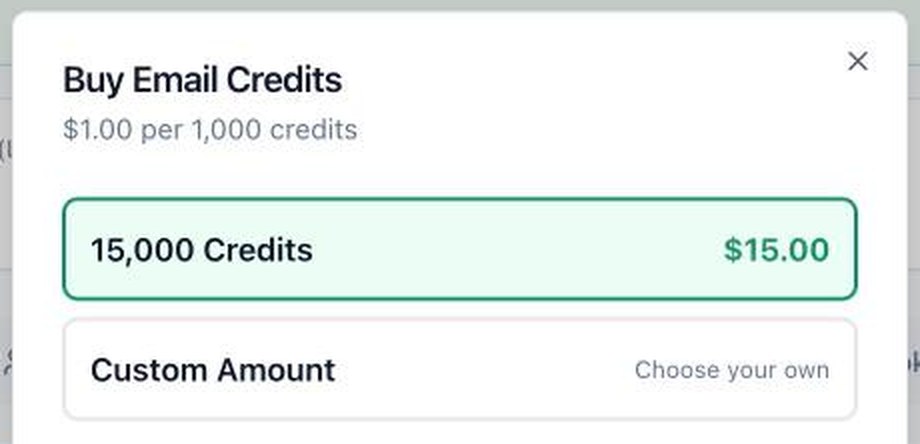
HBA’s own product page describes it as a “Built-in auto responder so you can easily send emails to convert more sales. Includes 300 free emails.” Credits after that run $1 per 1,000, with a $15 preset buying 15,000.
Now the part they undersell. That line sits in the bullet list for the $35 Triple Residuals stack, not in the $10 Let’s Goal card, and no HBA-owned page says a Let’s Goal subscriber gets it.
They do. I have it in my own back office at the Let’s Goal tier.
Ten dollars.
Which means HBA’s entry product ships with a working autoresponder, and the company has not got round to saying so on the page that sells it.
And the import screen bills separately to verify a list: free under 50 contacts, then three cents each up to 5,000. A five thousand name import runs about $150 before you send anything.
Same screen is refreshingly blunt about what it will not take: “Do NOT import: purchased leads, traffic exchanges, MLGS leads, scraped email lists, shared/swapped lists, co-registration leads, or old/stale lists from people who wouldn’t remember opting in.”
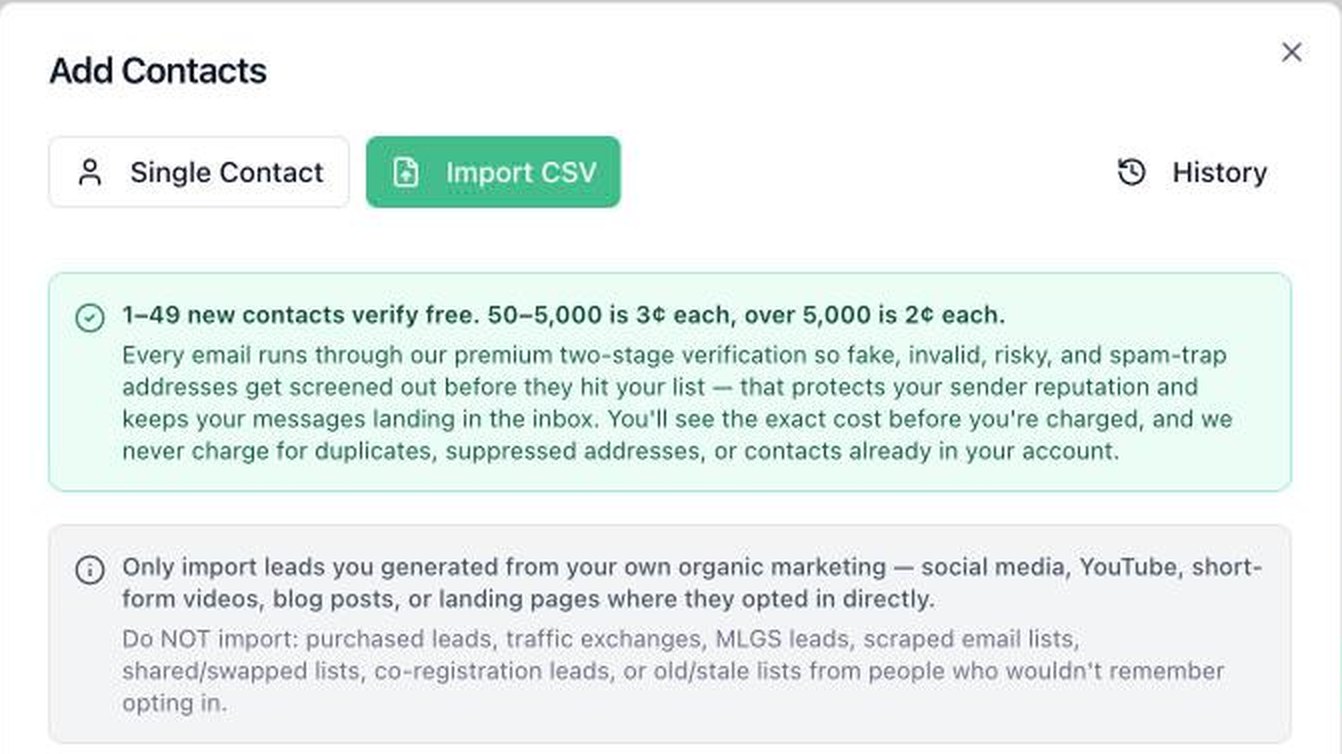
Good policy. Also a wall, if that describes the list you already own.
Let’s Goal is $10 a month, on a page that will also try to sell you the $35 stack. On the affiliate side, the twelve months to 30 September 2026 averaged out at $530 per active affiliate in HBA’s own published disclosure, while the person in the exact middle of that group finished the year on nothing. Payout also requires an active Funnel Builder or Premium subscription, so a $10 member collects nothing at all. My earnings disclosures carry the rest.
What I’d Stand Behind, And What I Wouldn’t
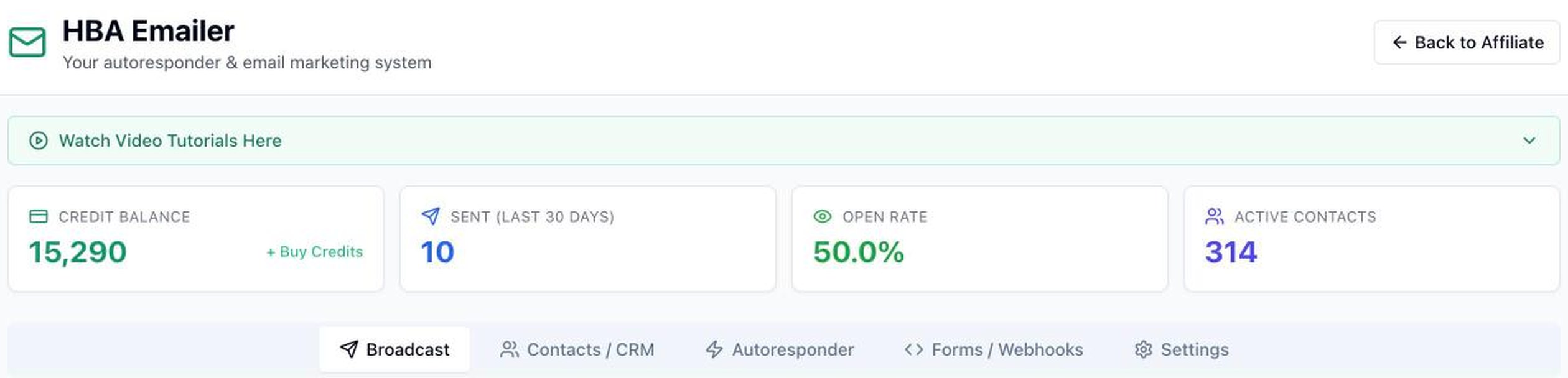
I have not run the HBA Emailer at volume. Ten sends in thirty days to 314 contacts is being inside a product, not stress-testing one. Fifty thousand messages would tell you things I cannot.
No open rates from me, and none worth having from anybody else. Google’s sender guidelines, say it flatly: “Google doesn’t track open rates. Google can’t verify the accuracy of open rates reported by third parties.” Apple’s Mail Privacy Protection pre-fetches images, and Litmus put Apple at 62.26% of over a billion tracked opens in July 2026. The instrument is broken.
The Velocify schedule is 2012 data from a vendor. I use it because it is the only published send schedule here with a stated sample size, not because it is scripture.
US rules only. CAN-SPAM is American. Canada’s CASL and Europe’s GDPR are stricter, neither is covered here, and both bite the moment somebody on your list lives there.
Which Part Of Email Should AI Touch?
Not where the sales pitch says. The best evidence available points somewhere else entirely.
Mercari published a randomized test in August 2025. Over a million users, split down the middle, GPT-4o-mini writing subject lines against their normal template, one week.
Opens moved 0.46%, which their own paper reports as not statistically significant, at a sample of a million people.
Buyer conversion moved backwards, down 0.42%, and that one is noise too.
What moved was the click rate INSIDE the email. Up 23.63%, at a z-score of 8.11, with the message body left completely unchanged. One number in their table worth quoting.
Their read, and I agree with it: the model wrote subject lines that accurately described what was in the message.
Relevance. Not persuasion.
So stop asking AI for clever subject lines and start asking for honest ones. And notice what that does to the rest of the job. If the win comes from describing your own content accurately, the model is doing research and structure, not writing. Same on your blog, and what AI does and does not replace for a beginner covers why pointing it at volume is the fastest way to lose a site.
Three Prompts You Can Run This Afternoon
You do not need a course to start. Three prompts and a free account is the whole setup.
Run them in order. The first is the one everybody skips, and skipping it is why most AI email sounds like nobody in particular.
Teach it your voice.
You are going to learn my writing voice, not invent one. Here are three things I wrote or said in my own words: [paste a text you sent a real prospect, a social post that got replies, and a two-minute transcript of you explaining your product out loud]. Do not write yet. List the ten patterns across all three: sentence length, words I repeat, what I do instead of hyping, how I open, how I close. Then turn those ten into a reusable instruction block I can paste into every future prompt.
Build the sequence around real objections.
Use my voice instructions. I sell [product] to [who]. Here are the five objections I actually hear, in the words people use: [paste five]. Write a five-email onboarding sequence for days 1, 4, 8, 14 and 22, one objection per email, in the order people raise them. Each email: one idea, under 200 words, one link, plain text, no images. Email 1 sends within twenty minutes of opt-in and asks them to reply with the one thing they are stuck on. No email promises a result, an income or a timeline. Subject lines describe what is inside. No curiosity hooks.
Make it go and get the sources.
Research task, not a writing task yet. Topic: [your keyword]. Primary sources only: vendor pricing pages, regulator guidance, income disclosures, studies with a stated sample size. For each, give me the exact URL, one verbatim quote, and the date you opened it. Mark anything you could not open live as UNCONFIRMED. Then tell me the one thing the top three ranking pages get wrong or leave out.
That third one produced the post you are reading. It is the one that matters most, because it forces the model to go and fetch facts instead of confidently rearranging words it already had.
Build The List, Or Skip It?
Build it if you have traffic landing somewhere and nothing catching it. Most expensive leak in this business, and it takes one afternoon to plug.
Build it if you have been in network marketing for years and never written a follow-up sequence.
Your competition has not either.
Skip it where the only list you own is bought, swapped or scraped. Every import screen worth using will refuse it anyway, and where your leads came from matters far more than how many there are.
And skip it if you will not write the first five emails yourself before handing any of it to a model.
A sequence in nobody’s voice converts like a sequence from nobody.
Your First Two Weeks
- Today: open the free systeme.io account and build one capture page. Two fields, first name and email. Do not design it. Point your bio link at it tonight.
- Today: write down your five objections. Not invented ones. Go into your DMs, comments and text messages and copy the actual sentences people typed at you.
- Day two: capture your voice block before you generate a word. Paste it into every prompt after this. Skip it and the sequence reads like a brochure.
- Day three: rewrite every generated email by hand. Change the openings. Put your own stories in. The model handed you a skeleton, not a voice.
- Day four: load the sequence on days 1, 4, 8, 14 and 22. Five emails, no more, in month one.
- Day five: track clicks and replies, and kill every decision that rests on open rate. Google says it does not track opens and cannot verify anybody who claims to.
- Week two: broadcast to whoever is on there, even if it is nine people. Nine who reply teach you more than nine hundred who never asked. Read the disclosure rules for affiliate links first, because they apply to email exactly as they apply to a web page.
That is two weekends and the willingness to write five bad emails before you write five good ones. And the cost row still stands. It all goes out before anything comes back.
The list is a fence line. Slow to put in, boring the whole time you are digging, and the only thing still standing when the weather turns.
Bless and be blessed,

Sources
- Google, Email sender guidelines - checked Aug 22, 2026
- DMA UK, Marketer Email Tracker 2019 (methodology, 197 respondents) - checked Aug 22, 2026
- Litmus, The ROI of Email Marketing (survey of ~500 marketers) - checked Aug 22, 2026
- McKinsey, Why marketers should keep sending you e-mails (1 January 2014) - checked Aug 22, 2026
- Velocify, The Ultimate Contact Strategy (3.5 million leads, 400 companies, 2012) - checked Aug 22, 2026
- Litmus, Email Client Market Share, July 2026 report - checked Aug 22, 2026
- systeme.io pricing - checked Aug 22, 2026
- The Home Business Academy, Triple Residuals product page - checked Aug 22, 2026
- The Home Business Academy, income disclosure (Oct 2025 to Sep 2026) - checked Oct 8, 2026
- Ray Higdon, The 2 Rules of Following Up in Network Marketing (15 October 2018) - checked Aug 22, 2026
- Russell Brunson, Marketing Secrets 56, Soap Operas Vs. Seinfeld (transcript, page undated) - checked Aug 23, 2026
- Jobson et al., Mercari, Using item recommendations and LLMs in marketing email titles, arXiv:2508.20024 - checked Aug 22, 2026
- Vendor pricing and plan pages for the comparison table: Kit, MailerLite, Brevo, beehiiv and GMass - checked Sep 11, 2026