
AI Copywriting: How to Make AI Write Like the Best Copywriters
AI copywriting means using a tool like Claude or ChatGPT to draft sales pages, emails and posts. Left alone, it writes clean but general copy. I coded the rules of 36 top copywriters and testers into prompts, so the AI follows what the masters did. That stacks the odds. It doesn't promise sales.
You want AI to write a sales page that actually sells.
So you tell it to go make that happen, and it comes back with a pretty good sounding page. Way better than anything you could write yourself, and a whole lot faster, too.
But will it sell? Perhaps. But how do YOU know?
Maybe you’re a butcher, a baker or a candlestick maker. You know your product cold. You don’t know copywriting…
And there’s the problem.
How would you or I even know if the copy is any good?
So pull up a chair, and let’s figure it out together. I’m going to tell you about a contest.
Who’s In The Copywriting Contest?
Every contestant gets the same job: write one sales page for the same product, HBA’s $25 a month Funnel Builder. The prize is the one every one of us is after… more leads, sales and sign ups from the visitors you already get.
Here’s who signed up:
- You. Let’s say you’re the baker. Your sourdough sells out every Saturday at the farmers market, and you’d like to sell your starter kits online. You know bread like nobody else in town. You’ve never written a sales page in your life.
- Generic AI. Free Claude, handed one sentence: “Write me a sales page.” Fast, tireless, polite, and it’s read more sales pages than you and I will see in ten lifetimes.
- The masters. A team of the best copywriters who ever lived. Between them, by their own accounts, they’ve sold billions of dollars’ worth of everything from piano lessons to sunglasses.
And one late entry, the contestant nobody sees coming: a page coached by the masters.
I’ve been marketing online since 1996, and I’ve written plenty of copy that sucked.
So in September 2026 I set out to find out if we COULD teach AI to write like the masters and, if so, would that give us a real world edge that we can trust?
Would it stack the odds of writing copy that SELLS in our favor?
The rules of the contest are simple. Every page gets graded against the same seven rules. Pass all seven and you stay in. Fail one and… BUZZER. You’re out. Next contestant, please.
And the FTC is the referee. Break its rules, and you’re disqualified on the spot.
Who Grades The Pages, And Why Trust Them?
Before anybody takes a turn, you should know who’s holding the scorecard. In September 2026 I had the research done on the masters: fourteen classic direct-response copywriters going back to Claude Hopkins, whose Scientific Advertising came out in 1923, plus twenty-two modern copywriters and testing teams who publish their split tests. Then I checked them against the conversion data: Unbounce’s 41,000 landing pages, Nielsen Norman Group’s eyetracking studies, and every published A/B test we could get our hands on.
The early ones sold by mail. They’d run an ad with a coupon in it, count the coupons that came back, and change one thing at a time. The modern ones do the same with split tests on web pages.
Here’s the starting lineup, and how much weight I’d put on each one’s lesson. In the last column, “Tested” means there’s a published test you can check. “Their word” means it’s their own account, never checked by anybody else. And “Long use, no published proof” means the masters did it the same way for years, and some tested it themselves, but no results were ever published that you or I can check. The label rates each master’s own evidence. Some of their lessons were tested later by other people, and the playbook in Round 3 shows which.
| Who | Where to find it | The lesson | How solid it is |
|---|---|---|---|
| Claude Hopkins | Scientific Advertising, 1923 | Be specific, and test every ad by counting the replies | Long use, no published proof. His bigger sales stories are his word |
| John Caples | “They Laughed When I Sat Down at the Piano,” 1926; Tested Advertising Methods | The headline decides whether anything else gets read | Long use, no published proof. The ad is on record; his test results are his word |
| Robert Collier | The Robert Collier Letter Book, 1931 | Start with what’s already on the reader’s mind, then bring the talk around to your offer | Long use, no published proof |
| Victor Schwab | How to Write a Good Advertisement | Five steps: get attention, show the advantage, prove it, persuade, ask | Long use, no published proof |
| David Ogilvy | Ogilvy on Advertising, 1983 | Facts, not adjectives. Most people only read the headline | Long use, no published proof |
| Eugene Schwartz | Breakthrough Advertising, 1966 | Write to how much the reader already knows about their problem and your product | Long use, no published proof |
| Joseph Sugarman | The Adweek Copywriting Handbook, first published in 1998 as Advertising Secrets of the Written Word | Every sentence has one job: get the next sentence read | Long use, no published proof |
| Gary Bencivenga | Interview, around 2005 | Proof outpulls promise. A careful “may” beat a bold “will” | Their word |
| Joanna Wiebe | Copyhackers | Use your customers’ own words. Beat an already-optimized Crazy Egg page by 13% | Tested |
| Michael Aagaard | ContentVerve, 2013 | Write the button as the reader talking | Tested, on one site |
| Harry Dry | Marketing Examples | Three edit checks: can you picture it, can you prove it false, could anybody else say it | Long use, no published proof |
| Alex Hormozi | $100M Offers | Fix the offer before you write a word about it | Their word |
Look at that lineup for a minute. A hundred years apart, these people keep saying the same things in different words.
Plain words. Real facts. Prove it before you ask for anything.
But here’s the twist. My research report, dated 24 September 2026, opened with this: “There is no single ‘best’ copywriter by conversion, because almost nobody in this field publishes audited numbers.”
Almost nobody.
And the billions in sales the masters’ team claims? Most of it is their own word. The whole industry runs on big names and bigger revenue claims, and hardly anybody shows you the receipts. The proof.
So nothing made the scorecard on a famous name alone. Every claim went into one of four piles, and a legend never gets to be a rule:
| Pile | What it means | Examples |
|---|---|---|
| Tested | A published test you can check | Unbounce’s reading-level data; Joanna Wiebe’s Crazy Egg test; Michael Aagaard’s button test |
| Long use, no published proof | The masters did it for years, some tested it privately, but no results you can check | Opening on the reader’s problem; Victor Schwab’s five steps |
| Their word | The writer says so. Plausible, never checked by anybody else | Gary Bencivenga’s unbeaten record in Rodale’s split tests |
| Legend | Repeated everywhere, traced to nothing | “Ogilvy’s Rolls-Royce ad raised sales 50%”; “video lifts landing page conversions 80%” |
Let me tell you about that video legend, because you’ve probably heard it.
It traces back to a 2010 white paper from EyeView, a company that sold video for landing pages. They wrote that “in some cases the boost in conversion was over 80%” for their own clients. Somewhere along the way, “some cases” got dropped, and it became a statistic everybody quotes. Then Unbounce studied about 35,000 of its own customers’ pages in 2021, and concluded: “Videos do not boost your landing page conversion rates.”
Some cases. Two words.
That’s how a legend gets made.
What’s On The Masters’ Scorecard?
Seven rules. Every contestant gets graded on all seven, and every rule earned its place one of three ways: a published test, “long use, no published proof,” or the law. Nothing in the “their word” or “legend” piles made a rule on its own.
| Rule | The master | The evidence | Why it works |
|---|---|---|---|
| 1. Write at a 5th to 7th grade level | Caples, Ogilvy | Unbounce 2024, 41,000 pages | People skim. Short words cost less effort |
| 2. Open on the reader’s problem | Robert Collier, 1930s | Long use, no published proof | They decide in seconds if it’s about them |
| 3. Swap empty adjectives for numbers you can check | Claude Hopkins, 1923 | 37signals’ Highrise, 2009 | A number can be checked, so it gets believed |
| 4. Prove it or cut it | Gary Bencivenga, Claude Hopkins | Long use, no published proof, back to Hopkins; Bencivenga’s word; the FTC reviews rule | Proof does the persuading. Promises don’t |
| 5. Make the button the reader talking | Modern testers | Michael Aagaard, 2013 | “My” makes it their decision, not yours |
| 6. Disclosure next to the link | None. This one is the law | FTC Endorsement Guides | Trust, and staying out of trouble |
| 7. Promise and button on the first screen | Ogilvy, on headlines | Nielsen Norman Group, 2018 | That’s where the reading time goes |
Rule 1, the reading level, has the strongest numbers behind it. Unbounce analyzed 41,000 landing pages in late 2024, and its report, says “Landing pages written at a 5th to 7th grade level convert at 11.1%,” which is “more than 2x higher than professional-level writing which converts at 5.3%.”
That’s a correlation, not a controlled test. But it’s the best-measured rule of the seven, and it matches the plain-language advice in the masters’ books. Good news if you’re a beginner. Nobody’s asking you to sound clever. They’re asking you to sound clear.
Rule 3, numbers you can check instead of empty adjectives, is Hopkins word for word: “Platitudes and generalities roll off the human understanding like water from a duck.” When 37signals made “30-day free trial” the headline on its Highrise signup page in 2009, it won by “30% better conversion than the original.” So a baker doesn’t write “our bread is delicious.” A baker writes “the same starter I’ve fed every morning for 11 years.” Somebody can check that.
And rule 7, the first screen? Ogilvy, in Ogilvy on Advertising, 1983: “On the average, five times as many people read the headlines as read the body copy.” Nielsen Norman Group measured something close to it on web pages in 2018, when “users spent about 57% of their page-viewing time above the fold.”
Notice something?
Not one of those seven rules needs talent. Anybody can follow them, and so can a machine.
Alright. Scorecards out. Let’s play.
Contestant 1: You (Well, Me, Before I Knew Better)
I’ll take the baker’s turn myself, because I’ve written this kind of page for real more times than I’d like to admit. This is how I might have written the Funnel Builder page years ago, before I learned the FTC rules. Excited. Pushing hard for the sale. Promising the moon.
I published it as a labeled example at the hype page, so you can see the whole thing.
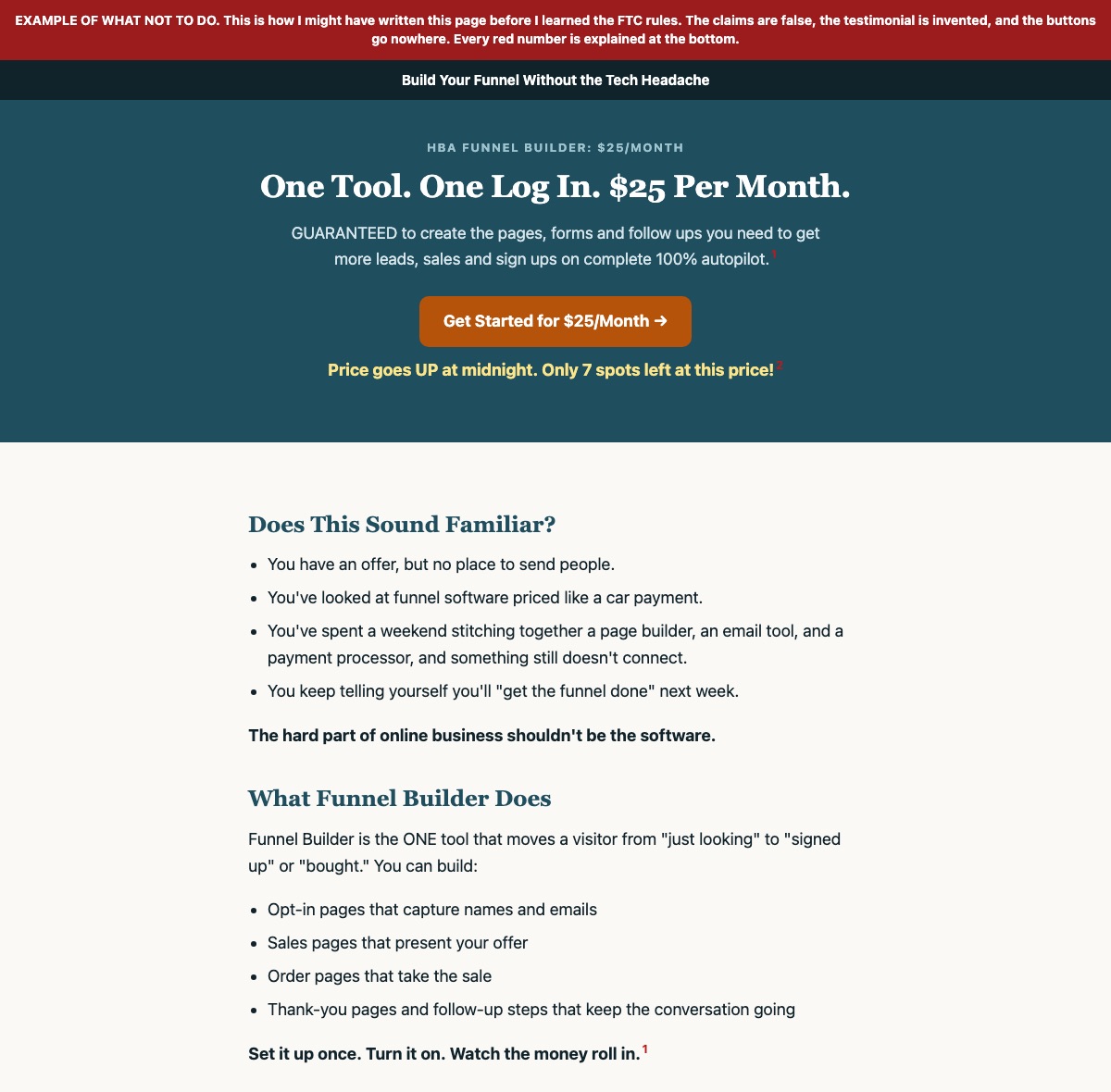
Reads great, doesn’t it? Grade 4 to 4.5 on the reading formulas. Big promises, a midnight deadline, and a five-star testimonial from “Jessica M., Ohio” who made “$3,200 my first week.”
Here’s how the masters graded my hype page:
- Reading level: pass
- The reader’s problem first: fail. The headline is about the product and the price, not the reader
- Numbers you can check: fail. It’s full of numbers, but nobody can check “$500, $1,000, even $5,000 a month”
- Proof: fail. Jessica M. doesn’t exist. I made her up
- The “my” button: fail. “Get Started for $25/Month”
- Affiliate disclosure next to the link: fail. It’s in tiny print at the very bottom
- The first screen: pass
Two out of seven.
BUZZER.
And then the referee blows the whistle, too. The FTC’s rule on reviews and testimonials “went into effect on October 21, 2024,” per its own Q&A. When the FTC announced that rule, it named the target: reviews that “misrepresent that they are by someone who does not exist, such as AI-generated fake reviews.” Jessica M. is exactly that. And on disclosures, the FTC’s Endorsement Guides FAQ warns: “Consumers may miss a disclosure at the bottom of a blog or page.”
Disqualified.
I made a career out of income claims like those before the rules changed. Today, a page like that would put me, personally, on the wrong end of the FTC. My post on what the FTC now expects from affiliates explains why.
Next contestant, please.
Contestant 2: Generic AI
On 30 September 2026 I gave generic AI its turn. I opened free Claude and typed one sentence:
Write a sales page for HBA's Funnel Builder. It costs $25 a month.
No facts. No rules. Exactly the way most of us use these tools. I built what came back as a real page, word for word, and it’s still up as the before page.
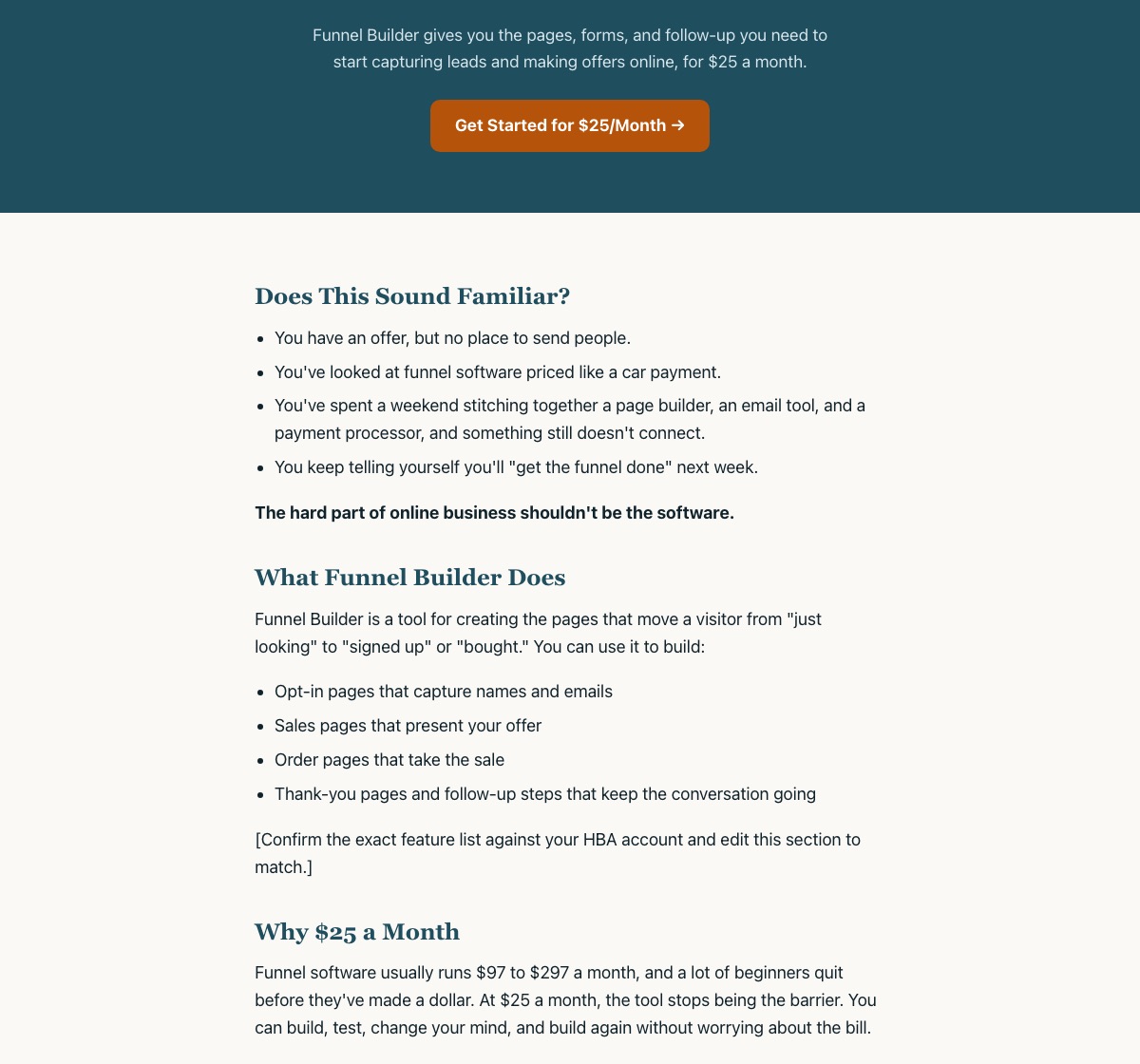
| What I measured on 3 October | Claude’s draft |
|---|---|
| Reading level, ARI and Flesch-Kincaid | Grade 4.5 and 5.0 |
| Exclamation points, fake reviews, income promises | 0, 0, 0 |
| Specific numbers about the product | 1, the price |
| Notes to self left in square brackets | 4 |
Clean as a whistle. No hype, no fake reviews, no income promises. If you or I had written that, we’d have been proud of it.
Here’s how the masters graded Claude’s page:
- Reading level: pass
- The reader’s problem first: pass
- Numbers you can check: fail. “Simple, guided setup” with a checkmark and nothing you could check
- Proof: fail. Claude even left a note to itself on the published page: “[State the actual cancellation and refund terms from HBA here.]”
- The “my” button: fail
- Affiliate disclosure next to the link: fail. It’s at the very bottom
- The first screen: pass
Three out of seven. Grade that like a school test and it’s 43%… an F.
BUZZER.
Better than the hype page I wrote in the first round. But fail is fail.
And the referee? Claude put the disclosure at the very bottom of the page, the exact spot the FTC warns about. That’s a foul, too, and a foul means disqualified, even if it’s a much smaller one than mine.
So why did a page that clean lose? Two reasons. Missing facts: Claude didn’t know the product, the prices or the refund terms. Missing rules: nobody told Claude to put “my” on the button, or the disclosure beside it.
AI can't follow a rule nobody gave it.
Next contestant, please.
Contestant 3: The Masters
The masters’ team walks up to the table… and doesn’t play.
They can’t. The best of the old masters have been gone for decades, and the living ones don’t work cheap. Even if you could afford one, they’d want weeks, not minutes.
So the masters forfeit. But on the way out, they hand over something better than a page.
Their playbook.
Contestant 4: Coached By The Masters (Played By Hand)
Last turn. This contestant gets the two things the first three were missing: the facts, and the masters’ seven rules.
I’ll be straight with you about how this round was played. I took the page free Claude wrote from one sentence in the generic AI round, kept everything Claude got right, added the facts it didn’t have, and applied the masters’ seven rules by hand. That’s the same playbook the coaching prompts further down hand to your AI. Then I published the result too, as the after page.
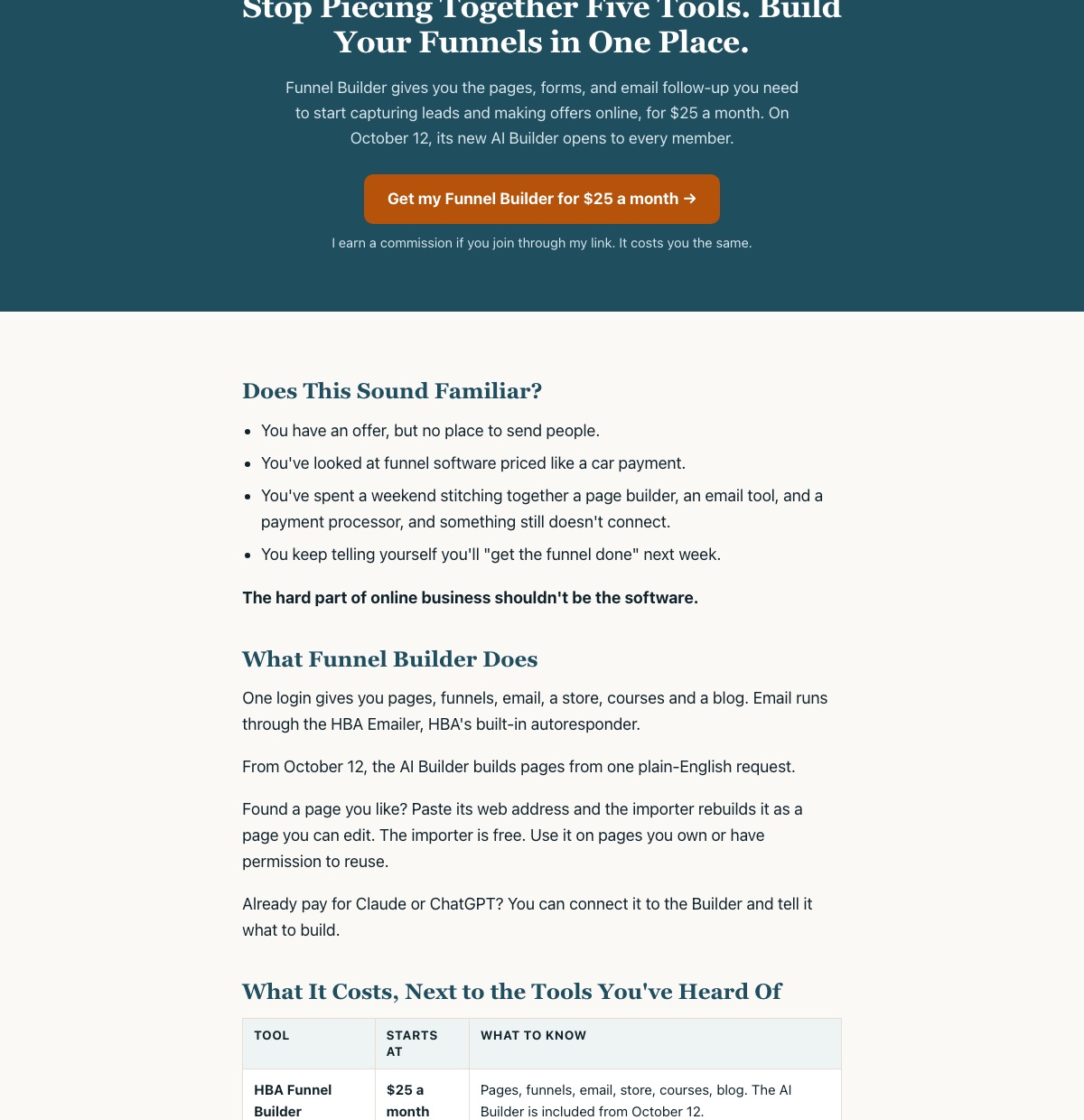
| Before | After |
|---|---|
| Checkmarks: “Simple, guided setup ✔” | Five tools with their real starting prices, from each company’s own pricing page |
| Four notes in brackets | The AI Builder date, the built-in autoresponder, the real cancel terms |
| “Get Started for $25/Month” | “Get my Funnel Builder for $25 a month” |
| Disclosure at the very bottom | One line under every button: “I earn a commission if you join through my link.” |
Here’s how the masters graded the coached page:
- Reading level: pass. Still about grade 5
- The reader’s problem first: pass
- Numbers you can check: pass. Five tools with their real starting prices
- Proof: pass. Real facts, HBA’s own clips, my own story, and no invented anybody
- The “my” button: pass. “Get my Funnel Builder for $25 a month”
- Affiliate disclosure next to the link: pass. Right under every button
- The first screen: pass
Seven out of seven.
No buzzer. Still standing.
One honest footnote, because it matters: I played this round by hand. The fully automatic version, with Claude running the coaching prompts on its own, is a round nobody has scored yet, me included.
Who Wins The Copywriting Contest?
The masters' playbook wins. Not a person, and not a machine.
Look at who’s left standing. My hype page had the energy and broke the law. Generic AI had the polish and none of the facts. The masters couldn’t show up. The only page still standing is the one that followed the masters’ seven rules with real facts, and anybody can do that. Including the baker who’s never written a sales page in their life.
Now, does the winning page actually sell more? That’s the one judge this contest hasn’t heard from yet: real visitors. The rules stack the odds in your favor. They don’t guarantee the sale, and I’d be lying if I told you otherwise.
But I know which page I’d put my name on.
How Do YOU Get On The Winning Team?
You take your own turn, with the masters’ playbook in your hand. Three steps: score your page, coach your AI, and pick the right voice for the job.
Step 1: Score your page against the masters’ rules
You don’t need the masters’ talent to judge a page by the masters’ rules. Just eight yes-or-no questions. Generic Claude’s page clears three of them. The winning page clears all eight.
- Can a 6th grader read it? Paste it into a free readability checker
- Does the first line talk about the reader’s problem, not you or your product?
- Where a claim can carry a number, is it an exact one somebody can check?
- Could a competitor paste their name on it and change nothing? If yes, it fails
- Is every claim backed by proof on the page, and every testimonial from a real, named person?
- Does the button start with a verb and say “my”?
- Is the disclosure right next to every link?
- Do the headline, the promise and the button show before anybody scrolls?
Look at which question made the difference. “Could a competitor paste their name on it and change nothing?” Almost every fact on the winning page is HBA’s, so any HBA affiliate could have used it. What clears that question is one short section called “Why I Use It”, built from facts only I have: I’ve been marketing online since 1996, and my own funnel runs on 34 pages I built by hand. Nobody else can write that.
That’s what the fact sheet prompt is for.
Your story, your results, your reasons. It's the one part of your page no competitor can copy.
That’s how YOU know whether the copy is any good. Not whether it will sell, because nobody can promise you that before real visitors show up. But whether it’s built the way the masters built theirs, and that’s the part you control.
Step 2: Coach your AI with these five prompts
Copy these, fill in the brackets, and use them in free Claude or free ChatGPT. Prompt 2 is the masters’ playbook, boiled down to one paste.
Prompt 1: The fact sheet. Generic AI fails when it doesn’t know your facts. This prompt gets them out of your head, and everybody skips it.
Interview me to build a fact sheet about [my offer] that an AI copywriter can use. Ask me one question, then stop until I reply. Cover: what it is, exactly what it costs and how it bills, what the buyer gets (by name), the refund and cancel terms word for word from the seller, who it's for and who it isn't, my real experience with it (how long, what I did, what went wrong), proof I can link to, and how I get paid if someone buys. Then give me the fact sheet as a list. Mark anything I couldn't confirm as UNCONFIRMED. Never invent a number, a feature, a testimonial or a result.
Prompt 2: The masters’ rulebook. Generic AI also fails when nobody hands it the masters’ rules. This prompt does.
Write [a sales page / an opt-in page / an email / a product description] for [offer] using ONLY this fact sheet: [paste it]. Follow these rules from the best direct-response copywriters and the tests since. Write at a 5th to 7th grade level, with sentences averaging 12 to 16 words and none over 30. Open on the reader's problem in their words, not on the product. Where a claim can carry a number, use the exact one from the fact sheet, and cut any adjective you can't back with a fact. Never add a number that doesn't help the reader. Prove each claim before you ask for anything, and use no testimonial I didn't paste with a real name. Make one offer and one ask. Write the headline in 10 to 14 words: who it's for and what they get. Start every button with a verb and the word "my." Put this line under every button: "[I earn a commission if you buy through my link. It costs you the same.]" Keep the headline, the main promise and the first button on the first screen. Never use: unlock, game-changing, skyrocket, secret, guaranteed, passive income. If you need a fact that isn't there, ask me. Never leave a note in brackets.
Prompt 3: The tutorial voice.
Write a step-by-step tutorial for a first-timer: [task]. Open with what they'll have at the end, how long it takes and how many steps. Label each step "Step [number]: [verb] [outcome]." One action per step, the exact button text in quotes, then what they'll see. Where a step involves a time, a count, a price or a position, give the exact one. Where people get stuck, add an "If you don't see it" line with the fix. Grade 5 to 7, talk to "you," and skip simply, just, easy and seamless. End with one next step for today.
Prompt 4: The personal voice.
Help me write a short personal post about [topic]. First ask me three questions, one at a time: what happened (a day, a place, a person, a number), what I got wrong, and what I'd tell a friend now. Write it from my answers, in my phrases. Keep my rough edges. No income figures, no lessons-learned list at the end, and never use game-changer, journey, unlock or empower. If it sounds like an ad, rewrite it like a text to a friend.
Prompt 5: The red pen.
Check this copy before I publish it: [paste copy]. Quote every line that promises income, results or a timeline; includes a testimonial or quote I didn't supply; states a guarantee or refund term that isn't word for word from the seller; uses a number with no source; leaves a note in brackets; has an affiliate link with no disclosure right beside it; has a button that doesn't start with a verb; or runs over 25 words. Tell me how to fix each one, then give me the reading grade level. Don't rewrite the whole thing. Just the list.
One more thing before you publish anything.
I’ve led glass walks at marketing events since 2008. Bare feet, broken bottles. And I tell every walker the same thing: “Don’t step on anything sharp.”
Which sounds bizarre when you’re getting ready to walk across a bed of broken glass in your bare feet, right?
But the reality is, if you feel each step before you put your weight on it, you’ll know exactly when to move your foot BEFORE putting your weight on it. Make sense? Because nobody gets cut by the piece they felt.
AI copy works the same way. Claude wrote “I’m also a member and use the product” in my disclosure. True, as it happens, but Claude couldn’t have known. A model that makes up a true-sounding fact about you will make up a customer quote just as easily. Read every line, and run the red pen prompt, before anything goes live.
Step 3: Pick the right voice for the job
A sales page is one kind of job. A how-to video is a different one, and so is a post about your weekend. The masters’ seven rules are conversion rules, built for copy that asks for a click. Use them on a setup tutorial and you’ve stuck a sales button in the middle of somebody’s homework.
So on 27 September 2026 I split the work three ways:
| Voice | The reader’s next move | Use it for | Built on |
|---|---|---|---|
| Conversion | Click, opt in, buy or reply | Sales and opt-in pages, offer emails, store descriptions | The masters’ seven rules |
| Tutorial | Finish a task | How-to videos, setup steps, checklists | My study of 12 top online teachers, 25 September 2026 |
| Personal | Trust you | Your About page, personal posts, replies | Your own life. Nobody can copy it |
For the tutorial voice, I had two tutorials from each of 12 top online teachers measured. The tightest ones sat between grade 5 and grade 8, with one action per step. Brian Dean’s Search Console guide at Backlinko came in at 5.4.
The personal voice has just one rule: every sentence shows a person, an action, a number, a time or a thing. “I’ve helped a lot of people” is a concept. “I sat with my neighbor for two hours on a Tuesday and built her first opt-in page” is a person.
Step 4: Learn from the masters yourself (optional)
Want to learn from the masters directly? Read these five, in this order:
- Scientific Advertising, Claude Hopkins. It’s in the public domain, it’s short, and it’s still the foundation.
- Tested Advertising Methods, John Caples. Headlines, with the testing behind them.
- The Adweek Copywriting Handbook, Joseph Sugarman. How to keep someone reading.
- Breakthrough Advertising, Eugene Schwartz. Harder going, and the best book there is on knowing your reader.
- $100M Offers, Alex Hormozi. Fix the offer before you write a word.
You don’t need any of them to coach your AI, because the prompts above do that for you. But if you only read one, read Hopkins.
Which AI Is Best For Copywriting?
Whichever one you’ll actually coach with your facts and the masters’ rules. For most beginners, that’s Claude’s free plan, $0 on its pricing page. It’s what I tested, and the writing was never the weak spot.
| Tool | Price | My take |
|---|---|---|
| Claude Free | $0 | What I tested. Plenty to start |
| Claude Pro | $20 a month, or $17 a month billed yearly | Once you hit the free limits |
| ChatGPT Free | $0 | Not tested by me |
| ChatGPT Plus | $20 a month | Fine if you already pay for it |
If you’re writing all day, every day, Claude Free isn’t for you. You’ll hit its limits, and that’s when a $20 plan earns its keep. Already paying for ChatGPT? Keep it, and don’t pay for two. The coaching matters a lot more than the logo on the tool.
Where AI Copywriting Falls Short
Nobody has tested whether coached AI sells more. Not me, and not anybody I could find. I didn’t even let AI play the coached round; I applied the rules by hand. A rulebook score isn’t a conversion rate. The rules stack the odds in your favor, and only real visitors settle it.
The rules are my synthesis. My research picked the masters’ seven rules, and they aren’t equally strong. The reading-level rule rests on 41,000 pages. The “my” button rule rests on one test, on one site, in 2013. The disclosure rule is the law, and I’d follow it even if it cost me sales.
It’s one tool and one offer. I ran one prompt in free Claude and none in ChatGPT. That’s an anecdote, not a study.
The famous tests are old, mostly 2010 to 2013, one website each. The direction has held up, but the size of the lift won’t carry over to your page. And no copy brings its own traffic, which I covered in my look at HBA’s AI funnel builder. Brand new to all of this? Start with what AI does and doesn’t do for a beginner.
So here’s what I’d do if I were starting out. Score your page tonight with the eight yes-or-no questions. Then run the fact sheet prompt and the masters’ rulebook prompt, and let the masters coach your AI. And if Builder by HBA’s AI writes your pages, my free Day-One Kit has ten requests ready to paste into it.
Bless and be blessed,

AI Copywriting FAQs
Can AI write like a professional copywriter?
It can follow the same rules. Most of what made the great copywriters great is a set of habits you can write down: plain words, specific numbers, proof before the ask, one clear button. Give an AI those rules and your real facts, and it writes much closer to how they wrote.
Is AI copywriting any good?
For a first draft, yes. In my September 2026 test, free Claude wrote a sales page at a 5th grade reading level with no hype and no fake reviews. It still failed 4 of 7 copywriting rules, because it lacked the facts that sell and the rules I never gave it.
What is the best AI for copywriting?
The one you give real facts and real rules to. I tested Claude's free plan, $0 on its pricing page, and it was plenty. I haven't run the same test on ChatGPT, so I won't rank it. Either one writes generic copy from a one-line prompt.
How do I learn copywriting as a complete beginner?
Start with two old books that are still the foundation: Claude Hopkins' Scientific Advertising, which is in the public domain, and John Caples' Tested Advertising Methods. Then grade your own page against the scorecard in this post before you publish anything.
Can AI write my testimonials?
No. The FTC's rule on consumer reviews and testimonials, in force since 21 October 2024, covers reviews by someone who does not exist, and the FTC named AI-generated fake reviews as an example. Only quote real people, by name, saying what they actually said.
Will Google penalize AI-written content?
Not for being AI-written. Google's spam policies define scaled content abuse as many pages generated mainly to manipulate rankings rather than help users, no matter how they're created. A page that genuinely helps the reader is fine however it was drafted.
Sources
- Rob Fore, Conversion Copy Voice research report (unpublished, 24 September 2026): 14 classic direct-response copywriters, 22 modern copywriters and testing teams, and the conversion data - checked Oct 4, 2026
- EyeView Digital white paper, Making Video Accountable (2010), the origin of the video 80% figure - checked Oct 4, 2026
- Unbounce, video on landing pages study (2021), about 35,000 customer pages per time frame - checked Oct 4, 2026
- Joanna Wiebe, Copyhackers, beating the optimized Crazy Egg home page (13% lift) - checked Oct 4, 2026
- David Ogilvy, Ogilvy on Advertising (1983), on headline readership - checked Oct 4, 2026
- Claude, free claude.ai, my one-sentence sales page prompt and the draft it returned, 30 September 2026, published unedited as the before page - checked Oct 3, 2026
- The same draft fixed against the seven rules, published as the after page - checked Oct 3, 2026
- Unbounce Conversion Benchmark Report 2024, reading level and conversion across 41,000 landing pages - checked Oct 3, 2026
- VWO, A/B testing copy written by GPT-3.5 against human copy - checked Oct 3, 2026
- 37signals, Writing decisions: headline tests on the Highrise signup page (2009) - checked Oct 3, 2026
- Claude Hopkins, Scientific Advertising (1923), chapter Being Specific - checked Oct 3, 2026
- Michael Aagaard, ContentVerve, 10 call-to-action case studies (25 March 2013, archived copy): the my-versus-your button test - checked Oct 3, 2026
- Nielsen Norman Group, Scrolling and Attention (2018 eyetracking study) - checked Oct 3, 2026
- FTC, Consumer Reviews and Testimonials Rule: Questions and Answers - checked Oct 3, 2026
- FTC press release, 14 August 2024: final rule banning fake reviews and testimonials, including AI-generated ones - checked Oct 3, 2026
- FTC, Endorsement Guides: What People Are Asking - checked Oct 3, 2026
- Google Search Central, spam policies, scaled content abuse - checked Oct 3, 2026
- Claude pricing page, Free $0 and Pro $20 a month billed monthly or $17 a month billed annually - checked Oct 3, 2026
- ChatGPT pricing page, Free $0, Go $8, Plus $20 a month - checked Oct 3, 2026
- Reading levels of Claude's draft, measured on its 350 words of paragraph prose with the standard ARI and Flesch-Kincaid formulas - checked Oct 3, 2026