
Affiliate Marketing With AI: Can A Beginner Actually Do This?
Yes, if you use AI to close the skill gap instead of to replace the work. It can draft copy you could not write yourself, research a market you do not know, and turn one video into a week of content. It will not build you an audience, and it will not stop you quitting in month four.
Full disclosure: I am an active Home Business Academy affiliate and I earn a recurring commission if you buy HBA through a link on this page. I pay for HBA Premium myself and read the tools from inside the member area to write this.
You are brand new. No list, no audience, no copywriting skills, no clue how to build a page or pick who to target. You have a moderate budget and maybe twelve to fifteen hours a week.
Can AI actually get you to a profitable affiliate or MLM business?
Short answer: it closes a gap that used to take years to close.
The gap that actually kills people, it leaves exactly where it was.
Both halves below.
Decide with your eyes open.
So Where Is The Edge, Exactly?
Bottom line?
AI helps you get more done, faster, and often at a quality you could not have produced on your own.
Rupert Chesman publishes his whole pipeline and says a substantial blog post now takes him three to five hours instead of eight to ten. Louis-Francois Bouchard published his workflow on 28 July 2026 and says a full YouTube release went from two or three days of his own work down to about five hours.
Think about that.
Both men sell something adjacent.
So those are their claims, not audited findings. Discount them however you like. Cut the numbers in half.
Still the difference between publishing once a month and publishing once a week.
For you, with twelve hours, that is the whole ballgame. Twelve hours used to buy you one decent piece of content.
Now it buys you four.
I have been at this since 1996, and I have watched a dozen tools get sold to this industry as the thing that changes everything. Autoresponders. Article directories. Blogging. Video. Funnels. Every one of them was real. Every one was oversold by about a factor of ten in the first two years.
AI is real. It is also currently oversold by about a factor of ten.
So let’s be precise about which tenth.
What AI Replaces For A Beginner
This is the part that matters to you, and almost nobody writes it down.
You have a list of skills you do not have. Here is which ones AI covers, and what it still needs from you.
| The skill you do not have | What AI does about it | What it still needs from you |
|---|---|---|
| Copywriting | Drafts headlines, emails, ad copy, page copy in seconds | Your angle, your story, and a final read out loud |
| Market research | Finds who is searching for what, and what they complain about | Picking the market you can stand talking about for two years |
| Page and funnel design | Writes the page, suggests the layout, drafts the popup copy | An actual page builder, and the taste to keep it simple |
| Building a bonus stack | Writes the bonus, the checklist, the swipe file, the mini course | Knowing what your buyer is actually stuck on |
| Targeting and approach | Researches a prospect in ninety seconds before you message them | The message itself, in your voice, sent by you |
| Video and repurposing | Scripts it, transcribes it, cuts clips, writes the captions | Being on camera, or at least being a person on the page |
| Editing and proofing | Catches errors, checks your numbers against sources | Deciding what is true and putting your name on it |
Read that as one sentence: AI closes the execution gap almost overnight and leaves the judgment gap exactly where it was.
Which is good news, because the execution gap is what used to take three years to close.
Is AI Worth The Twenty Bucks?
Hours.
Not sales, not an advantage, not a shortcut into anything. You are buying back the work you would otherwise pay a writer, an editor or a VA to do: research, first drafts, transcription, clipping, scheduling. Five to thirty dollars a month, against a freelancer who charges that in an afternoon.
What you are not buying is conversion. Nothing verified shows AI-written copy converting better than the other kind. Better copy converts better. AI gets you to better faster, which is a different sentence, and the difference is the whole thing.
AI does not sell.
And whatever advantage you feel this week has a short shelf life. The guy you are competing with is running the same model you are, for the same twenty bucks, this afternoon. There is no secret prompt. Your edge is whatever you know that he does not, and the only way to get that is to go and do the thing and take notes.
What AI Will Not Do For You
Three things, and they are the three that decide whether you make money.
It will not give you an audience. Not one person. AI writes the post, you still have to go get somebody to read it. That takes months of showing up in the same place, and it is the part nobody sells you a tool for.
It will not tell you when it is wrong. It will hand you a confident number that is off by a year or a decimal point, in a tone that sounds exactly like the true ones. Every figure you publish gets checked against the source before your name goes near it.
It will not stop you quitting. Across the three companies I have built teams in since 1996, genuine producers have never come out above roughly 3% of a roster. Most people are gone inside a year. That was true before AI and it will be true after.
Here is the uncomfortable version. The skill gap was never the main reason people fail in this business. Consistency was. AI just removed your best excuse.
What Happens If You Let It Run The Whole Thing?
It falls over in about ninety days, and there is published evidence with dates on it.
SE Ranking ran the clean version. Twenty brand-new sites, 2,000 unedited AI articles, nobody reading them. It worked at first: 122,000 impressions in month one, clicks tripling by month three. Then at around ninety days the share of pages in Google’s top 100 fell from 28% to 3%, and most had not recovered sixteen months later.
The other arm of the same test: six AI-drafted, human-edited, fact-checked articles on an established blog pulled 555,000 impressions and about 2,300 clicks over thirteen months. Fair warning, roughly 70% of those clicks came from one post, and the two arms differ by more than just editing.
SE Ranking sells an AI writer. Publishing that result was straight of them.
Same story on social. Lilach Bullock batched ninety days of LinkedIn posts in one afternoon and scheduled the lot. Her engagement rate fell from around 3.5% to 0.6%, and real conversations in her DMs went from ten or twelve a week to two. Her diagnosis is the useful part: a post written three months before it publishes is written blind to the day it lands.
Batch the thinking. Never batch the finished thing.
What Should You Buy First?
One AI assistant. Nothing else yet. Everything else waits until you are publishing every week.
Prices off each vendor’s own page.
| Tool | Price | When to buy it |
|---|---|---|
| Google AI Plus | $4.99/month | Now. Cheapest way to find out if you will use it |
| ChatGPT Go | $8.00/month | Now, if you want more headroom. Their card notes it may include ads |
| ChatGPT Plus or Claude Pro | $20.00/month | When you hit a wall you can actually name |
| OpusClip Starter | $15.00/month | Only once you are making video weekly |
| Publer Professional | $5.00/month, about $12 for three accounts | Only once you have somewhere to post it |
Start at five dollars. Not fifty.
The full kit, an assistant plus a clipper plus a scheduler, runs about $32 a month or $383.88 a year. Arithmetic and nothing else. Do not buy the full kit in week one, because you will spend three weeks configuring tools instead of publishing, and I have watched that particular movie many times.
One bundled option, and I have to disclose it. If your plan is video every week, HBA Premium wraps an AI script-and-teleprompter tool, an AI writer, an image generator, an AI email writer, transcription and a cross-platform publisher into one bill, with daily coaching. It runs $125 a month after a free 14-day trial. I pay for it, I use it, and I earn $100 a month if you join through me. Read my full review before you decide anything, and read this next line twice.
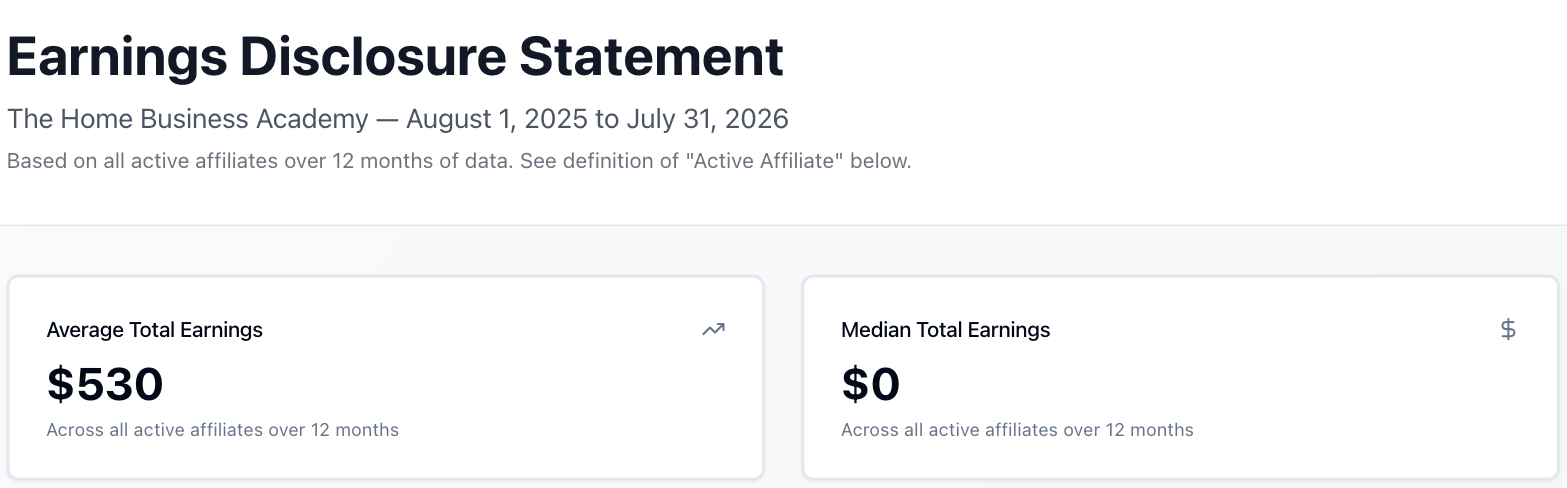
HBA’s own earnings disclosure shows a median of $0 sitting under a $530 average, across 1,572 active affiliates over the twelve months to 30 September 2026. Only 26.5% made even one sale. Most people who buy it earn nothing. Any figures of mine are my own and are not typical. Full earnings disclosure.
Do not buy a $125 bundle in month one. Buy the $5 assistant, prove you will use it, then decide.
Your First Thirty Days On Twelve Hours A Week
Seven steps. Roughly three hours a week, so you have slack for real life.
- Pick one market you can stand for two years. Not the most profitable one. The one where you already know something. Two hours, once.
- Have AI research that market’s five biggest frustrations, then go read the actual forums and comments yourself to check it. One hour.
- Pick one channel and one format. A blog post, a YouTube video, or a short. One. Not three.
- Publish weekly. Same day, same time. Draft with AI, then rewrite the opening and the ending in your own words. Three hours a week.
- Add one first-hand thing to every piece. What you tried, what it cost, what went wrong. This is the only part a competitor cannot copy, and it is what makes the AI draft yours.
- Check every number before it ships. Source and date in the copy itself. Twenty minutes a piece.
- Repurpose after publishing, never before. Hand the finished piece back to AI and ask for the clips, the captions and the email. Thirty minutes.
Do that for thirty days and you will know something most people never find out: whether you will actually do this work when nobody is making you.
What Google And The FTC Will Not Let You Do
Two rules. Both narrower than the rumors, and both worth knowing before you scale anything.
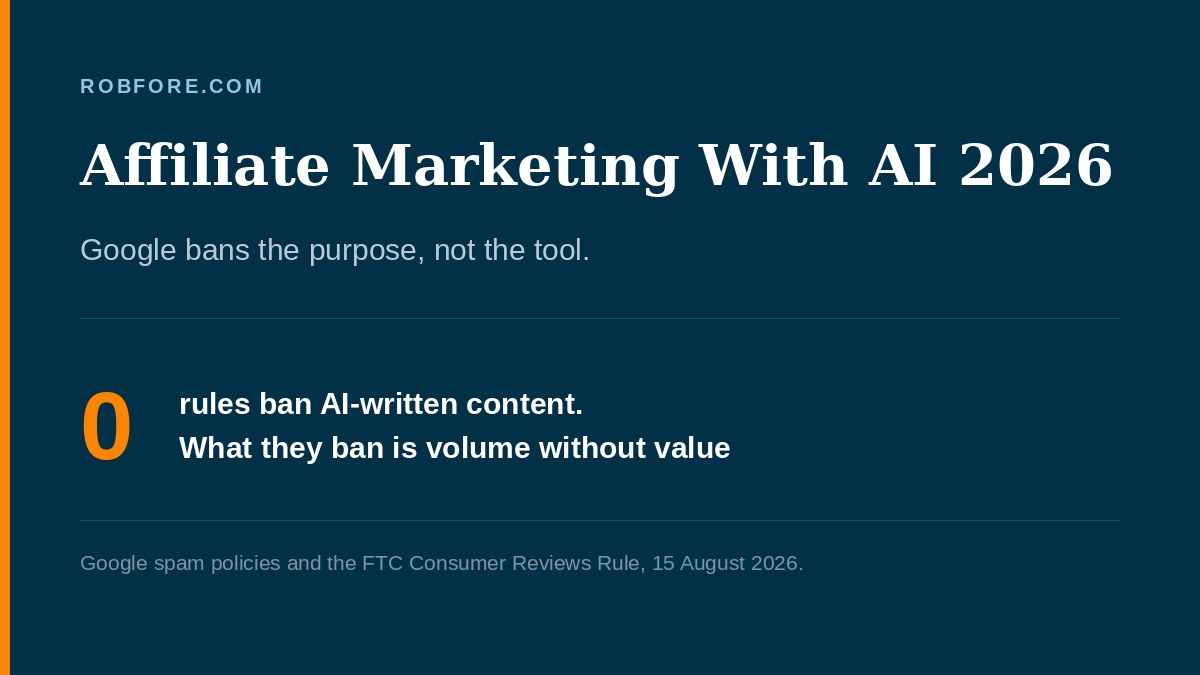
Google does not ban AI writing. It bans volume without value. Its spam policy draws the line at scale without added value, on a page updated 15 May 2026. The full list of named tactics sits on the SEO page.
The half that matters here is the permission. Google’s own guidance says generative AI “can be particularly useful when researching a topic, and to add structure to original content.”
Google also says affiliate content is not the target of its site reputation abuse policy, with one condition attached: “affiliate links marked appropriately aren’t considered site reputation abuse.” Marked appropriately. The whole safe harbor, right there.
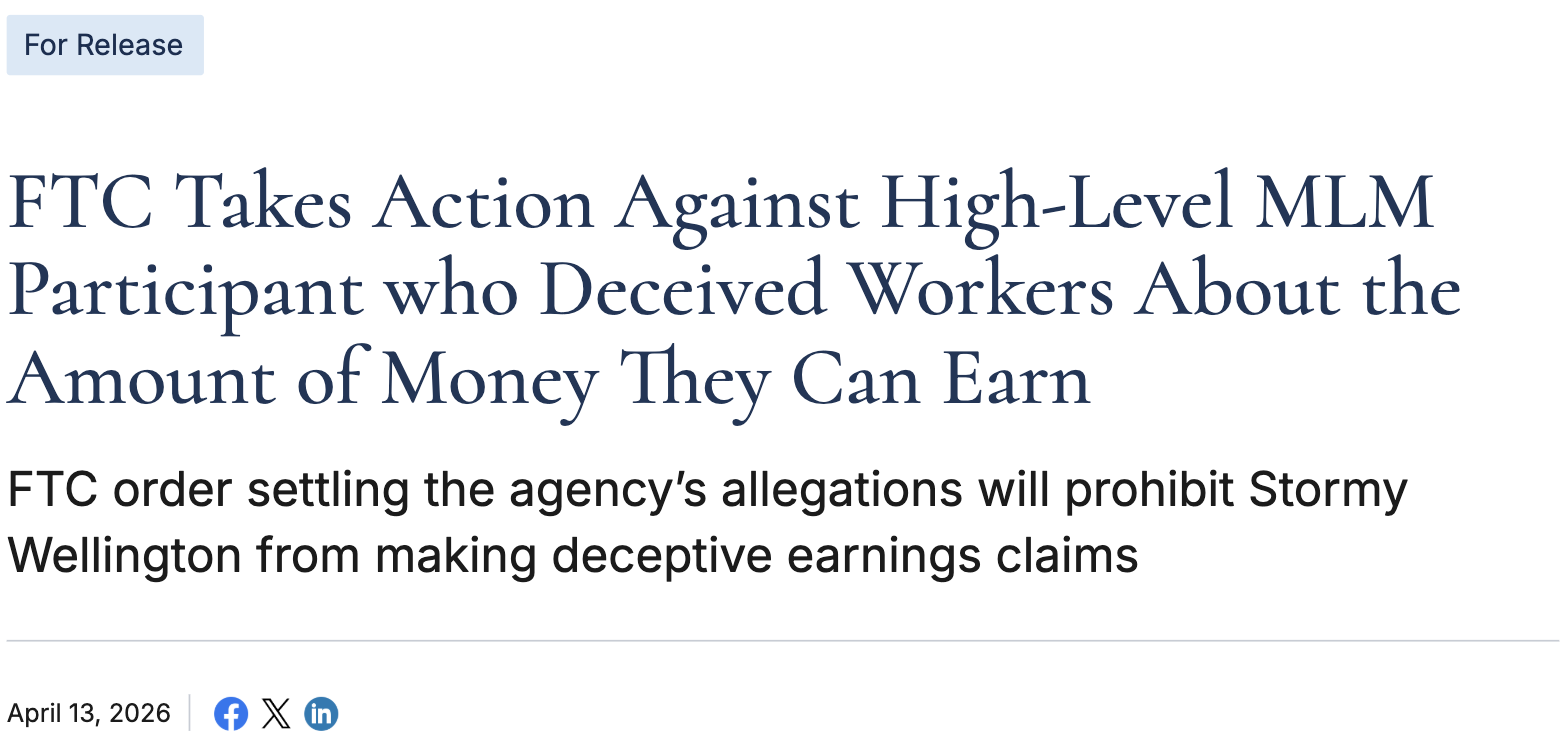
The FTC is not chasing AI. Chasing what you promise. In April 2026 it acted against individual MLM participants, not just the companies above them, over earnings claims. Those orders prohibit misrepresenting earnings “including through images of homes, vehicles, purchases, or travel, and through discussion of lifestyle changes or activities tied to compensation.”
Read that twice. The car in your story is an earnings claim. So is the beach. So is arithmetic, because 16 CFR 437.1(f)(1) counts “any chart, table, or mathematical calculation that demonstrates possible results” as one.
None of that is about AI. It is about a tool that lets a beginner produce fifty pieces of copy a week, any one of which can get you in trouble. More in the FTC rules for affiliates.
What I Would Stake My Name On, And What I Would Not
Thumbs up on the mechanics. What these tools do, what they cost, what happened to the people who ran them badly. All of it public, primary and dated further up the page.
Thumbs down on anything shaped like a productivity number.
There is no controlled test of mine behind any of this, and nobody should hand you a clean figure for “AI made me X% more productive.” Including me. Every time saving quoted anywhere gets self-reported by somebody selling something adjacent - a course, a toolkit, an automation product. What makes those accounts usable is not their arithmetic. People who are not citing each other describe the same sequence and the same failure.
Thumbs down again on whether any of this works for a beginner specifically. Nobody has published that study.
And thumbs down on HBA’s AI tools at volume. I use them, I read them from inside the member area, and what they do on the four hundredth video I could not tell you.
Came Here For A Shortcut? Read This Part Twice
AI fixes one problem and fixes it this week: you know what you want to say and cannot produce fast enough. Starting from zero skills counts too, genuinely, because the writing, research and design gaps used to take years and now take weeks.
Now the part that annoys somebody every time I say it.
Hoping to skip learning to market? The tool sits downstream of the skill. Skill is the bottleneck, not the opportunity, and the same has been true of every tool this industry has sold since 1996.
Hoping the tools decide what to sell? They will not, and no version of them ever will. The decision sits upstream of every feature on this page, and there it stays.
And where the plan is volume, ninety days is roughly how long that takes to stop working.
AI is a chainsaw. Cuts faster than you can, cares nothing about what it cuts, which is fine in a woodlot and expensive in an orchard.
The saw was never the decision.
Which tree, and why, still is.
So What Would I Do Starting Over Today?
Spend five dollars, not five hundred.
Google AI Plus at $4.99, one market, one channel, one piece a week for thirty days, with something first-hand in every piece. The whole plan, and it costs less than lunch.
If you are still publishing at day thirty, add the clipper and the scheduler, about $27 more. If you are producing video every week by month three, look at a bundle like HBA Premium then, and weigh it against that $0 median.
If you stopped publishing in week two, no tool was ever going to fix that, and better to find it out for five dollars than for five hundred.
The honest answer, in one line. The edge is real, it is bigger for a beginner than it has ever been, and it still only pays the person who shows up. More on the channel that feeds all of it in YouTube video marketing, the human half in MLM prospecting, and what this actually looks like financially in online income, realistically.
Bless and be blessed,

AI Affiliate Marketing FAQs
Can you start affiliate marketing with AI and no experience?
You can start faster than you could have five years ago, because AI closes the writing, design and research gaps quickly. It does not close the audience gap or the judgment gap. Those still take months of showing up, and they are what most people quit over.
How much does an AI setup cost to start?
One assistant is enough to begin. Google AI Plus is $4.99 a month and ChatGPT Go is $8, on each vendor's own page. Add a clipper and a scheduler later, around $27 more, once you are actually publishing every week.
Does AI traffic count when my AI-written blog post ranks on Google?
No, and people mix this up constantly. A post you drafted with AI that ranks in Google is counted as Google traffic. The AI referral numbers you see quoted only measure clicks sent from chat apps like ChatGPT and Perplexity, which is a separate and much smaller channel.
Will Google penalize me for using AI to write?
Not for using it. Google's spam policy targets scaled content abuse, defined as many pages generated primarily to manipulate rankings rather than help users. Google's own guidance says generative AI is useful for researching a topic and adding structure to original content.
What happens if I let AI publish for me automatically?
It fails in about ninety days. In SE Ranking's published experiment, twenty new sites running unedited AI output saw pages in Google's top 100 fall from 28% to 3% at around the three-month mark, and most had not recovered sixteen months later.
Can AI write my prospecting messages?
It can, and that is the wrong job for it. Use AI to prepare and yourself to connect. Ninety seconds of research before you reach out, so your opener references something real, beats thirty messages that all sound like they came off a template.
How many hours a week does this actually take?
Twelve to fifteen is enough to run a real publishing cadence with AI, which is roughly what it took without AI to do half as much. What it will not do is compress three years of relationship building into three months. Nothing does that.
What can AI not do for a new affiliate?
It cannot give you an audience, decide what you believe, or make anyone trust you. It also cannot tell you when its answer is wrong. Every number it hands you needs checking against a primary source before it goes anywhere near your name.
Sources
- Rupert Chesman, AI content pipeline timings, 7 May 2026. Author sells AI courses - checked Aug 17, 2026
- Louis-Francois Bouchard, AI agent content pipeline, 28 July 2026 - checked Aug 17, 2026
- SE Ranking, sixteen-month controlled AI content experiment, 19 March 2026 - checked Aug 17, 2026
- Martin Schenk, 2,300 AI articles and a click collapse, 13 July 2026. Author sells AI content automation - checked Aug 17, 2026
- Lilach Bullock, on batching AI-written LinkedIn posts, 18 July 2026 - checked Aug 17, 2026
- Google Search Central, Spam policies for Google web search, page updated 15 May 2026 - checked Aug 17, 2026
- Google Search Central, guidance on using generative AI content, updated 10 December 2025 - checked Aug 17, 2026
- Google Search Central, site reputation abuse policy and affiliate FAQ, 19 November 2024 - checked Aug 17, 2026
- FTC, action against a high-level MLM participant over earnings claims, 13 April 2026 - checked Aug 23, 2026
- Business Opportunity Rule, 16 CFR 437.1(f)(1), definition of an earnings claim - checked Aug 17, 2026
- Vendor pricing pages: Google Gemini subscriptions, OpenAI, Anthropic, OpusClip, Publer - checked Aug 17, 2026
- HBA Premium member area tool list, read as a paying member - checked Aug 17, 2026
- HBA Earnings Disclosure Statement, period 1 October 2025 to 30 September 2026 - checked Oct 8, 2026