
Best MLM Companies 2026: The Five Checks That Actually Pick One
The best MLM company is the one that survives five checks: customers who would buy the product with no opportunity attached, a comp plan that pays on sales rather than recruiting, an income disclosure that counts everybody, a qualification cost you can carry, and room to earn from your tools. Most fail at least two.
Every “best MLM companies” page on the internet is a ranked list written by somebody who joined none of them.
You don’t need another list.
You need a way to decide.
Because after thirty years in and around this industry, here’s what I know for certain: the company you pick matters less than the checks you run before you pick it. And almost nobody runs any.
Full disclosure before we go one step further. I’m an active affiliate of The Home Business Academy and systeme.io, both of which appear on this page, and I earn recurring commission through the links to them. HBA sits in the disclosure table with everyone else, same treatment, and the treatment is not flattering.
Why “Which Company Is Best?” Is the Wrong First Question
Ask ten top earners how they picked their company and you’ll hear ten versions of the same accident. A friend called. A product worked. Somebody got in a room with the right upline.
The company was rarely the decision.
The work was.
I’ve been doing this since 1996 and watched hundreds of companies launch, merge, reprice and vanish. The pattern that survives all of it: the same company that made one person a career made ten thousand others nothing, in the same year, on the same comp plan.
So “which company is best?” has no answer. “Which opportunity can survive five specific checks, run against documents the company publishes itself?” does.
That second question takes one afternoon. Here’s how to run it.
What Are Your Actual Odds Going In?
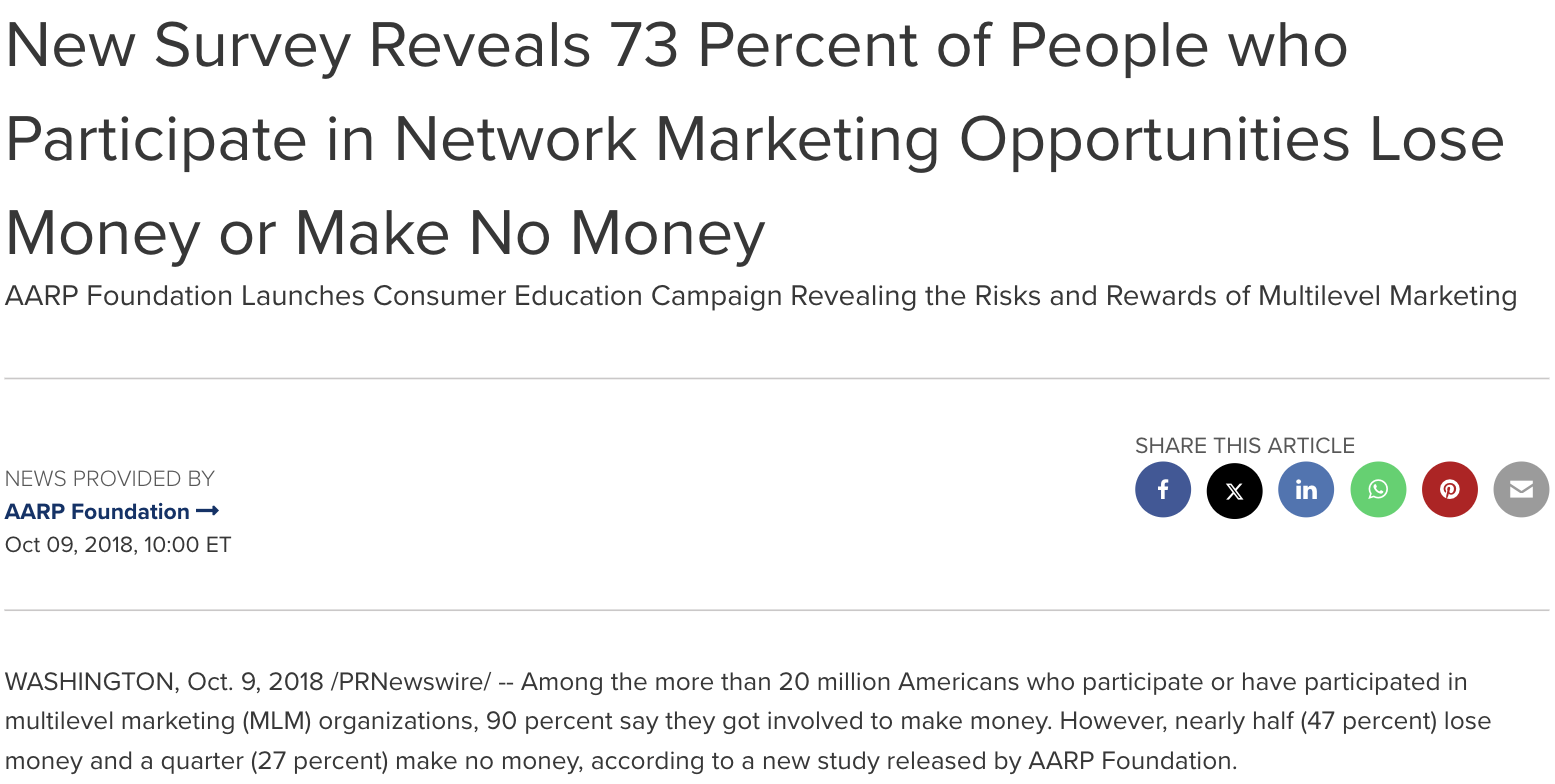
About one in four MLM participants turn any profit at all, and most of those clear less than $5,000 a year. That comes from AARP Foundation’s 2018 national study of MLM participants, still the largest independent look at the question: 47% lost money, 27% made nothing, and roughly 25% came out ahead, with more than half of the winners under $5,000 for the year.
Grocery money, for the winners.
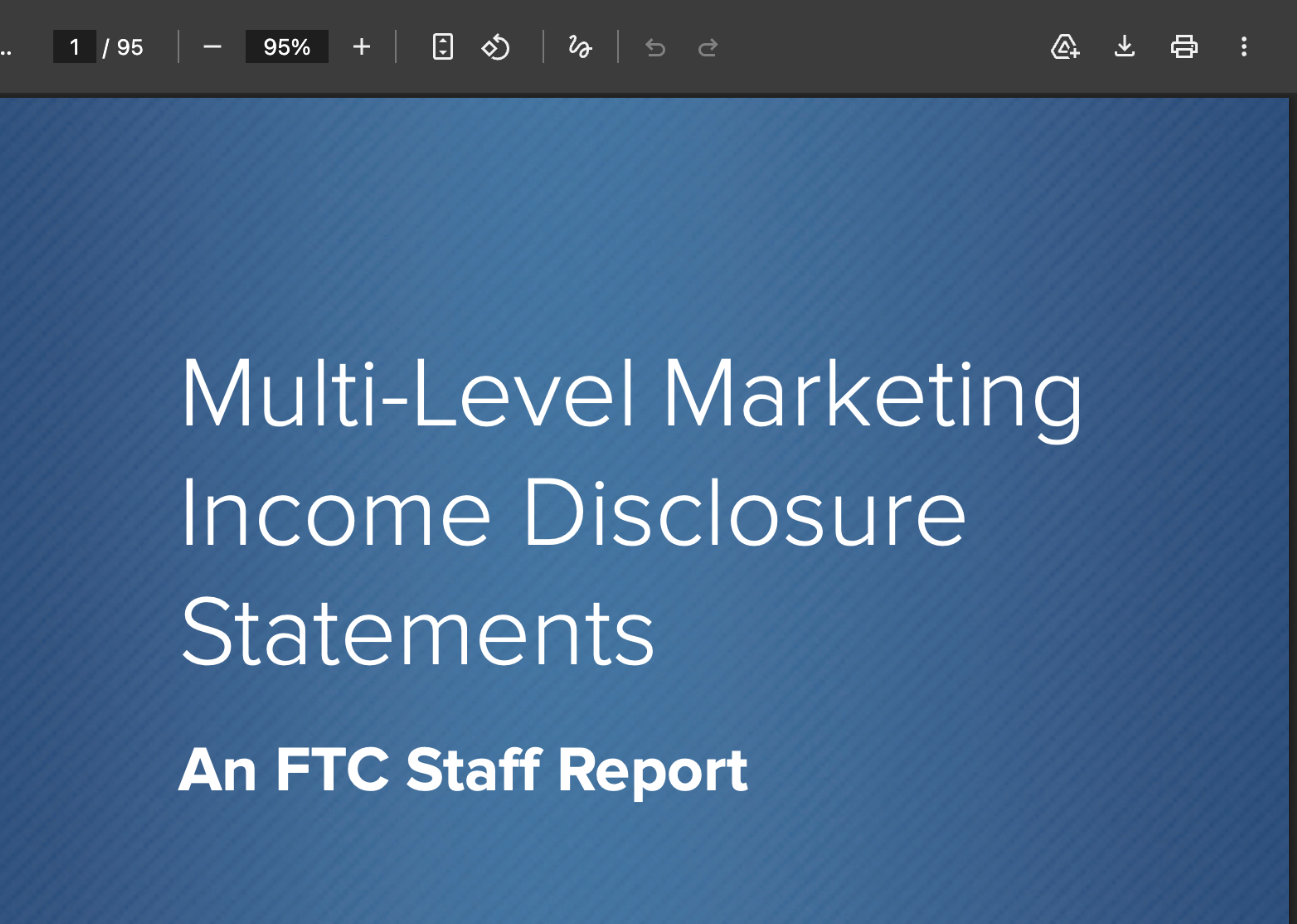
The companies’ own paperwork tells the same story. In September 2024 the FTC published a staff report reviewing 70 MLM income disclosure statements and found most of them present income figures without counting the participants who earned nothing, and none of the 70 accounted for expenses.
Those are the odds of picking on hope. I’ve written elsewhere about what online income realistically looks like, and none of what follows changes those numbers. The checks exist to keep you out of the 47% who paid for somebody else’s bonus, and to make sure that if you do the work, you’re doing it inside a structure where the work can compound.
Which Five Checks Pick a Viable Opportunity?
Retail demand, sales-based pay, an honest income disclosure, a qualification cost you can carry, and room to stack income beyond the comp plan. Every one runs on documents you can get before you sign, and a company failing two of the five is a no, whatever the products taste like.
My younger son sells mining claims. In that world, nobody sinks a shaft on a seller’s story. You pull a sample and assay it first, because the assay costs a day and the shaft costs a year.
These five checks are the assay.
Check 1: Would anyone buy this with no income attached?
Strip the opportunity off the product and look at what’s left. Would a stranger, with no position and no dream attached, pay this price for this thing when Amazon sells something similar for less?
If the honest answer is no, then every “customer” is really a distributor buying their own qualification, and the whole structure is recruitment wearing a price tag.
The FTC’s business guidance on multi-level marketing, revised in 2024, treats sales to real customers outside the network as the dividing line between a legitimate MLM and a pyramid. That’s not my standard. That’s the regulator’s.
Quick field test: ask the person recruiting you what percentage of the company’s buyers hold no distributor position at all. If they don’t know, the company probably doesn’t publish it. That silence is data.
Check 2: Does the money move on sales or on recruiting?
Open the compensation plan and find where the biggest bonuses trigger. If the serious money releases when somebody new buys a starter package, and only trickles when a customer reorders product, you’ve just learned what the company actually sells…
Positions.
A plan built on consumable products with a real reorder rate pays you next month for work you did this month. A plan built on enrollment packages pays you once and hands you a treadmill. If you’re still working out what network marketing is supposed to be underneath the hype, start there, because this check is the whole difference.
Check 3: What does the income disclosure admit?
Every company on your shortlist either publishes an income disclosure or doesn’t. Both answers tell you something.
When one exists, ignore the headline average and find the denominator: who got counted? Most disclosures report medians only for people who already earned something, which quietly deletes everyone who made nothing. Amway’s 2025 statement is a clean example: a $551 median that sounds respectable, calculated only across IBOs who received at least one payment, in a document that also admits 38% received no payment at all.
Here’s what twelve recognizable names admit in their own documents, gross, before expenses:
| Company | Data year | Counts everybody? | Their own figure |
|---|---|---|---|
| OPTAVIA | 2025 | Yes | 23.28% earned nothing |
| Young Living | 2022 | Yes | Median $23 across all Brand Partners |
| Amway | 2025 | Partly | 38% received no payment |
| doTERRA | 2025 | No | 58% of active advocates earned no commission |
| Nu Skin | 2025 | No | 26.67% of active affiliates paid in a month |
| Herbalife | 2025 | No | ~47,000 of 107,769 earned in a typical month |
| Melaleuca | 2022 | No | 82% are customers receiving no compensation |
| Plexus | 2025 | No | Average $771 across active and inactive |
| Isagenix | 2022 | No | Average $892 across all associates |
| It Works! | 2021 | No | Average $202 a month |
| Arbonne | 2021 | By level | A typical consultant earned $250 |
| Home Business Academy | 2026 | Active only | Median $0, average $530 |
Two of twelve count everybody. Two.
A company that publishes its full distribution, zeros included, has decided it can survive you knowing. That willingness is worth more than any product demo, and it’s the fastest single sort you can run on a shortlist. Dates and document details for every row are in the sources at the end of the page.
Check 4: What does qualifying for full commissions actually cost?
Almost every comp plan pays different rates at different qualification levels, and the difference is usually decided by what you buy or subscribe to each month.
So price the top tier before you join. Not the entry price. The monthly cost of staying qualified for the commissions everyone in the opportunity meeting was talking about, multiplied by twenty-four months, because a real build takes years and the subscription doesn’t pause while you learn.
Across the programs I’ve watched since 1996, staying fully qualified typically runs somewhere between $10 and $200 a month once the autoship is counted. Take the top of that range: $200 a month is a $4,800 commitment over two years. That’s arithmetic, not a projection, and it assumes you never miss a month. If that number makes you flinch, the honest move is picking a cheaper structure, not joining anyway and hoping commissions outrun the bill. They usually don’t: remember the median rows in that table.
And yes, if you clear this check, join at the level that qualifies you for full commissions from day one. Earning half rate on your first sales because you saved $50 up front is the expensive kind of cheap. But that logic only holds AFTER the products passed Check 1, because otherwise you’re just the biggest victim of Check 2.
Check 5: Can you stack income beyond the comp plan?
The people who survive in this industry rarely have one income stream, because every team needs tools the company doesn’t sell.
Your team members need a page builder, an email platform, a way to generate leads. When you recommend the tools you actually use and earn affiliate commissions on them, you’ve built a second stream from the same audience, one that keeps paying even if the company changes its comp plan under you. Companies do. I’ve watched it happen more times than I can count.
The free layer exists too: systeme.io’s free plan carries 2,000 contacts, three funnels and one course at $0, per their pricing page, so the funnel-and-list layer of a new build can cost nothing while you find your feet.
This is also where the bonus stack comes in. Everybody in your company sells the identical product at the identical price, so the only reason to join through YOU is what you add on top.
Mine is sitting under your cursor. The training on this blog, the AI skills stack I publish and keep current, and the systems I hand to people who start through me. I’ve never split-tested a join rate and I won’t invent one, but thirty years of watching this industry says people don’t join the first link they see. They join the person who already helped them before any money moved.
A real bonus stack costs you effort once and answers “why you?” forever.
A viable opportunity leaves room for both. A company that bans outside tools, or locks your team inside its own ecosystem, took your second stream off the table before you started.
What Do The Checks Buy You?
One afternoon of reading, spent now, against nineteen months of paying for the wrong thing.
The trade, plainly. The checks kill a bad subscription before month one instead of month nineteen, and they push you toward a product with real retail demand, which is far easier to sell to a stranger than a dream is. Reading disclosures and comp plans is slower than signing at the meeting. Supposed to be, in fact.
What they do not buy is an edge. Anybody can run them, and running them well only removes handicaps. The audience, the skill and the stack still get built by you, afterward, the slow way.
And some offers you are genuinely excited about will not survive the reading.
Better to know before the money moves. What an afternoon buys is not success. It is a structure where two years of real work can accumulate instead of evaporating.
Does HBA Pass Its Own Checks?
Four of the five, one with bruises. I earn recurring commission from The Home Business Academy, so this is me eating my own cooking: the thing I promote, through the same five gates, in public.
Check 1, retail demand: passes, and the company publishes the proof. The core products are a $25 a month funnel builder and a $125 a month training and AI tool membership, per HBA’s own product pages. Most people find HBA through the opportunity rather than the tool aisle, but the disclosure answers the field test directly: of 2,817 paying customers in the twelve months ending 30 September 2026, 44.2% had no recorded affiliate participation, per the statement. More than four in ten customers are buying the tools, not the position. Self-reported like everything else in a disclosure, but it’s the exact number Check 1 tells you to ask for, in writing.
Check 2, sales or recruiting: passes. Commissions are 80% recurring on product subscriptions. Nothing pays on enrollment itself; the money only moves while a customer keeps paying for a product. On the $25 Funnel Builder that’s $20 per active customer per month for as long as they stay. That’s arithmetic from the published comp structure, not a projection, and it assumes the customer stays subscribed, which most don’t do for long.
Check 3, the disclosure: passes with bruises. HBA publishes its numbers at thehba.app/income, and the median across all active affiliates is $0, with an average of $530, over the twelve months ending 30 September 2026. The median affiliate earned NOTHING. The company says so itself, which puts it ahead of most of that table, and the number is still $0.
Check 4, qualification cost: $10 to $160 a month depending on which products you hold, so the two-year top-tier commitment runs to $3,840. Same arithmetic as before, same caveat.
Check 5, stacking: passes. The product is the tool stack, outside tools aren’t banned, and affiliates keep their customer relationships.
That retail split changes how you’d promote it, too. When almost half the customers hold no affiliate position, you can lead with the $25 tool for the person who just needs a funnel and let the opportunity conversation happen later, or never. That’s the version of this business that survives scrutiny.
Four passes and a bruise. That’s a worked example, not a verdict. If it has you curious, my full HBA review runs a lot deeper and less politely, or you can see the three-product stack yourself and run the checks on me.
What Gets A Green Light Here, And What Doesn’t
Green on the method. Five checks, run against documents the company published itself, and every one of them beats a testimonial.
Red on what the method can do for you.
The checks filter. They don’t build. A company that passes all five will still pay you nothing where the traffic, the follow-up and the daily exposures never happen, and in my own teams since 1996 the share of people who sustained that work has never run past about three in a hundred.
Red on the paperwork too. The documents these checks read are self-published and unaudited, and the FTC’s 2024 report confirms most are built to flatter. What I am reporting is what companies admit.
A floor, not the truth.
Red on the age of the best evidence. The AARP study is from 2018. Still the best independent data available, which is its own indictment, and eight years is eight years.
And red on the one thing that helped me most, because no check on this page can measure it: who your upline actually is, and whether they will still answer the phone in month seven.
You learn that by asking their current team.
So ask.
One Question Decides Whether This Page Is Yours
Will you open the PDF?
Everything here rests on that, and no insult is meant by asking. The entire method is reading documents most people skip. Where the reading does not happen, no list on the internet can save you, mine included.
Say yes and there are two versions of you this was written for.
The first is holding a link somebody sent and has not signed yet. The whole method assumes the decision is still open, so run the checks tonight, before the three-way call, while nobody’s excitement is in the room but yours.
The second is already in and quietly re-running the decision. The checks work in reverse just as well. A company that fails three of five is not a reason to despair - that is information you can act on while your list still belongs to you.
And one version of you should probably close the tab.
Already committed, and looking for a page that says you chose right? I have no idea what you chose.
Run the checks. Let the documents tell you.
Your Picking Plan
You already know more than most people who’ve been in for a year. Here’s the afternoon, step by step.
- Pull the income disclosure for every company on your shortlist. Today, free. Search the company name plus “income disclosure.” A company you can’t find one for goes to the bottom of the list with a note, not in the trash.
- Find the denominator sentence in each one. Who got counted? Everybody, or only earners? Sort your shortlist by that answer alone.
- Open each compensation plan and find the biggest bonus. Note whether it triggers on customer orders or on new enrollments.
- Price the top qualification tier for twenty-four months. Write the total where you’ll see it. This is the number your spouse should hear before anyone’s testimonial does.
- Ask your recruiter one question: what percentage of buyers hold no distributor position? Write down the answer, or the silence.
- Check the company’s policies for what you’re allowed to do online. This is the step everyone skips, and it’s the one that kills the plan: plenty of companies still ban paid ads, restrict social media, or forbid you building your own list. A company that won’t let you market is a company betting you’ll only ever talk to relatives. And while you’re in the policy documents, read what the FTC now expects from individual affiliates, because the exposure is yours, not the company’s.
- Price your tool stack before you’re emotionally committed. A free funnel-and-email layer exists, so anything a company charges you for tools is a choice, not a necessity.
- Then decide once, in writing, and start the daily work. The picking was the easy part. Across three companies it took me years of daily exposures before any of them paid like real income, most who start never stay long enough to find out, and that attrition is exactly why the ones who stay get noticed.
Bless and be blessed,

Sources
- AARP Foundation national study of MLM participants, 2018, announced via PR Newswire - checked Aug 23, 2026
- FTC Staff Report, Multi-Level Marketing Income Disclosure Statements, September 2024 - checked Aug 22, 2026
- FTC Business Guidance Concerning Multi-Level Marketing, revised 2024 - checked Aug 22, 2026
- systeme.io pricing page, plan limits and prices - checked Aug 22, 2026
- HBA earnings disclosure, 1 October 2025 to 30 September 2026 period, including the customer-mix split - checked Oct 8, 2026
- OPTAVIA 2025 U.S. Income Disclosure Statement (doc OPTAVIA_LRN_IDS_033126) - checked Aug 14, 2026
- doTERRA 2026 Opportunity and Earnings Disclosure Summary (2025 data) - checked Aug 14, 2026
- Herbalife U.S. Statement of Typical Distributor Earnings 2025, published June 2026 - checked Aug 14, 2026
- Nu Skin 2025 Brand Affiliate Sales Compensation Summary, U.S. market - checked Aug 14, 2026
- Amway 2025 U.S. Income Disclosure (doc 177300ENB), copy retrieved 7 August 2026 - checked Aug 7, 2026
- Plexus Worldwide 2025 Global Brand Ambassador Compensation Disclosure Statement (doc WF-3515337) - checked Aug 7, 2026
- Young Living 2023 U.S. Income Disclosure Statement, 2022 data, copy republished by TruthInAdvertising.org - checked Aug 7, 2026
- HBA products page, Funnel Builder $25 a month and Premium $125 a month - checked Aug 22, 2026