
What Is Network Marketing? (2026, With The Real Numbers)
Network marketing is a distribution model where independent representatives sell a company's products and earn on their own sales plus sales of people they recruit. It is legal and regulated. The companies' own disclosures show most participants earn very little: Young Living reported a median of $23 for 2022.
I have built three network marketing businesses since 1996, so take the definition from somebody inside it and the numbers from the companies themselves.
Both are below.
The definition is short. The numbers are the part worth your time.
What Is Network Marketing?
A company sells through people instead of shops.
The whole idea.
Independent representatives buy or promote the products, earn commission on what they sell, and earn additional commission on the sales of people they recruit. That second layer is the whole distinction. Without it you have affiliate marketing or ordinary retail.
The labels are interchangeable - network marketing, multi-level marketing, MLM, direct sales, social selling.
Same model. Different packaging.
It is a legal model, regulated primarily by the FTC in the United States.
How Does The Money Move?
Customers pay the company. The company pays commissions down the structure according to a compensation plan.
Two things follow from that, and they explain most of what people find confusing.
Your income depends on volume you do not personally control. Beyond your own sales, you are paid on what other people do, and most of them will do nothing. That is not a criticism of anybody, it is the arithmetic of every structure like this.
Qualification usually costs money. Most plans require an active subscription or a monthly volume to stay eligible for commission. So the cost is monthly and the income is not, especially at the start.
I went through one plan line by line in the HBA review, including the qualification requirement and the payout threshold, which is the level of detail worth demanding before joining anything.
Does Network Marketing Actually Work?
For a small minority, on the companies’ own figures.
Take the handful of companies willing to count everybody, earners and non-earners alike, and this is what falls out:
| Company | Year | Against all participants |
|---|---|---|
| Young Living | 2022 | Average $881. Median $23 |
| OPTAVIA | 2025 | 23.28% earned nothing |
| Amway | 2025 | Average $750 for all US IBOs at Founders Platinum and below, before expenses |
Young Living’s row is the one to sit with…
Average $881. Median $23.
Forty times apart.
A few large earners drag an average upward. The median ignores them and reports whoever is standing at the halfway mark. Put that much distance between the two and the average has stopped describing a real person.
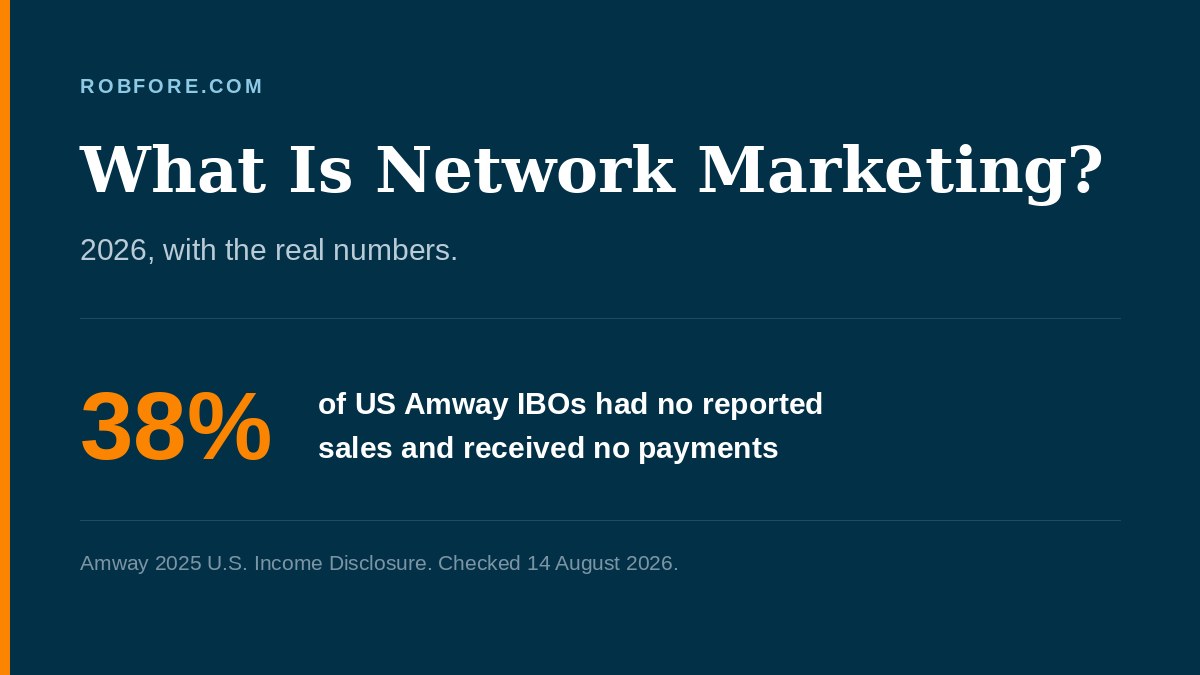
Amway’s own 2025 disclosure reports $750 average for all US IBOs at Founders Platinum and below, while the same file records 38% of US IBOs as having no reported product sales, no sponsoring and no payments at all.
I read twelve of these documents in the income disclosure roundup and the pattern did not break once.
Is It A Pyramid Scheme?
Not inherently, and the distinction is worth understanding properly rather than as an insult.
The legal question is where the money comes from. If compensation flows primarily from selling products to actual customers, it is a distribution model. If it flows primarily from recruitment, with product as a formality wrapped around it, that is where regulators focus.
The FTC has been active recently and it now reaches individuals. April 2026 brought stipulated orders against individual high-level participants rather than the company above them, and what those orders reach is broader than figures: they name misrepresenting earnings through images of homes, vehicles, purchases or travel.
Being downstream is not a shield. I covered what that means for anybody promoting in the FTC rules for affiliates.
Real red flags, none of which are subtle: no genuine product, a plan that pays mainly on recruitment, hype with no timeline, and income claims with no cost disclosure beside them.
What To Check Before You Join
Four things, in this order, and all four are free.
- Read the income disclosure. If there is not one, that is information.
- Check the denominator. Is the median across everybody, or only across people who already earned? Most report the second and describe it like the first.
- Add up the monthly cost of staying qualified, for a year, and compare it against the median. Do that arithmetic before you do the optimistic one.
- Ask what happens if you stop recruiting. If the answer is that income stops quickly, you have learned where the money actually comes from.
None of that tells you not to join.
It tells you what you are joining, which is a different and far more USEFUL thing.
Where This Falls Short
These are US disclosures from different years with different definitions. Young Living’s figure covers 2022, OPTAVIA’s and Amway’s cover 2025. “Active” means something different in every document, so lining them up is useful for scale and useless for ranking one against another.
Two of these did not come from the company’s own server. TruthInAdvertising.org’s Young Living database is where I found the Young Living statement, and Amway’s came out of a 7 August 2026 capture, the live URL having started erroring at anything automated. OPTAVIA’s disclosure does serve from the company’s own media domain.
I am not neutral. Three of these businesses have been mine, and I am an active affiliate of one program right now. That is disclosed on the disclosure page, and it is why this page leans on documents rather than on my opinion.
No income figure of mine appears here. Mine would not be typical, and putting it next to a $23 median would undo the point of the page.
This is the model, not a company verdict. Whether any particular company is worth joining needs its own reading of its own disclosure.
Who This Is For, And Who It Isn’t
It fits you if somebody has approached you and you want the plain version before the presentation. The definition is at the top and the numbers are in the table.
It fits you if you are already in and want to understand why the published figures never matched your experience. Check the denominator.
It does not fit you if you want to be talked out of it. I have not done that. I have built three of these and I am telling you what the documents say.
It does not fit you if you want to be talked into it either. The median is $23 in the one company that publishes it honestly, and no amount of enthusiasm changes that number.
So before you decide anything, find the company’s own disclosure and read the median. Not the average, not the top rank. The median, which is one number and settles most of the argument.
Bless and be blessed,

Network Marketing FAQs
What is network marketing in simple terms?
A company sells its products through independent representatives instead of shops. Those representatives earn a commission on what they sell, and additional commission on sales made by people they recruit. The recruiting layer is what separates it from ordinary affiliate or retail selling.
Is network marketing the same as MLM?
Yes. Multi-level marketing, network marketing, direct sales and social selling are largely the same model wearing different labels. The multi-level part refers to earning on the sales of people below you in the structure, which is the defining feature.
Does network marketing actually work?
It works for a small minority. In the disclosures I have read that count every participant instead of filtering to earners, the median usually sits between zero and a few hundred dollars a year. OPTAVIA reported 23.28% of US coaches earned nothing in 2025.
Is network marketing a pyramid scheme?
Not inherently. The legal distinction turns on whether compensation comes primarily from product sales to real customers or from recruitment itself. A plan paying mainly for recruiting, with product as a formality, is where regulators focus their attention.
How much do network marketers actually make?
Usually very little, and the published averages overstate it. Amway reported average annual earnings of $750 for all US IBOs at Founders Platinum and below in 2025, before expenses, in the same document that says 38% received no payments at all.
Why do the income figures look better than that?
Because most disclosures report medians only for participants who already earned something. Everybody who made nothing is removed before the median is calculated, which lifts the number substantially and describes a different group than the one you would be joining.
Should I join a network marketing company?
Read its income disclosure first, and check the denominator. If the company does not publish one, or publishes figures only for people who already earned, treat that as information. It takes ten minutes and it is the highest-return reading available before you sign anything.
Sources
- Young Living 2023 U.S. Income Disclosure Statement, covering calendar year 2022. Copy in hand republished by TruthInAdvertising.org rather than retrieved from Young Living - checked Aug 22, 2026
- OPTAVIA 2025 U.S. Income Disclosure Statement (doc OPTAVIA_LRN_IDS_033126) - checked Aug 22, 2026
- Amway 2025 U.S. Income Disclosure (doc 177300ENB). Copy retrieved 7 August 2026; the live URL now returns an error to automated requests - checked Aug 14, 2026
- FTC action against high-level MLM participants (Merritt / LifeWave) - checked Aug 15, 2026