
Home Business Academy Review 2026 ($530 Average. Don't Be Average)
The Home Business Academy sells five digital products from $10 a month and pays affiliates 80% recurring commission on products they personally own. Its own earnings disclosure reports an average of $530 and a median of $0 across 1,572 active affiliates. The tools are real. Most earn nothing.
Full disclosure: I’m an active Home Business Academy affiliate, I’m one of the highest-earning affiliates in the company, and I earn recurring commissions on every referral. That is a real conflict of interest and you should read this with it in mind. I’ve covered the parts most affiliate reviews skip: what a lapsed subscription costs you, the 72-hour refund window, the two documents that contradict each other, and the median earnings figure. Full disclosure
Income disclosure: HBA’s own published statement, reports an average of $530 and a median of $0 across 1,572 active affiliates over twelve months. Most participants earn little or nothing. Any figures I share are my own and are not typical. Nothing here is a promise or projection of what you will earn. Full earnings disclosure
Are you thinking about joining the Home Business Academy?
Then you’ve already found the problem with researching it. Nearly every review on page one is written by somebody who gets paid 80% if you click their link.
Including this one.
So here’s my offer. I’m going to price every product, compare each one against what the same capability costs on the open market, quote the compensation plan and the affiliate agreement word for word, publish what my own customers actually did over six years, and put HBA’s own earnings numbers on the page without softening them.
Then you decide.
What The Home Business Academy Sells
HBA is a digital education and software company founded in 2016 by Paul Hutchings and Mike Hobbs, selling tools and training to people building a business from home.
The structure matters more than the marketing.
This is not an MLM. There is no matrix, no binary, no downline, no genealogy, no rank ladder, no autoship and no volume quota. HBA’s compensation page states it flatly: “Our affiliate program is one tier, meaning you earn commissions on the products purchased by customers you refer directly.” Nobody above you earns a cent off your customers, and you earn nothing off anyone else’s.
Ten years in, I can’t find an FTC action, an SEC action, a state attorney-general action, a self-regulatory case or a class action against the company or either founder. A CourtListener full-text search for “Home Business Academy” returned zero results on 15 August 2026. That’s a negative result from a search, not proof that nothing exists, and I’d rather phrase it that way than overclaim on the company’s behalf.
That is worth saying plainly, because in this industry it isn’t the default.
The catch is narrower.
And it is not a legal one. This is a subscription business whose most enthusiastic buyers are people who want to resell the subscription. I’ll come back to that in Where This Falls Short, because it’s the honest center of the whole review.
What Is HBA’s New AI Builder?
HBA’s new AI Builder replaces the Funnel Builder on Monday, 12 October 2026, when HBA says it opens to every member at 8 PM Eastern. You type one plain-English request, and an AI agent builds the pages, the opt-in form, the email list and the follow-up emails. HBA revealed it at its Freedom Fest event on 18 September 2026.
I haven’t used it yet.
Nobody outside HBA’s test group has. So this section is what HBA showed in its own clips, what its credit screen lists, and what members testing it have reported on camera. I’ll replace it with my own numbers once I’ve built something with it.
Here’s what HBA showed. On stage, one request built a capture page, a thank-you page with a YouTube video on it, a new email list and four autoresponder emails, then connected a domain and published. HBA’s own clip puts it at “like six minutes.” In the same demo, the first email’s first-name field didn’t fill in. “We’ll fix the variable,” they said, live on stage.
Fair enough. It’s a beta.
What Does The AI Cost To Use?
The Builder comes with the $25 Funnel Builder. The AI inside it runs on credits, and that part of the bill nobody is putting on a page.
| Item | Cost | Where the number comes from |
|---|---|---|
| 5 credits a day | Free | HBA’s credit screen |
| Credit packs | $10 for 50, up to $100 for 500. 20 cents a credit at every size | HBA’s credit screen |
| One page | About 15 credits, so about $3 | Richard Hairston’s beta build on YouTube, 25 September 2026 |
| One email | About 1 credit, so about 20 cents | Richard Hairston’s beta build on YouTube, 25 September 2026 |
| 2 pages and 5 emails | 36 credits, about $7.20 | Richard Hairston’s beta build on YouTube, 25 September 2026 |
| 1 long page and 3 emails | About 55 credits, about $11 | Robin Williams’s beta build on YouTube, 28 September 2026 |
| Your own Claude or ChatGPT, connected | HBA says no HBA credits | HBA’s “Bring your own AI” clip, 26 September 2026 |
Five free credits a day is a third of a page.
So the free allowance covers small edits, not builds. Plan on paying for the builds, or connect an AI you already pay for. And one thing on that credit screen doesn’t add up yet: it says “Bigger packs save more per credit,” but at the listed prices every pack works out to the same 20 cents. Either the words or the prices will change.
What Don’t We Know Yet?
- Whether old pages move over. My whole funnel, 34 pages, lives in the current Funnel Builder. HBA hasn’t said publicly what happens to pages like mine on the 12th. I’ve asked. No answer yet.
- What the AI writes in your name. In Robin Williams’s beta build, the AI added a money-back guarantee line and testimonials he hadn’t asked for. His words: “the work comes in for me is to read it to make sure it’s telling the truth.” Read every word before you publish it. Your name is on that page, not HBA’s.
- Which AI model runs it. HBA hasn’t named one.
- When everyone else gets it. Members get it on 12 October. Affiliates have said 20 October and 28 October for the public launch. They can’t both be right.
None of it changes the median further down this page.
A faster builder makes the page in six minutes. It doesn’t bring a single person to it. That part is still your job, every week.
If you’re going to join anyway, join before the 12th and finish the setup first: the domain, the email list, the profile the AI reads before it writes. Then on the first night it has something real to build from. I put the seven things to set up, a credit calculator and the ten prompts I’ll paste in on launch night into a free kit.
What Does HBA Cost, All In?
Between $10 and $160 a month, plus a one-time $500 to $1,000 course if you want the whole thing. HBA’s own income disclosure confirms the range: active members pay “between $10-$160/month depending on which products they subscribe to.”
Here is every product, priced.
| Product | What it is | Price | What it pays you |
|---|---|---|---|
| Let’s Goal | Goal, habit and morning-routine app | $10/month | $8/month recurring |
| HBA Emailer | Autoresponder and broadcast tool | Free with any product | $5 per $15 credit pack |
| HBA Funnel Builder | Page and funnel builder, hosting, checkout. Includes the new AI Builder from 12 October 2026 | $25/month | $20/month recurring |
| HBA Premium | Traffic and Conversions Academy, AI tools, daily coaching | $125/month | $100/month recurring |
| Financial Literacy Academy | Debt, tax, retirement and asset-protection courses | $500 in first 7 days, $1,000 after | $400 or $800 one time |
Two things about that table you should notice before anything else.
Only two of those prices appear on HBA’s own products page. You get $10 and $25. Premium’s $125 is published on the company’s Premium page, which is a funnel page, not the shop. The Financial Literacy Academy carries no public price anywhere on the company’s own site. The Emailer isn’t listed as a product at all.
The full monthly stack is $160. That’s Let’s Goal plus Funnel Builder plus Premium. At 80%, a customer who takes all three pays you $128 a month for as long as they stay.
Which is where the whole business gets interesting, and also where it gets expensive.
Gross figures, over twelve months, before subscription costs. The base is 1,572 customers with recorded affiliate participation.
One definition on that page is worth more than the averages. “Actively promoted” is HBA’s own label for an affiliate who sent five unique visitors in twelve months. More than half of them did not clear that bar.
Put the two halves together, and put it in a year so the math is easy.
The median active affiliate earned $0 over twelve months while paying to stay qualified. The cheapest tier that actually qualifies you is the $25 Funnel Builder, because Let’s Goal at $10 does not: that’s $300 across the twelve months, against nothing coming back. Go all in on the full stack at $160 a month and you’re looking at $1,920.
That’s arithmetic, not a projection. It assumes a constant subscription level and uses HBA’s own published figures. For what people actually earn, see the disclosure itself.
Their number, not mine.
Even the group that made at least one sale shows a median of $203 across twelve months. Against a $25 Funnel Builder subscription that’s roughly break-even. Against the full stack it isn’t close.
Credit where it’s due.
Publishing a median of $0 is more honest than most of the twelve companies I read for the income disclosure roundup.
Every HBA sales page points to the same disclosure. No average-earnings figure appears on the compensation page, the Premium page or the All-In-One page. All three carry the same “typical affiliates earn no income” disclaimer, and the compensation page links out with “Full earnings disclosure: thehba.app/income.” Income.TheHBA.net redirects to that same disclosure. The published figures are $530 average and $0 median.
Here’s the part that catches everybody. That page recalculates from purchase records and carries no update timestamp of its own. The twelve-month window rolls forward and every figure moves with it. The figures here cover 1 October 2025 through 30 September 2026: $530 average, 1,572 affiliates, 48.2% promoting, 26.5% making a sale.
So any figure quoted from it is only as good as the day it was read, and the date this review read it is in the sources. If a review quotes you a number with no date attached, it hasn’t been checked recently, and that tells you what to assume about the rest of it.
My own numbers, and why they don’t help you
My HBA back office showed $279,182.87 paid across 1,301 commissions when I opened it on 23 August 2026. I have not actively promoted HBA since 2023, and across those years the book has still averaged roughly $50,000 a year.
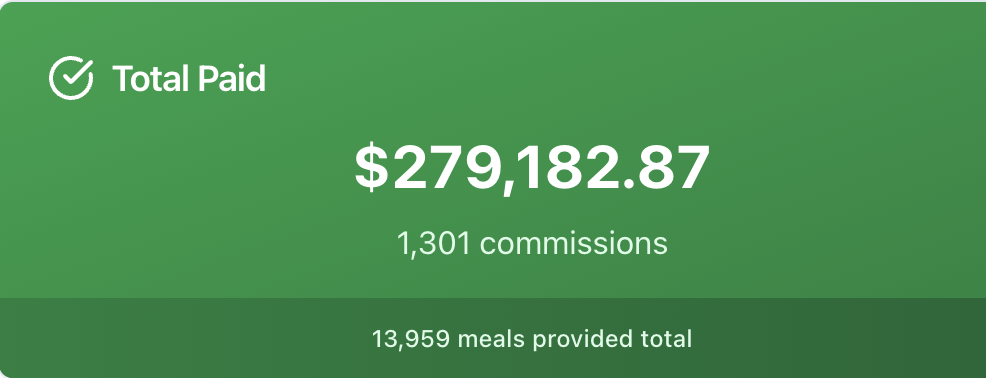
Now hold that next to the table above: the median active affiliate earned $0 over twelve months, and HBA’s own disclaimer says “typical affiliates earn no income.”
Both of those are true.
The second one describes you. The difference between us isn’t HBA, and it isn’t effort - it’s a list I started building in 1996 and thirty years of learning how to market to it. Full earnings disclosure. There’s a longer honest version of this arithmetic in realistic online income.
What Happens To Customers After They Join
This is the number nobody in this ecosystem publishes, so here’s mine.
I pulled my full commission ledger from 11 September 2020 to 11 August 2026: 297 unique paying customers, 4,472 commission line items.
About one customer in ten is still active. My back office on 23 August 2026 lists 32 active and 276 inactive, so 308 referred customers lifetime, and 10.4% of them still paying.
That is eleven more than the ledger export counted, because the export closed twelve days earlier. Two reads, two dates, and you are getting both rather than the tidier one.
Nearly nine in ten are gone.
The median Funnel Builder customer billed 3.5 times.
The median Premium customer billed 3.0 times. Three months, not three years. The averages are more than twice that because a handful of long-tenured customers drag them up, and both numbers are true - the median describes the customer you’re most likely to enroll, the average describes what a hundred of them look like together.
Refunds and chargebacks came to 1.03% of gross. So the leak isn’t disputes. People don’t ask for their money back, they just stop.
Two findings from that ledger changed how I think about this business.
One in eight customers was still paying three to five years later, through a long stretch when I ran essentially no promotion. That window paid $42,098.47, and 89% of it was rebills rather than new sales. Residual income at this company is real, it’s about 13%, and it holds rather than grows. Twelve genuinely new customers arrived in twenty-one months of doing nothing.
Twelve. Anyone telling you the money arrives while you sleep is describing the 13%, not the 87%.
And what you own decides most of your income. 88.2% of my customers have owned the Funnel Builder. 57.9% went on to own Premium. 30.3% bought Financial Literacy. At HBA you’re only paid on products you personally own, so an affiliate holding only the $25 tool watches the rest of that money go somewhere else.
One median customer pays a Funnel Builder-only affiliate $70. That same customer, with identical retention, pays a full-stack affiliate $770.
That’s arithmetic on measured retention from my own book, not a projection of your results. It assumes the customer buys all three products.
My live residual makes the same point without any arithmetic at all. Here is what those 32 active customers actually pay me, read from the back office on 23 August 2026.
| Product | Active customers | Monthly residual |
|---|---|---|
| Let’s Goal | 20 | $160 |
| HBA Funnel Builder | 29 | $580 |
| HBA Premium | 16 | $1,600 |
| Total | 32 unique customers | $2,340 |
Sixteen customers produce two thirds of it.
Premium is half my active list and 68% of the money, which is the entire case for owning a product before you try to sell it.
One more thing about that table, because the multiplication invites a question. $2,340 a month is $28,080 a year, well short of the $50,000 average above. Both are real. A residual screen can only show recurring products, and the Financial Literacy Academy pays $400 to $800 exactly once, so it never appears here; the multi-year average carries those one-time commissions and the sales that still arrive unasked. Neither figure is a projection of yours.
The median active affiliate earned $0.
Among my customers who are still active today, 91% own the Funnel Builder, 66% own Financial Literacy, 63% own Let’s Goal and 50% own Premium. The people who stick are overwhelmingly the people who went all in. Whether commitment causes persistence or persistent people commit, I can’t tell you. The correlation is in the data and it’s strong.
What Do The Top HBA Producers Have In Common?
Publish the same handful of things for years, without ads and without income screenshots.
In August 2026 I studied fifteen active HBA promoters, including both founders, and counted their published output rather than asking them about it. The results are more encouraging for a part-timer than you’d expect.
| What they do | How many | Can a beginner copy it? |
|---|---|---|
| Publish long-form YouTube video | 15 of 15 | Yes, free |
| Repeat the 80% commission fact constantly | 15 of 15 | Yes, free |
| Review HBA by name, year in the title | 14 of 15 | Yes, free |
| Tell their own story repeatedly | 13 of 15 | Yes, free |
| Say “I got burned before” | 12 of 15 | Yes, and you already have this credential |
| Offer a bonus for joining through them | 11 of 15 | Yes, if it’s real access |
| Give something free to collect an email | 11 of 15 | Yes |
| Use the “two customers covers your costs” math | 11 of 15 | Yes |
| Make short-form video | 5 of 15 | Yes, and this is the open lane |
| Show income screenshots | 3 of 15 | No, and you shouldn’t |
| Buy paid traffic | 2 of 15 | No, not at this stage |
| Run a podcast | 0 of 15 | Nobody does. Interesting. |
Sample of 15 active HBA promoters, measured from public output in August 2026.
Four things in that table matter more than the rest.
Almost nobody at the top is buying ads. Two out of fifteen. Several market against it on purpose. So the thing you can’t afford is the thing that isn’t working anyway.
Almost nobody at the top is showing income proof. Three out of fifteen, and the highest-volume publisher using income-claim titles has the worst measured results in the whole sample. The people who produce show arithmetic instead: 80%, $20 and $100 a month, two customers and your overhead is covered. You can do that today with zero income, and it’s compliant in a way a screenshot isn’t.
Short-form is wide open. Only a third make it. One founder’s short videos average about 1,300 views against roughly 264 for his long ones. Five times the eyes, and almost nobody in the company is there. That is a free lane, and YouTube video marketing and social media marketing both cover how to work it.
More than half already had an audience for something else. Eight of fifteen brought a group with them - gold and silver investors, day traders, small business owners, software reviewers. HBA was their second offer, not their first. If you already have a list, a channel, a congregation or a trade, that is worth more than every tactic on this page. If you don’t, this still works. It’s just slower, and you deserve to know that going in.
Here is the part that should sober you and encourage you at the same time. The two highest producers in that sample have been publishing for five and seven years. Nobody in the study got there in twelve months.
Not one person.
But the work itself is about eleven hours a week, it costs nothing but time, and it is entirely doable in the evenings around a job. That combination - years of patience, part-time hours - is the real shape of this thing. Anyone selling you a shorter timeline is selling you something.
Whether you can hold that pace for years is a separate question from whether the offer works, and it is the whole subject of mindset and consistency.
What Happens If Your Subscription Lapses?
Your customers stop being yours after roughly eleven weeks, and they go to whoever sponsored you.
HBA’s compensation page publishes a staged timeline.
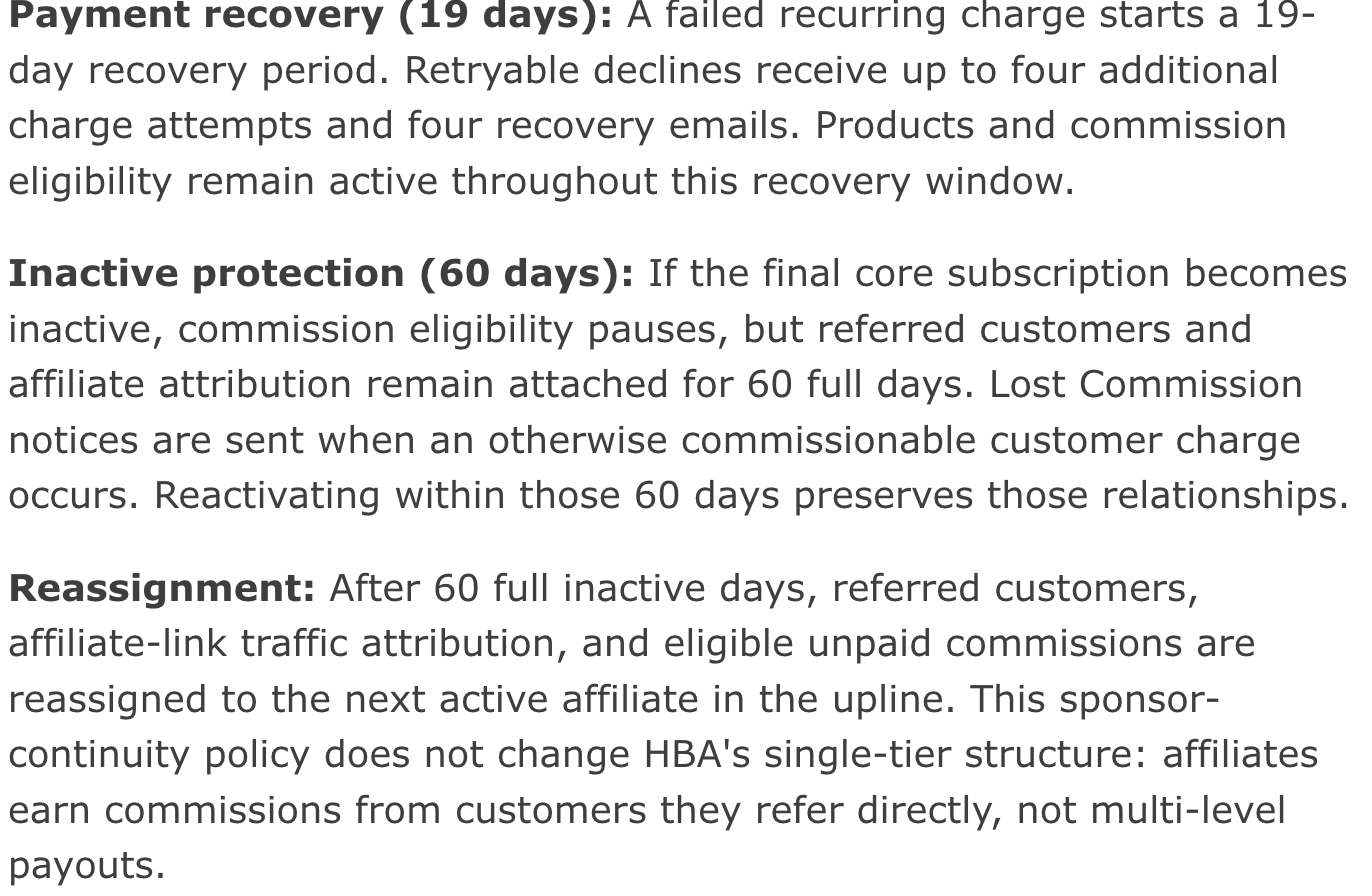
A failed recurring charge opens a 19-day recovery window, and HBA says products and commission eligibility stay active the whole way through it. If your last core subscription then goes inactive, eligibility pauses, but your referred customers and your link attribution stay attached to you for 60 more days. Reactivate inside that window and you keep them.
Miss it, and here is the part to read twice.
After 60 full inactive days, HBA hands your referred customers, the credit for your affiliate links and any eligible unpaid commissions to the next active affiliate above you.
Not held. Not returned on appeal. Handed to the person above you.
Eleven weeks of rope is a real grace period and I would rather say so than pretend otherwise. What sits at the end of those weeks is the whole book of business you built, and somebody else collecting on it.
Put the subscription on a card that is not about to expire, add a backup, and set a reminder 45 days before it does.
Five minutes. Do it on day one.
Five Things I’d Want To Know Before I Paid
Written in the order I’d weigh them, by somebody who earns a commission if you join.
A lapse hands your customers to your upline. Sixty days after your last core subscription goes inactive, the book you built is reassigned upward. The 60 days are a genuine grace period, and the destination at the end of them is your upline, not you.
More than half the buyers are people who want to resell it. This is the honest center of the review, and HBA publishes the number. Of 2,817 distinct paying customers in the year to 30 September 2026, 55.8% had recorded affiliate participation and 44.2% did not. Credit for publishing it, and 44.2% retail is a better mix than I expected. It still means the sales force is more than half the customer base, the training still teaches you to promote HBA, and page one of Google for the company name is still mostly people earning 80% on your click.
The refund window is 72 hours. On a $1,000 course.
Three days is not enough time to evaluate a financial-education curriculum, and after that nothing is refundable.
The brand-name search space is saturated. Fifteen-plus affiliates publishing near-identical “Home Business Academy Review 2026” videos, with a measured median around 180 views and a floor in single digits. If your plan is to make that video, you are the sixteenth person making it.
Go and count them.
And the FAQ still sells a product that isn’t on the shop. HBA’s FAQ offers Freedom Launchpad at $27 as the cheapest way in. It doesn’t appear on the products page, and it hasn’t appeared in my own commission ledger since March 2023.
Whether that order form still processes, I can’t tell you.
Two Buyers Walk In. Only One Should Sign Up.
The first already has an audience. A list, a channel, a group, a trade, a congregation. Eight of the fifteen top producers brought one with them, and a low-priced recurring offer put in front of people who already listen to you is the single highest-probability version of this whole thing.
The second wants the tools and would pay for them anyway. A page builder, hosting, checkout and an autoresponder for $25 to $35 a month is honest value, and HBA says so itself: “Many members enroll for the training and tools without pursuing the affiliate opportunity.”
A legitimate purchase. Feel no pressure to do anything else with it.
Now the third person.
He needs the commission to arrive before the subscription renews. The median says $0. My own median customer paid for three months, the producers took five to seven years, building anything real took me years, and most people quit inside the first. Across three companies and thirty years of my own teams, the share of genuinely committed producers has never run higher than about 3%.
So the honest answer to him is no.
Same answer where $160 a month is money you need. Say that plainly, because the disclosure says the median affiliate earned nothing across twelve months while paying that bill.
And same again where a declined card could go two months unnoticed.
Two months is the entire window. Your sponsor inherits the customers at the end of it.
In a gold rush, the reliable money is in shovels.
HBA sells shovels and I sell HBA. Weigh both of those before you weigh anything else on this page.
So How Would I Start?
Buy it for the tools. Position for the commission.
In that order.
If the workflow above is what you want - pages, checkout, hosting, a list, and an AI production line that turns one idea into eight posts - then start where the value is honest and the risk is smallest.
Start at $10 if you want the autoresponder. Let’s Goal plus 300 free Emailer credits is the cheapest real list-building tool I know of. It won’t qualify you for commissions, and it isn’t meant to. It’s a $10 test of whether you’ll actually mail people.
Start at $25 if you want the funnel. Unlimited pages, hosting, checkout and the Academy course, the new AI Builder from 12 October, and it’s the qualification gate for the affiliate program. If you only ever own one thing here, own this. Start my Funnel Builder at $25 a month.
Take the Premium trial deliberately, because the AI production line is the actual product. Traffic Maestro, Smart Post, Van Gogh and Email Alchemist are the difference between a marketing plan and a published week, and they’re why $125 prices well against a $135-to-$201 pile of separate subscriptions. It also happens to be the difference between a $20 referral and a $120 one. Put a reminder on your phone for day 13 either way, because a trial you forgot about becomes a $125 charge you resent. See the $35 Starter Pack, Premium trial included.
Own what your customers will buy, or don’t collect on it. That’s the whole structural argument, and my ledger says it’s worth roughly eleven times over a customer’s life. If you’re going to promote this seriously, go in understanding that the cheap way to join is the expensive way to run it. See every product and where to start.
And if it doesn’t fit, it doesn’t fit. Go use systeme.io on the free tier and Kit on theirs, build the list, and come back in a year if you still want the commission. I’d rather tell you that now than have you find out in month four.
So what’s the bottom line?
HBA is a real company selling real software with an unusually clean single-tier plan, at prices that mostly survive comparison, and its own numbers say the typical affiliate makes nothing. Both halves of that sentence are load-bearing. If you can already send traffic, $25 buys you a competitive tool and an 80% recurring offer worth building on. If you can’t, no compensation plan on earth fixes that, and this one won’t either.
Go and read the disclosure yourself before you read another affiliate’s review of this company.
Including mine.
Bless and be blessed,

Sources
- HBA Earnings Disclosure Statement, period 1 Oct 2025 to 30 Sep 2026, including the customer-mix split. Page recalculates and carries no timestamp of its own, so the read date is ours; figures read from the /api/income-disclaimer endpoint it renders from, methodology version customer-mix-2026-08-16-v2 - checked Sep 8, 2026
- HBA Products page, pricing for Let's Goal and the Funnel Builder - checked Aug 15, 2026
- HBA Premium page, $125 a month, $1 seven day trial, $100 and $400-$800 commissions - checked Aug 15, 2026
- HBA Compensation Plan page, 80% rate, qualified sale, 19-day recovery, 60-day inactive protection and upline reassignment. Rewritten between our 15 and 23 August 2026 reads; the earlier immediate-forfeiture wording is gone - checked Aug 23, 2026
- HBA Affiliate Agreement, refund window, $20 minimum, promotional restrictions - checked Aug 15, 2026
- HBA FAQ, 72 hour refund, Friday payout, meals-per-product ratios - checked Aug 15, 2026
- HBA sneak-peek clips of the new AI Builder, Freedom Fest 2026 reveal, opening to every member 12 October 2026 - checked Oct 1, 2026
- HBA AI credit packs and the 5 free daily credits, from the new Builder's credit screen - checked Sep 29, 2026
- Richard Hairston, I Tested The HBA AI Funnel Builder (beta build, credit costs per page and per email) - checked Sep 29, 2026
- Robin Williams, Page, Funnel and 3 Emails in Under 20 Minutes (beta build, about 55 credits, AI-added claims) - checked Sep 29, 2026
- My own HBA commission ledger and back office, 11 Sep 2020 to 23 Aug 2026 - checked Aug 23, 2026
- Competitor pricing checked against each vendor's own pricing page - checked Aug 15, 2026
- Replacement-cost pricing: Descript, Opus Clip, Metricool, Buffer, TubeBuddy, vidIQ, Adobe Express, Canva, Claude, Wealthy Affiliate - checked Aug 16, 2026
- DNS records for thehba.app and thehomebusinessacademy.com, SPF and tracking CNAME - checked Aug 15, 2026
- CourtListener full-text search for The Home Business Academy, zero results - checked Aug 15, 2026