
SEO For Affiliate Marketers 2026 (Ranking Is Half Of It)
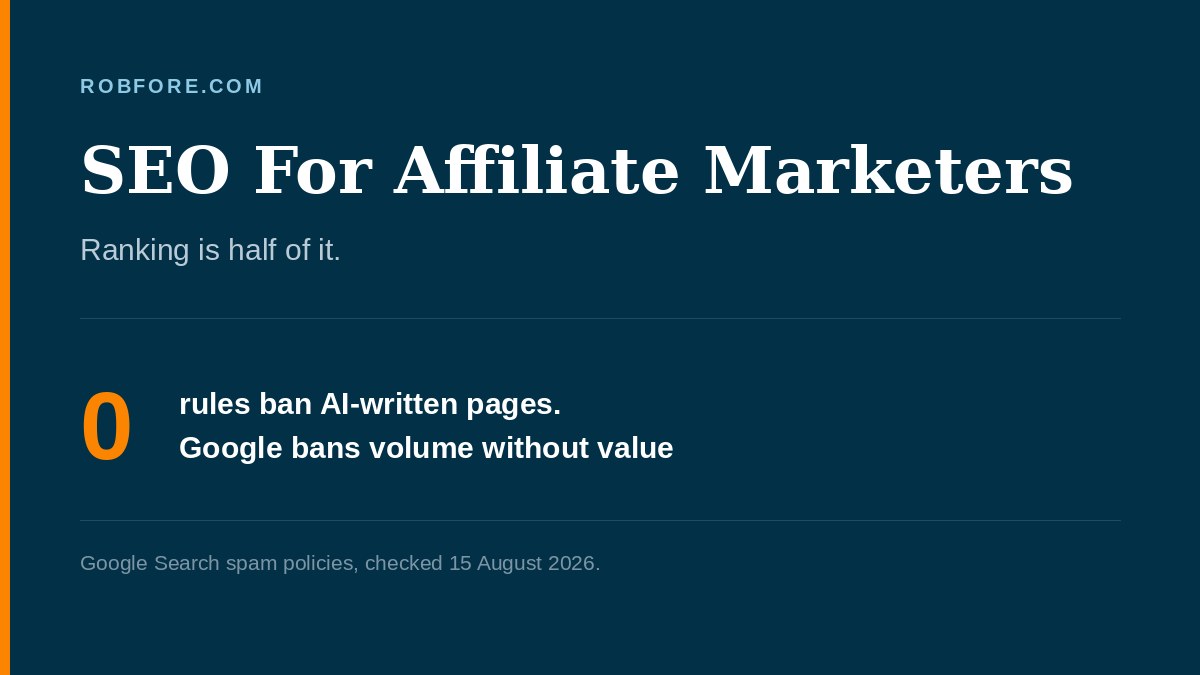
SEO for affiliate marketers still means earning rankings, and now also being quotable by AI assistants. Google's spam policy bans scaled content abuse: many pages generated primarily to manipulate rankings rather than help users. Sourced, dated, specific pages win both routes. Thin pages at volume lose both.
I have been doing SEO since the days when you could rank by repeating a phrase enough times.
That worked. Then it stopped working…
And roughly every tactic since has followed the same arc.
Here is what has not changed in thirty years: pages that answer a real question, specifically, win eventually.
Everything else has been WEATHER.
What Changed About Ranking?
The target widened. Ranking used to be the whole game and now it is about half of it.
When somebody asks an assistant instead of typing into a search box, the page that gets used is the one carrying a clean, self-contained, sourced answer. That is a different optimization target from ten blue links, and it rewards something affiliate content has been bad at for two decades: saying exactly what you mean, with a date and a source attached.
Which is convenient, because it is also what makes a page useful to a person.
So the work did not get harder.
It got more honest.
What Does Google Actually Ban?
Volume without value. Not AI, and not any particular tool.
From Google’s spam policies, scaled content abuse is “when many pages are generated for the primary purpose of manipulating search rankings and not helping users.”
The policy names the methods together: generating many pages with generative AI, scraping, stitching sources, spinning and translating to dodge duplication, and splitting an operation across domains to hide it.
Every one of those was a mainstream affiliate SEO tactic at some point. Article spinning WAS the industry for a while.
The pattern is worth internalizing. Each of those tactics worked - then became the thing being penalized.
The half-life gets shorter each cycle.
I went through the AI-specific version of this in affiliate marketing with AI.
What To Do Instead
Five things, none of them clever.
- One question set per page, answered thoroughly. Splitting near-identical intents across thin pages is the policy above, and it makes your own pages compete with each other.
- Answer in the first hundred words. Assistants cap how much they pull. Being early matters more than being complete.
- Source and date every number in the copy, not in a footnote. This is the highest-value habit available and almost nobody does it.
- Tables, not images, for data. Crawlers read table markup and do not read pictures at all.
- Link out to primary sources. Vendor pricing pages, the FTC, government releases. It reads as sourcing rather than as leaking traffic.
The entire method. It is unglamorous, it takes longer than a plugin, and it is durable in a way that no tactic on the banned list ever was.
What About Rankings Tools And Algorithm Updates?
People still search for the old landmarks - the named algorithm updates, the ranking checkers, the page rank scores.
Page rank as a public number is long gone. The named updates are history rather than a checklist. And ranking tools tell you where you sit today, which is useful for measurement and useless as a strategy.
I have no current tool recommendation, and inventing one would be worse than saying so. What I would spend the time on instead is reading your own pages and asking whether a stranger could act on them.
Disclosure Is Not Optional
Any page carrying affiliate links needs the disclosure above the fold, before the first link. The FTC’s endorsement guidance is clear and it is not a ranking consideration, it is a legal one.
It also reads as trustworthy, which never hurt a page anywhere. The FTC rules for affiliates has the full version.
Everything On This Page That Is Not Evidence
Method, mostly. Here is the honest inventory of what’s missing.
No tool recommendations and no link-building data, because I have not run a link campaign recently enough to tell you anything useful.
No traffic figures from this site either. The rebuild is underway as you read it, so everything here is method rather than a case study with numbers hanging off it.
Google’s policy page carries no stated introduction date. A last update of 15 May 2026 showed when I read it, which means I can tell you what the document says now and not when each clause arrived.
Then a scope problem worth naming. “SEO” covers very different jobs - technical, local, e-commerce, affiliate content - and they overlap far less than the one label suggests. This is the affiliate content slice and nothing wider.
And the big one. Whether any of this beats mass generation, I cannot tell you.
No A/B test. No comparison.
What I can say is which of the two approaches the published policy describes as spam, and that is a different claim, weaker and more useful.
Read This If You Are About To Publish Something
Two readers should keep going.
One writes affiliate pages and wants to know where the line actually sits. The line is in Google’s own documentation and it runs narrower than the rumors do.
The other has been publishing thin pages at volume and has more queued up. Read the policy section before any of them go live.
Two readers should stop here.
One came for tactics. There are none on this page that will still work in three years, which is precisely why there are none on this page.
The other will not go back and fix what he already published. Search rewards maintenance far more than it rewards launches, and a page you refresh beats a page you add - which is also the argument for publishing one piece a week instead of five.
If the question underneath all this is whether a blog still pays, that one has its own page and a shorter answer than you would expect.
SEO now is like being a good witness. Say what you saw, say when, say who told you, and do not embellish. The pages that survive every update are the ones that would still be true if nobody was ranking them.
Bless and be blessed,

SEO For Affiliates FAQs
Does SEO still work for affiliate sites?
Yes, and the target has widened. Pages now earn traffic by ranking and by being quoted in AI answers. Both reward the same things: a specific question answered clearly, with sources and dates attached, on a page somebody stands behind.
What does Google actually penalize?
Scaled content abuse, which Google defines as many pages generated for the primary purpose of manipulating search rankings and not helping users. Generative AI is listed as one method alongside scraping and spinning. The purpose is the violation, not the tool.
How many keywords should a page target?
One question set, answered thoroughly. Splitting near-identical intents across separate thin pages is the pattern Google's scaled content policy describes, and it also splits your own ranking between pages competing with each other.
Do I need backlinks to rank?
They help and they are not the whole game. Being mentioned and cited elsewhere matters, which is a broader activity than link building and includes video, podcasts and forums. I have no current link-building data of my own to offer.
How long does SEO take to work?
Longer than any honest person will promise. Search compounds, so the first year usually pays nothing and later years pay for it. If you need traffic this quarter, this is the wrong channel and paid or social will move faster.
Should affiliate pages disclose the relationship?
Yes, above the fold and before the first affiliate link. The FTC requires it and it is not a ranking tactic, it is a legal obligation. It also happens to read as trustworthy, which does no harm anywhere.
What is the single highest-value SEO habit?
Putting a named source and a date beside every number in the copy itself. It makes the page defensible, it makes it quotable, and almost nobody in affiliate content does it, which is exactly why it is worth doing.
Sources
- Google Search Central, Spam policies for Google web search - checked Aug 15, 2026
- FTC Endorsement Guides: What People Are Asking - checked Aug 15, 2026