
systeme.io Review 2026 (The 60% Is Not 60% Of The Price)
systeme.io states its plans run $0 to $97 a month with 0% transaction fees on every tier. The free plan carries 2,000 contacts, three funnels and one course, no card, no expiry. The affiliate program pays 60%, though VAT comes off first per their own help center, so a $17 plan pays $8.43 or $10.20.

Full disclosure: I’m an active systeme.io affiliate and I earn recurring commission on anybody who signs up through this page. That’s a real conflict of interest and you should read this with that in mind. So I’ve spent most of this review on the parts a commissioned reviewer normally skips: the clause that lets them cut my rate tomorrow, the 30-day hold nobody mentions, and the fact that the commission is not calculated on the price you see. Full disclosure
Let’s start with the part that costs me money.
The 60% Commission Is Not 60% Of The Price
I’ve been recommending this platform on the strength of a number that turns out to be incomplete.
Every review of this thing, including my own until today, runs the same arithmetic.
The Startup plan is $17. Sixty percent of $17 is $10.20. systeme.io’s own affiliate program page prints that figure, so it isn’t as if anybody was making it up.
Then you read the help center.
systeme.io’s help documentation states that VAT comes off first, and the 60% is calculated on what’s left. They print two worked examples on the same $17 plan, on a page they last updated 28 July 2026:
Personal purchase with VAT: $17 minus $2.95 (VAT) = $14.05. $14.05 x 60% = $8.43 commission.
Business purchase with 0% VAT: $17 minus $0 (VAT) = $17. $17 x 60% = $10.20 commission.
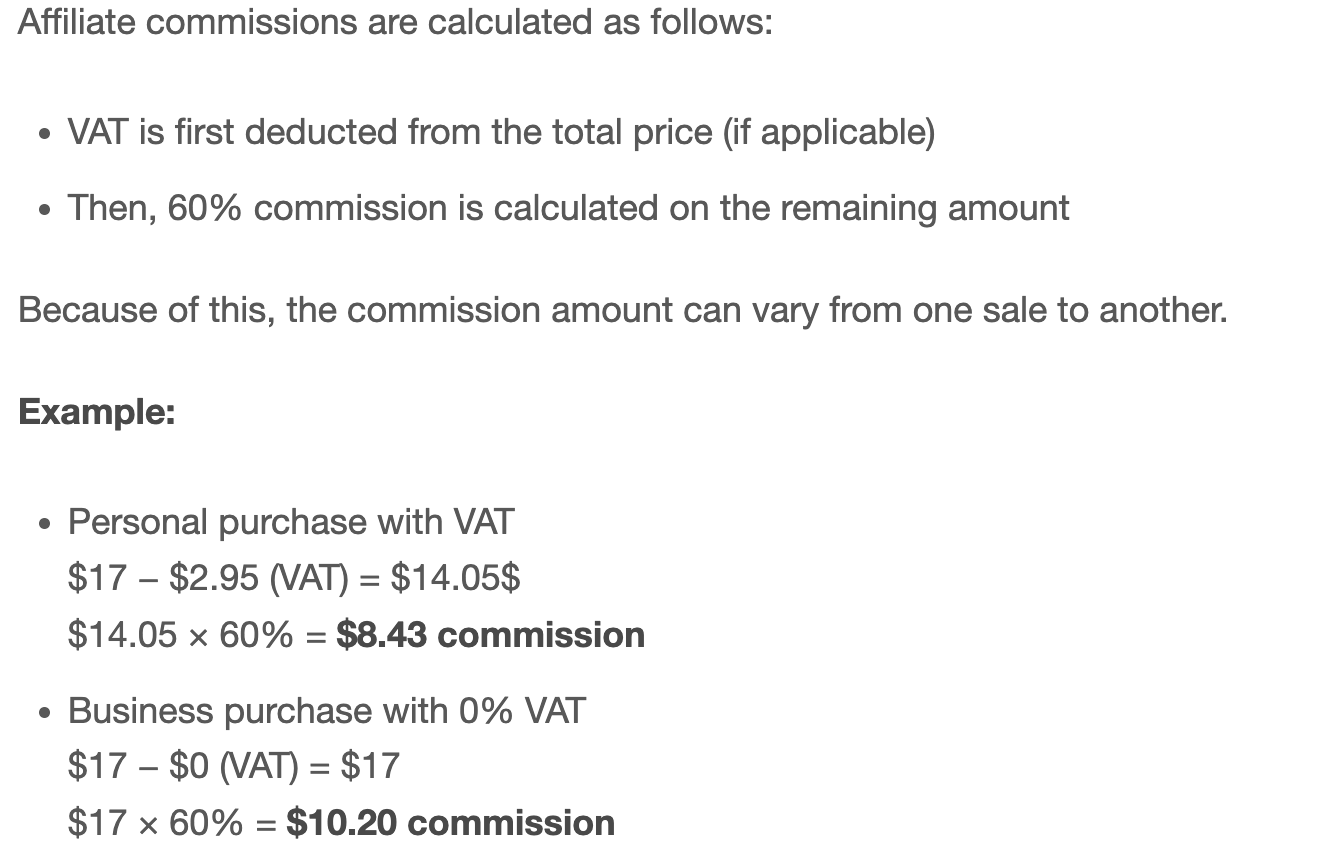
So $10.20 is real.
It is the best case, not the normal one.
Eight dollars and forty-three cents is what the same referral pays when the buyer is an individual in a VAT country, and that is most of them if you promote to Europe or the UK.
A 17% haircut, and which one you get is decided by somebody else’s tax status. Their affiliate page prints only the $10.20.
| What you refer | Business buyer, 0% VAT | Individual buyer, VAT applies | Difference |
|---|---|---|---|
| Startup, $17/mo | $10.20 | $8.43 | $1.77 |
| Webinar, $47/mo | $28.20 | not published | not published |
| Unlimited, $97/mo | $58.20 | not published | not published |
systeme.io publishes the VAT arithmetic only for the $17 plan. I’m not going to extrapolate it to the other two, because the VAT rate varies by buyer country and the company doesn’t show that math anywhere. So those cells say “not published,” which is the honest answer.
Here’s the part that matters more than the number.
Two systeme.io pages disagree with each other, and the one telling you the smaller number is the more recently updated one. That’s worth knowing about any vendor before you build a business on top of them.
What Does systeme.io Actually Cost?
Free, then $17, $47 and $97 a month, with two months free on annual billing. Every tier carries 0% transaction fees, which is the single biggest structural difference between this and most of what it competes with.
Now the caveat, because it’s a real one.
systeme.io’s pricing table does not exist in served HTML. I fetched their pricing page on 15 August 2026 and the entire plan comparison grid came back as untranslated template keys - components.price_element.plans.transaction_fees followed by four empty values, row after row. The prices only render for a browser running their JavaScript.
Where did I get the numbers, then?
From the static FAQ block at the bottom of the same page, which does serve, and which carries its own stamp: “Last updated: April 2026.”
So these are systeme.io’s published figures as of a four-month-old page stamp, read today. Not a rendered price table anybody can point at. I’d rather tell you that than pretend the sourcing is stronger than it is.
| Plan | Monthly | Contacts | Funnels | Courses | Transaction fee |
|---|---|---|---|---|---|
| Free | $0 | 2,000 | 3 | 1 | 0% |
| Startup | $17 | 5,000 | Unlimited | 5 | 0% |
| Webinar | $47 | 10,000 | Unlimited | Unlimited | 0% |
| Unlimited | $97 | Unlimited | Unlimited | Unlimited | 0% |
systeme.io’s own pricing FAQ, page stamp April 2026.
Check the current prices on systeme.io yourself, because a four-month-old page stamp is exactly the kind of thing that moves without anybody announcing it.
That’s my affiliate link.
Verify me. Please.
One aside while we’re here, because it confuses people. You’ll see this written systeme.io, systeme io and system io. Same product.
The dot gets dropped constantly and the misspelling pulls real search volume of its own, which tells you something about how most people arrive at it.
The only thing that meters is contact count.
Not email volume. You can mail your list every day on the free plan and systeme.io doesn’t care, which is genuinely unusual and worth understanding if you’ve ever been billed by send volume.
If you want the wider picture of what a funnel actually needs to do, I wrote that up separately in funnels and landing pages.
What Do You Get On The Free Plan?
2,000 contacts, three sales funnels, one course, one blog, one custom domain and unlimited email sends, with no credit card and no expiry date. systeme.io states this on their pricing FAQ.
A real free tier. Not a trial wearing a costume.
One thing that list does not tell you, and you will find out the moment you try to send: those unlimited emails cannot go out from a Gmail address. systeme.io states that “as of July 16, 2024, it is no longer possible to use an @gmail.com address to send emails to your list via systeme.io,” on a page they last updated 9 April 2026. The block is deliberate, it is enforced in the interface, and it applies to automation-rule emails the same as broadcasts.
Gmail is not the only one.
The same article lists Yahoo, laposte.net, Zoho and ProtonMail as prohibited, each for the same underlying reason: those providers publish DMARC policies that tell receiving servers to reject or quarantine mail sent on their behalf from somebody else’s platform.
There is one live exception, and systeme.io tells you not to take it. Microsoft’s free domains are still technically accepted as sender addresses: Outlook, Hotmail and Live, including the .fr variants of each. systeme.io’s own wording is “even though these domains are currently allowed, we strongly advise against using them,” because deliverability suffers. Treat it as a way to finish a test you already started, not as a setup you keep.
There is a second requirement that catches people, in the domain-authentication article: the domain has to have a working site on it. A domain that answers with a 404 gets its mail blocked at the receiving end.
Park it, and it bounces.
The rule is about who controls the domain, not what it costs or what it ends in. systeme.io’s own worked example in that article authenticates sio-team.live, an ordinary registered domain on a cheap TLD, and it passes for the same reason robfore.com would. What fails is a mailbox on somebody else’s domain, because you cannot publish DNS records for gmail.com.
Own a domain already? Twenty minutes with three CNAME records and a DMARC record.
Nobody who does not own one gets away free, though. A domain on a low-cost TLD runs a few dollars a year, so budget that before you count this tier as truly zero.
I want to be precise about the word “free,” because this industry has ruined it. A trial is free until day fourteen. A freemium plan is free until you need the thing you actually came for. systeme.io’s free plan has no clock on it at all, and the features that are gated are gated by quantity rather than by capability.
Three funnels is enough to launch an offer.
2,000 contacts is enough to find out whether anybody wants it. And if you cancel a paid plan later, systeme.io states contacts above the 2,000 line get archived rather than deleted, so you’re not held hostage.
Most people hit the contact ceiling before they hit a feature ceiling. That’s not an accident, it’s the business model, and it’s a more honest business model than metering the thing you already paid for.
Open a free systeme.io account here and see for yourself. That’s my affiliate link, so I get paid if you upgrade later, and it costs you nothing either way.
No card. No clock.
How Does systeme.io Compare On Price?
Cheaper than everything in its category at the entry tier, and the transaction fee is where the real gap sits. Here’s every competitor I could price off the vendor’s own page on 15 August 2026.
| Platform | Entry plan | Monthly | Annual equivalent | Transaction fee | What you get |
|---|---|---|---|---|---|
| systeme.io | Startup | $17 | 2 months free | 0% | 5,000 contacts, unlimited funnels, 5 courses |
| GetResponse | Starter | $19 | $15.58 | not stated | Email, landing pages, 1 automation |
| Kartra | Essentials | $59 | $52 | 5% of sales | 500 contacts, 5 pages, 1 product |
| ClickFunnels | Launch | $97 | $81 | 0% | 10,000 contacts, unlimited funnels, 3 courses |
| GoHighLevel | Starter | $97 | $970/yr | not stated | 3 sub-accounts, unlimited contacts |
| Leadpages | Grow | $99 | 20% off | not stated | Unlimited pages, 4 domains, A/B testing |
| Kajabi | Basic | $179 | $143 | 2% on third-party | 2,500 contacts, 5 products, 1 community |
Every figure read from the named vendor’s own pricing page on 15 August 2026. Annual columns are the vendor’s own advertised annual-billing rate.
Four things in that table are easy to miss, and three of them are traps.
ClickFunnels’ page defaults to the annual toggle, so $81 is the first number you see. The monthly rate is $97. I’ve broken down that matchup properly in systeme.io vs ClickFunnels.
Kartra’s $59 tier takes 5% of your sales on top of the subscription. Sell $4,000 in a month and Kartra’s cheap plan just cost you $259, not $59. That fee drops to 0% only at $119.
Kajabi’s cheapest plan isn’t Basic. There’s a Starter tier visible in their comparison chart at 250 contacts and a 5% third-party payment fee, and its price does not render anywhere in the served HTML. So I can’t tell you what Kajabi costs at the bottom, and neither can their page.
Leadpages is two products now. The “$10” you’ll see quoted is HTML Pub, a publishing tool. Leadpages proper starts at $99.
And one I genuinely could not check: Carrd. Three fetches of carrd.co/pricing on 15 August 2026 returned a body containing nothing but the URL string.
No plan names, no prices. I could not confirm Carrd’s pricing and I’m not going to quote it from a review site, so it’s absent from the table rather than guessed at.
That’s the honest state of it.
The Parts Of This Review You Should Discount
Four of them.
The last one is the one that would actually cost you money.
The page builder is fine, not good. If you’ve used ClickFunnels or Leadpages you’ll find it stiffer and less forgiving. Not broken. Just noticeably less polished, and you’ll spend longer nudging things into place.
Deliverability is shared and you can’t do much about it. systeme.io’s own help center has an article about whether you need a dedicated IP, which tells you how often it comes up. If email is the core of your business, read email marketing for affiliates and understand what you’re accepting before you migrate a list you care about. For heavy cold sending, this is the wrong tool entirely. GMass on top of a Google Workspace account is the better trade, and it lives or dies inside Google’s own sending limits.
The pricing table doesn’t render for crawlers. I covered this above but it belongs in the limitations too. A company whose own price grid is invisible to anything without JavaScript is a company that will be quoted inaccurately across the web for years, and some of those wrong numbers will end up in front of your prospects.
The commission rate can be changed at will, and the contract says so in one sentence.
That’s the next section. It deserves its own.
Is The “Lifetime” Commission Actually Contractual?
The attribution is. The rate is not. Those are two different promises and only one of them is written down in a way that binds anybody.
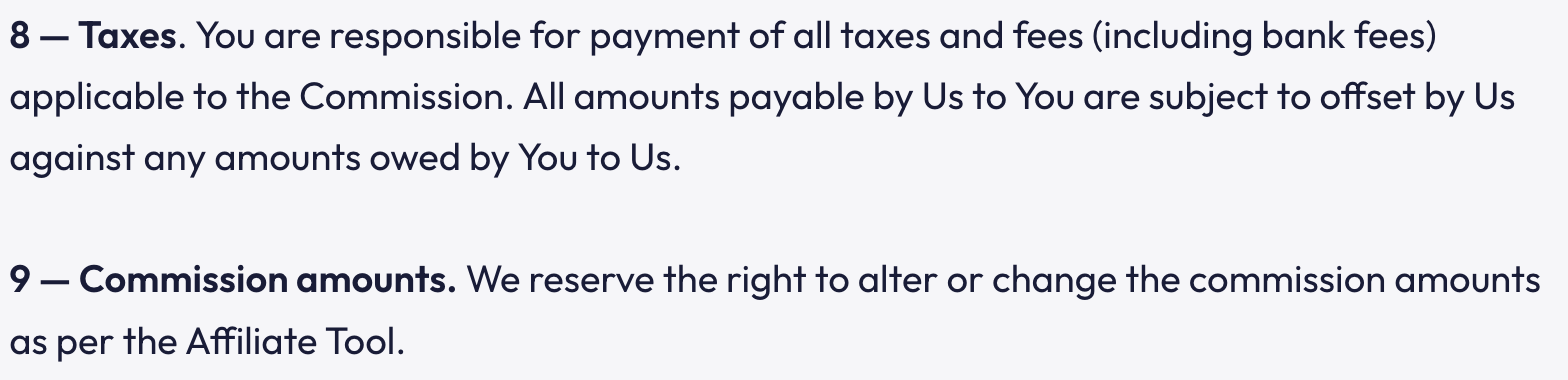
Here’s clause 9 of the affiliate agreement, verified character for character on 15 August 2026:
9 - Commission amounts. We reserve the right to alter or change the commission amounts as per the Affiliate Tool.
That’s the whole clause. One sentence.
No notice period.
No floor. No grandfathering of referrals you already brought in. They could take 60% to 20% on a Tuesday and the people you referred in 2024 come down with it.
Now the credit, because it’s real and it’s improved. The same agreement states that once a lead signs up for a free account through your link, you’re their affiliate for life, with one carve-out: if they later buy through a different affiliate’s payment-page link, that affiliate takes it. An older edition of this agreement expired each lead one year after the click. That clause is gone.
So the attribution genuinely got better. The rate behind it was never fixed to begin with.
Two more things I found in that document that nobody quotes.
The agreement carries no date. No effective date, no “last updated,” no version number, anywhere on the page. Meanwhile systeme.io’s pricing page and affiliate program page both end with “Last updated: April 2026.” The contract is the one document with no vintage on it.
Section 6 uses a term it never defines. “We will have no obligation to pay You Commission associated with a Forfeited Transaction.” Capitalized, twice, like a defined term. It is not in the agreement’s Definitions block and I could not find it defined anywhere else on that page on 15 August 2026. An undefined capitalized term inside a forfeiture clause is the kind of thing you notice once and then can’t stop noticing.
None of that makes this a bad program. It makes it a revocable one. Know which you’re building on.
If you want the wider frame on what you can and can’t say while promoting any of this, that’s FTC compliance for affiliates.
When Do You Get Paid?
On the 10th of the month, once your balance exceeds $30, after a minimum 30-day holding period. systeme.io’s own worked example is a purchase on 13 February paying out on 10 April.
That’s 56 days. Not ten.
I had the payout terms wrong on this page before today, and so does most of the internet, because the marketing page and the help center don’t agree. systeme.io’s affiliate program page says flatly:
There is no waiting period after a referral converts.
The help center says:
There is a minimum 30-day holding period before commissions are paid out.
You can reconcile them if you squint - one is about crediting your balance, the other about money leaving the building. A reader taking the marketing page at face value would still plan their cash flow wrong. Both pages were live on 15 August 2026.
| Term | What systeme.io states | Where |
|---|---|---|
| Rate | 60%, single tier | Agreement, program page, help center |
| Threshold | Must exceed $30 | Help center, article 162 |
| Schedule | 10th of each month | Help center, article 162 |
| Hold | Minimum 30 days | Help center, article 162 |
| Methods | PayPal or bank transfer | Help center, article 162 |
| Cookie | Expires after 1 year | Help center, article 162 |
| Attribution | Life of the lead, from free signup | Affiliate agreement |
| Self-referral | Forbidden | Help center, article 162 |
All from systeme.io’s own pages.
That cookie line deserves a sentence.
systeme.io states the tracking cookie expires after a year, and also states that tracking doesn’t depend on the cookie, because the affiliate ID is bolted to the referral’s email address and re-injected into every email they send. Both statements are on the same page. The practical read: if they sign up for a free account through your link, you’re covered. If they only ever clicked, you’ve got a year.
What systeme.io Does Not Publish
No affiliate income disclosure. None. No median, no distribution, no percentage earning nothing, no time to first commission.
I checked for one specifically. It isn’t there.
Nothing legally requires a software company to publish an affiliate income disclosure and most of them don’t, so this isn’t an accusation. But it is a fact you’re entitled to before you spend six months building content around somebody’s product.
What they publish instead is per-referral arithmetic. Their affiliate page quotes “$10.20/month per active referral,” “$58.20/month per active referral,” and “If you refer 10 people to the Unlimited plan, that is $582/month in recurring income,” alongside an unaudited headline of “Over $5,000,000 in commissions paid to our affiliates,” all. That’s arithmetic, not a projection. It assumes ten referrals who all buy the top tier, all pay zero VAT and all stay subscribed.
Not one of those figures carries a denominator. No median, no share earning nothing, and the $5,000,000 is cumulative over the life of the program, so it tells you nothing about what a typical affiliate makes.
Compare that to a company that does publish. When I reviewed The Home Business Academy I could quote their disclosure and tell you their median active affiliate earned exactly $0 across a full year. That number is unflattering and it is enormously more useful than “$5,000,000 paid.”
For what the numbers look like across this whole category, make money online 2026 walks through the disclosures that do exist. The short version is that the median is usually zero, and any program that doesn’t publish one should be assumed to be no different until it shows you otherwise.
So what would one referral be worth?
At $8.43 a month on a VAT-liable Startup referral, you’d need four active referrals to clear the $30 payout threshold, and they’d need to stay subscribed. That’s arithmetic, not a projection. It assumes the referral stays on the $17 plan, that the sale is VAT-liable, and that the rate doesn’t change - and clause 9 says the rate can change. systeme.io publishes no data on how long a referral typically stays, so I can’t tell you the number that would actually matter. See my full earnings disclosure.
At Zero Dollars, Who Should Not Bother?
Start with the people who should close this tab, because the free plan makes everyone else’s decision easy.
Your business is cold email? Wrong tool, different problem, and the deliverability section above names what to use instead.
You need one specific integration? Check it before you migrate, never after. The all-in-one trade is always the same trade: you accept somebody else’s version of eight tools instead of picking eight best-in-class ones.
You want a design tool? The builder is functional. Where pixel control is how you compete, you will fight it every single day.
Everybody else, keep reading.
It fits you if you’re starting from zero and you’d rather test an offer than furnish a business. The free plan is genuinely enough to find out whether anybody wants what you’re selling, and finding that out costs you nothing but time. That’s rare and it’s the strongest thing about this product. Start on the free tier and you’ll know inside a week whether the builder annoys you.
It fits you if you’re paying for three tools that don’t talk to each other. Funnel builder, email platform, course host. If that stack is running you $150 a month and none of it is integrated, systeme.io at $17 or $47 is a serious conversation.
It fits you if you sell digital products and you’re tired of transaction fees. 0% on every tier against Kartra’s 5% at the entry level is real money at any volume.
And it does not fit you if you’re picking a platform because its affiliate program pays well. Which brings me to the last thing.
What I Use It For, And Why
I’ve been marketing online since 1996, and the pattern I’ve watched play out for thirty years is that people choose their tools based on what the tool pays them rather than what the tool does. That’s how you end up with a business built on a rate somebody else can change in one sentence.
You don’t build a house on somebody else’s land because the rent is cheap this year.
I use systeme.io because the free tier let me test offers without a line item, and because 0% transaction fees on a digital product is a structural advantage rather than a promotional one. The 60% is a nice thing about a tool I’d already be using. It is not the reason, and after today’s reading it’s 17% less nice than I told you last week.
That’s the correction. I’d rather issue it than have you find it in month four.
If it’s the right tool for what you’re building, the free plan is here. If it isn’t, the table further up names six alternatives with their real prices and their real fees, and two of them beat it on things systeme.io does badly. Go use one of those instead.
Bless and be blessed,

Sources
- systeme.io pricing page and pricing FAQ (page stamp: April 2026) - checked Aug 15, 2026
- systeme.io affiliate program page (page stamp: April 2026) - checked Aug 15, 2026
- systeme.io affiliate agreement, clause 9 (page carries no date stamp) - checked Aug 15, 2026
- systeme.io help center, how the affiliate program works (page stamp: 28 July 2026) - checked Aug 23, 2026
- systeme.io help center, affiliate link tracking (page stamp: 8 January 2026) - checked Aug 15, 2026
- systeme.io help center, is it possible to use a personal email address to send emails (page stamp: 9 April 2026) - checked Sep 9, 2026
- systeme.io help center, how to authenticate your domain name for email sending (page stamp: 25 August 2026) - checked Sep 9, 2026
- ClickFunnels pricing page - checked Aug 15, 2026
- Kajabi pricing page - checked Aug 15, 2026
- Kartra plans and pricing (served as a split-test variant, noindex) - checked Aug 15, 2026
- GetResponse pricing page - checked Aug 15, 2026
- Leadpages pricing page - checked Aug 15, 2026
- GoHighLevel pricing page - checked Aug 15, 2026