
Social Media Marketing 2026 ($117.7B, And It Passed Search)
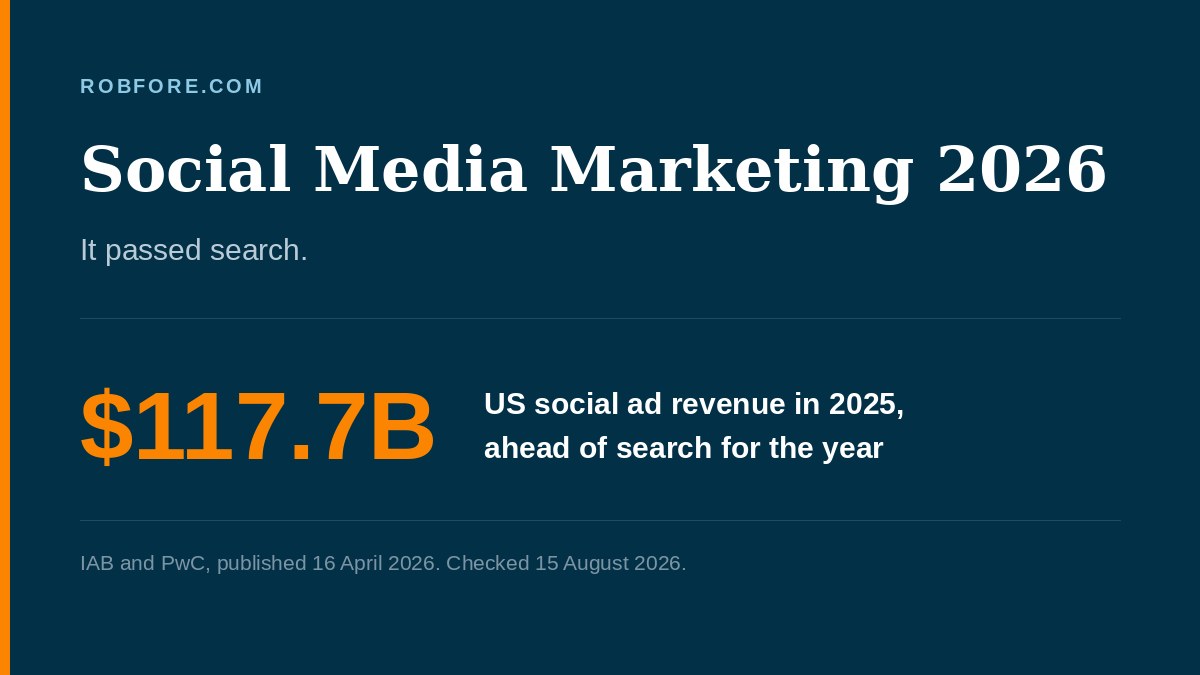
US social advertising revenue reached $117.7 billion in 2025, up 32.6%, overtaking search for the first time in the IAB and PwC report published 16 April 2026. Meta alone reported 3.60 billion daily active people in June 2026. The audience and the money are both there. What you do not get is ownership.
Something happened in 2025 that most social media advice has not caught up with.
Social advertising passed search.
IAB and PwC put US social advertising revenue at $117.7 billion for 2025, up 32.6%, against search at $114.2 billion, in a report published 16 April 2026.
The money moved because the attention moved first.
It always does.
Where The Money Went In 2025
Into social, faster than into anything else on the board.
| US ad revenue, 2025 | Amount | Growth |
|---|---|---|
| Social | $117.7 billion | 32.6% |
| Search | $114.2 billion | 11.0% |
Two caveats I am not going to bury. These are US figures, and IAB’s categories overlap - a video ad inside a social feed counts in more than one row - so this is not a clean pie chart and the report says so itself.
What it does tell you cleanly is the growth rate…
32.6% against 11.0%.
Not a small lead. A category pulling AWAY.
Is The Audience Still There?
Yes, and the scale is documented rather than estimated.
Meta’s own second-quarter filing, covering the three months to 30 June 2026, reports 3.60 billion daily active people across the Family of Apps, up 3% year on year.
So the audience question is settled.
It has been for a decade.
The interesting number in that filing is a different one. Average price per ad rose 12% year on year while impressions rose 14%. More inventory, higher prices anyway, which means advertisers are bidding harder for the same attention.
Social is not getting less effective. It is getting more expensive, which is a different problem and a more manageable one. I went through what that means for one platform specifically in the Facebook marketing hub.
What Are The Disadvantages Of Social Media Marketing?
There is really only one, and every other complaint is a symptom of it.
You do not own any of it.
Not the audience, not the reach, not the rules. A platform can change all three tomorrow, without notice, without appeal and without owing you an explanation. People who built entire businesses on a single network have found this out roughly once every three years since 2009.
Rented ground.
Not an argument against using it. Rented ground can be excellent ground - and 3.60 billion people is a lot of ground.
It is an argument against building the barn there.
What you own is the list sitting on infrastructure you control, and a site with your name in the URL. The rest is a driveway you are allowed to park in.
Does Organic Reach Still Work?
It does, and you will not get a percentage out of me, because nobody honest has one.
No major platform publishes organic reach figures. Every “average reach is X%” figure in circulation started life as one agency tallying up its own client accounts. That is real data about those accounts and it is not a benchmark for yours.
What I will say from experience is that formats generating replies outperform formats generating impressions, and that conversation still happens on profiles and in groups rather than on business pages.
Test it before you believe it. That is a pattern I have noticed across my own network, which is not the same as having measured anything.
What Holds Up On Social
Three things, and none of them is a platform-specific tactic that will date in a year.
Pick one and stay. Which platform you choose is close to irrelevant next to whether you are still showing up in month eleven. Every platform in that table has people making a full-time living on it.
Move people off it. Everything on social should eventually point at something you own. Email is the cheapest way to own an audience and Gmail’s sending limits are the practical ceiling once you do.
Say something checkable. Sourced, dated, specific posts travel further than encouragement, and they are the only kind that get quoted anywhere else. Same principle as affiliate marketing with AI.
Where This Falls Short
No platform tactics, no posting schedules, no algorithm advice. All of it dates within a year and most of it was never measured. This page is about where the channel sits, not how to work any specific network.
I have no meaningful paid social experience. The ad figures here are documentation, not testimony. I have said the same in the YouTube post and internet marketing basics, and it is still true.
The IAB figures are US only and the categories overlap. They do not transfer to another market and they do not sum to a total.
Meta is not all of social. The 3.60 billion is Meta’s Family of Apps. Other networks publish less, or differently, and I have not tried to reconcile them.
Organic reach is undocumented. Everything I said about profiles and groups is experience, not data. If somebody shows you a reach benchmark, ask whose accounts it came from.
Who This Is For, And Who It Isn’t
It fits you if you are deciding how much of your effort belongs on social. The answer the data supports is: a lot of your attention, none of your infrastructure.
It fits you if you have been treating a page as an asset. Not one. The list is.
It does not fit you if you want platform tactics. Wrong page, and honestly wrong site.
It does not fit you if you need a reach or cost benchmark. Neither exists in a form I would stand behind.
Social media is a market square. Enormous, free to walk into, and somebody else owns the square, sets the opening hours and decides tomorrow whether your stall is still by the entrance.
Trade there. Just keep the warehouse somewhere you hold the deed.
Bless and be blessed,

Sources
- IAB and PwC Internet Advertising Revenue Report, Full Year 2025 - checked Aug 15, 2026
- Meta Platforms, Second Quarter 2026 Results - checked Aug 15, 2026