
Mindset And Consistency 2026 (The 3% Who Actually Produce)
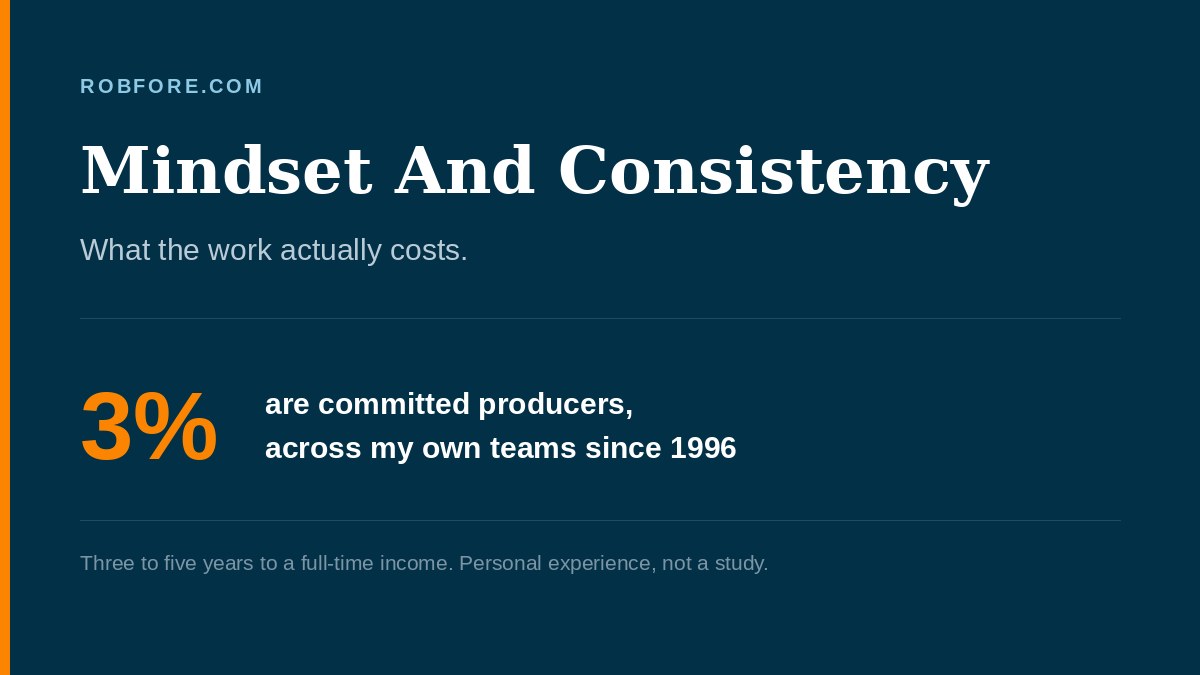
Most people who start this never produce. Across my own teams since 1996, committed producers have never been much more than 3%. A real full-time income takes three to five years, and it costs money before it makes any. Consistency is not motivation. It is doing the exposures after the excitement is gone.
In December 2008 my older son Tony and I did a fourteen-day breakthrough training that ended with walking forty feet across red-hot coals.
We both came out of it as Certified Advanced Firewalk Instructors.
It did not build my business.
That is the least popular sentence I could open a mindset page with…
It is also the one that would have saved me the most time if somebody had said it to me first.
What Does Consistency Cost You?
More than motivation, and in a currency most people have not budgeted for.
Here is the honest entry price. The timings and the exposure counts are my own experience over thirty years rather than a study. The cost row is the exception: it is checked against the tool and program pricing published on this site.
| What | Reality |
|---|---|
| Time to a real full-time income | Three to five years |
| Minimum intense focus before momentum | Six to twelve months |
| Cost before income | $0 to $97 a month at systeme.io, $10 to $160 at HBA, $97 and up at ClickFunnels, plus a learning curve |
| Exposures, part-time | About 2 a day |
| Exposures, somebody serious | 10 to 30 a day |
That last row is the whole thing. It is why this page is about consistency rather than mindset alone.
Exposures are the leading indicator.
Everything else is lagging.
You cannot control whether somebody says yes. You can control whether you made the approach, and that number is countable today rather than in eighteen months.
How Many People Actually Produce?
About 3%.
Most of a team never does anything at all. That is not cynicism, it is arithmetic I have watched repeat across three companies since 1996.
Roughly 5% to 8% will sponsor a few people, wait to get rich, get discouraged, and leave. About 3% turn out to be committed producers.
Those 3% are your leaders.
Everybody else is a customer who signed the wrong form.
I want to be careful about that number. It is my own experience across my own teams, not an industry study, and I am not going to dress it up as research. What I can point at is corroboration from documents companies publish themselves: OPTAVIA’s 2025 US disclosure reports 23.28% of its coaches earned nothing at all, and I went through eleven more of those in the income disclosure roundup.
The shape is consistent everywhere it gets measured. A small group produces. A large group does not.
Why Do Most People Quit?
Because the math is genuinely against them early, and quitting is a reasonable response to it.
Money goes out before money comes in. The feedback loop is slow enough to be indistinguishable from silence. And nobody tells you the timeline honestly at the start, so month nine feels like failure rather than schedule.
Building a business slowly is painful. I did that for a long time.
So when somebody stops after a year, the useful question is not what was wrong with them.
It is whether anybody ever told them a year was normal.
That is why I put the numbers on this page. Not to discourage you - to make month nine survivable.
The Firewalk, And What It Did Not Fix
I would much rather walk across forty feet of 1500 degree, third-degree-burn-worthy coals than work for someone else. A real position, and I hold it.
The training was genuinely valuable. It moved something.
But it moved an OBSTACLE.
It did not produce a result.
Knowing that is worth more than the coals were. Same goes for every breakthrough weekend, every seminar and every book on the shelf. They move the rock out of the road. None of them does the exposures for you on a Tuesday in February.
So my honest position on mindset training is: some of it changed how I operate, none of it built the business, and whatever gets sold to you as the missing piece is usually the wrong piece. There is a fuller version of that argument in MLM training and who is worth learning from.
I do not think there are a set number of steps to success. There are principles. Like gravity.
Four Steps, No Fifth
Four steps, and I have never found a fifth worth adding.
- Determine specifically what you want. Not “more income.” A number, a date, and what it is for.
- Take action. Exposures, daily, counted.
- Assess the results. Honestly, on a schedule, in writing.
- Change course if necessary. The plan is a hypothesis, not a vow.
Then two habits that carry the whole thing.
Model somebody producing the result. Find a person currently getting what you want and copy what they do. Unglamorous and by far the fastest route.
Work with the willing. You cannot want it harder than they do, and trying is where most people’s year goes. Spend your hours on people who are moving, and be available to everybody else without chasing them.
Consistency is like stacking firewood before winter. Nobody photographs it, no single armful matters, and the only question in February is whether the pile is there. You cannot cram it in November.
Where This Falls Short
The 3% figure is mine, not research. It comes from my own teams across three companies since 1996. I have never seen an independent study that measures it the same way, and I am not going to borrow one that measures something else.
Three to five years is my experience, not a forecast. It is not a promise, a projection, or a timeline for you. Your offer, market and effort decide that and I cannot see any of them.
I have not published income figures here on purpose. Anything I earned would not be typical, and putting it beside a page about persistence would turn a realism page into an advert. The earnings page covers that position.
Survivorship bias runs through all of this. I am somebody who kept going, writing about the value of keeping going. The people who stopped are not here to tell you what they saw, and they may have been right to stop.
“Mindset” is a crowded word. Nothing here is psychology or clinical advice. If the thing stopping you is not a scheduling problem, this page will not help and something else might.
Who This Is For, And Who It Isn’t
It fits you if you are somewhere between month six and month twenty-four and wondering whether the silence means failure. Usually it means month nine. The numbers at the top are there so you can check.
It fits you if you keep going back to the same unresponsive people. Letting that go frees more hours than any productivity system will.
It does not fit you if you want to be told it is quick. Three to five years is the honest figure and I would rather lose you here than at month nine.
It does not fit you if you are looking for a breakthrough weekend to fix it. I have done the fourteen-day version and walked the coals. It removed an obstacle. The exposures were still mine to make on the Monday.
Pick the smallest number you will actually hit every week. Then hit it in a week where nothing goes right.
That week is the one that decides it.
Bless and be blessed,

Sources
- Rob Fore's own teams across three network marketing companies since 1996. Personal experience, not an industry study - checked Aug 15, 2026
- OPTAVIA 2025 U.S. Income Disclosure Statement (doc OPTAVIA_LRN_IDS_033126) - checked Aug 22, 2026
- US Bureau of Labor Statistics, 1-year survival rates for new business establishments - checked Aug 15, 2026
- Tool and program pricing published on robfore.com, the source of the cost row - checked Aug 15, 2026