
MLM Gurus and Training: The Fix After the System Didn't Work
Generic guru training fails because it cannot answer the questions that decide your result: your company, your market, your message, your hours. Learn from practitioners currently producing results, then use AI to fit their proven models to your product and audience. Spend your budget on execution, not information.
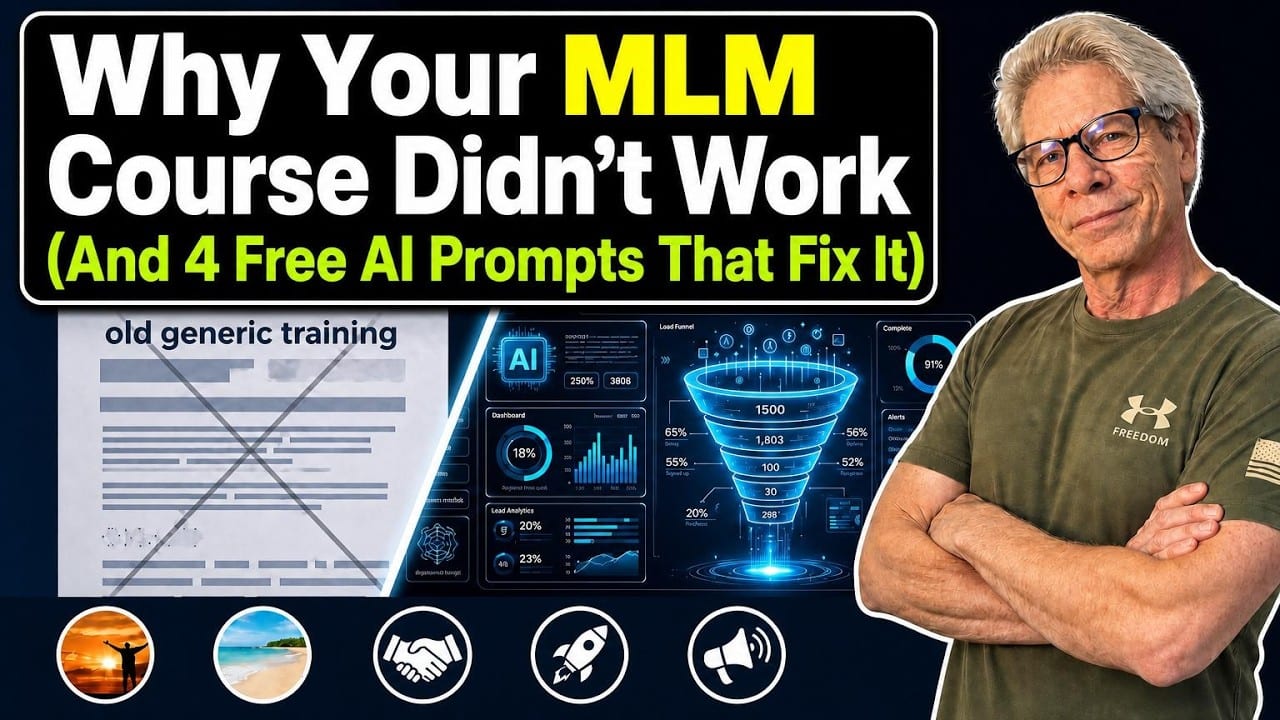
You bought the course. You watched the modules, filled in the workbook, maybe joined the Facebook group.
And nothing moved.
Full disclosure before we go one step further: near the end of this page I recommend a $67 product I sell. Everything before that point works without buying anything, from me or anybody else.
Here is the part nobody selling training will tell you. The material probably was not wrong. It was generic, and generic is a different kind of wrong. A funnel template written for everyone selling everything cannot answer the only questions that were ever going to decide your result: what do I say about MY product, to MY market, with MY fifteen hours a week?
You did not fail the training.
The training never met your business.
Why Didn’t the Training Work?
Because advice that fits everybody fits nobody.
And the training industry is built, structurally, to sell the fits-everybody kind. Follow the money and you can see why.
Think about the economics from the seller’s side. A course written once sells ten thousand times. A plan built for one person sells once. So the market produces courses, and every course has to stay general enough that a candle distributor in Ohio and a crypto affiliate in Manila can both feel it was written for them.
Neither one can run it as written.
Like buying a topographical map because you are climbing a mountain, and discovering at the trailhead that it is a beautifully drawn map of a different mountain. Nothing on the paper is false. None of it gets you up your hill.
So the buyer stalls, blames themselves, and eighteen months later buys the next map.
I know that loop personally, and my tuition ran well past the price of a map.
Lisa and I went all-in with a company called Empower Network. We spent thousands climbing the training ladder, and every rung of it was generic. The company-issued funnels were the same funnel, run by every affiliate at once. And when affiliates got tired of that, they built their own funnels to use and to resell, and those were generic too - the same promises in different fonts, because anything built to sell to the whole downline has to be.
You know what finally worked? Building our own funnels and our own bonus stack, around what we specifically could offer that every other affiliate running the identical page could not.
The profit showed up on the far side of that switch, and not a day before. And I will attach the attrition to that sentence, because it belongs there: most of the people we watched in that company never made the switch, and most of them never made money either. I do not think those are two separate facts.
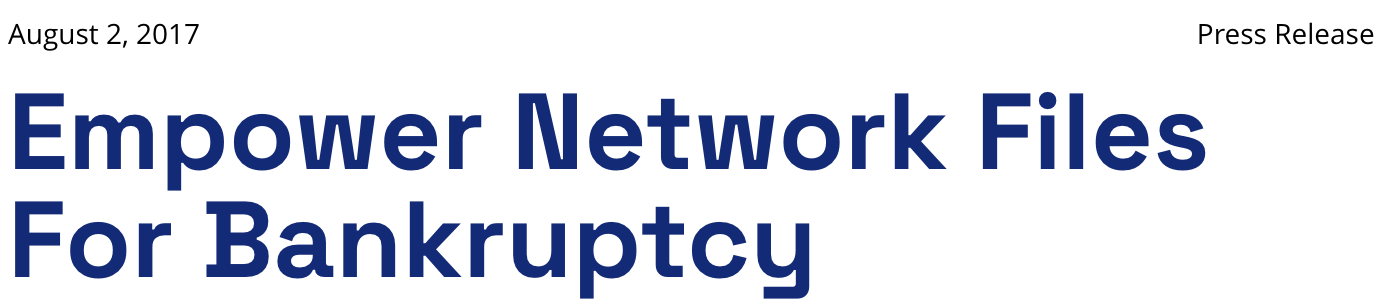
And you should know how the story ends, because your due diligence will find it anyway. Empower Network announced its bankruptcy in August 2017 and closed. The generic machine did not just fail its affiliates. It eventually failed itself.
The Guru Business Model, in One FTC Case
If you want to see the generic-training machine at full scale, the regulator already documented it.
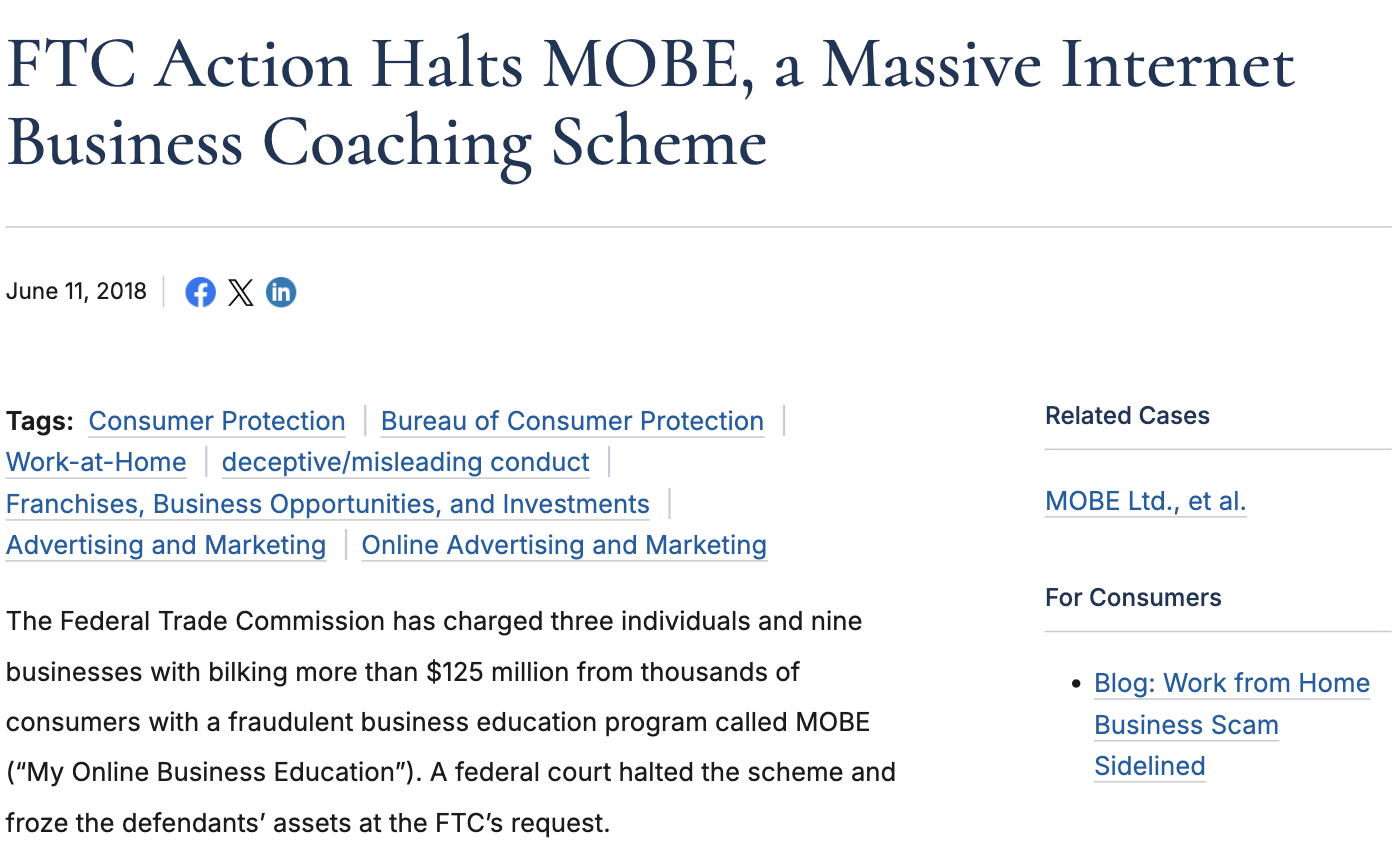
In June 2018 the FTC shut down MOBE, a business coaching operation it charged with taking more than $125 million from consumers. The pitch was a “proven 21-step system” for making money online. Entry cost $49. The 21 steps turned out to be, in large part, a sequence of pitches for memberships costing thousands more, and the FTC complaint says most buyers never recouped their costs. That is all from the FTC’s own June 2018 press release.
Read that pitch again. Proven. System. Steps.
The words are doing the selling, and none of them mention your product, your market or your life, because the machine cannot know them.
And this is not ancient history. In April 2026 the FTC resolved two actions by stipulated order against individual MLM participants, not companies, over deceptive earnings claims: one against a high-level participant on 13 April, and one against two LifeWave distributors on 27 April. The hype economy is alive. And now the sellers of it are personally on the hook.
Read that twice.
None of this means every trainer is running a scheme. Most are decent people selling honest generic material.
It means the burden of fit was always on you, and nobody said so at checkout.
Who Is Worth Learning From Now?
People who are doing the thing right now, in public, where you can check.
Not people who once did it. Not people whose entire income is teaching it. Practitioners, with current output you can inspect: their videos, their pages, their emails, their offers. When somebody’s method is visible in what they publish, you do not have to trust their sales page. You can audit their behavior.
That standard filters hard.
Apply it to any guru you are considering and watch how many survive.
And run it on me before you run it on anybody else. Do I currently produce the result I teach? Partly. This site and the channel are the doing, in public, and you can inspect every page. Does my income come from doing or from teaching? Both, flat out: I promote HBA, I sell a $67 plan, and teaching is part of how I get paid. When did I last build in current conditions? I shut everything down for roughly eighteen months and came back in 2025, so what you are reading was built under today’s rules, and the eighteen dark months are on my record too.
Score me however you like. A test that cannot bruise the person handing it to you was never a test.
Here is what it looks like in the one program I promote. When I went through the Home Business Academy’s numbers for my HBA review, the people at the top had mostly spent five to seven years building, and most brought an existing audience with them. Meanwhile the median active affiliate in HBA’s own earnings disclosure earns zero dollars.
Both facts, one page.
Slow at the top. Zero at the median. Published where anyone can read it, which is the part almost nobody does.
A seller who shows you that kind of number is worth your attention. A seller who shows you only wins is showing you marketing. The income disclosure math runs the same pattern across the whole industry if you want the full picture.
Generic Training vs. a Specific Plan
Here is the switch this whole page argues for, with both options standing next to each other.
| Generic training | A plan built for your business | |
|---|---|---|
| What it decides for you | Nothing. It describes a method and leaves every choice sitting on your desk | Your channel, your hours, your first ninety days, each one named |
| What it costs | A subscription habit, because there is always a next course | One decision, plus the pride of admitting the shelf did not work |
| What happens when you stall | You go buy another map of a different mountain | You look up the named next action and go do it |
| What a competitor can copy | All of it. He bought the same PDF you did | None of it. Your company, your story, your thirty specific facts |
| What it converts | Nobody | Nobody either, until it is in front of people |
That last row is doing more work than the other four, so look at it for a minute.
No plan, mine included, sells anything. It decides things. Selling still happens in front of people, daily, and that part has no substitute at any price.
Where Does AI Change This?
AI collapsed the price of personalization, and personalization was the whole problem.
The reason generic courses exist is that fitting advice to one business used to require an expensive human consultant. Now a capable model can read your company’s product page, research your market’s complaints, draft your positioning and build your content calendar in an afternoon, for less than the cost of lunch.
New. Five years ago you could not buy this at any sane price.
What AI does badly is judgment: knowing which proven model to fit in the first place, and noticing when its confident output is wrong. So the working combination is exactly the one this page has been building toward. Proven model from a practitioner, fitted to your business by AI, checked and executed by you. I wrote up the full beginner’s version of the toolchain in affiliate marketing with AI, so I will not repeat it here.
What I will give you is the fitting step itself.
Four Prompts You Can Run Today
These cost nothing and take about an hour total. Paste your real details in, run them in any capable AI assistant, and save every output into one document. That document becomes your positioning file, and everything you publish afterward draws on it.
Prompt 1 - your voice and story. Generic training skips your story entirely, which is backwards, because it is the one asset nobody can copy.
Interview me, one question at a time, about how I got here: my work history, what I have tried, what failed, what I know that most people in my niche do not, and what I actually care about. Ten questions maximum. Then write: my story in 150 words in my own words, three phrases I naturally use, and the one-sentence reason somebody would rather buy from me than from a stranger.
Prompt 2 - your target market. Do not guess who your buyer is. Work backward from the problem.
My product is [name], it costs [price], and here is what it does: [paste the plain description]. List the five groups of people who already spend money trying to solve this exact problem. For each group: what they type into Google and YouTube, what they have already tried that disappointed them, and where they gather online. Then rank the five by how easy they are for one person to reach consistently with zero ad budget, and tell me which one you would pick and why.
Prompt 3 - your product positioning. Your company’s official copy is written to please the company. Yours has to answer one buyer’s question.
Here is my company's page for the product I promote: [paste it]. Strip out every marketing adjective and rewrite what this product actually does as plain mechanisms a skeptical friend would accept. Then answer, in one sentence each: why would somebody buy this from me instead of straight from the company, what is the honest reason somebody should NOT buy it, and what is the single most believable specific claim I can make about it.
Prompt 4 - the model extraction. This is the modeling step, automated.
Here are links to [or transcripts of] the last ten pieces of content from a person currently succeeding in my niche: [paste]. Ignore what they say to do. Describe what they actually do: how often they publish, what format, what each piece asks the viewer to do next, what they sell and when it comes up, and how they open. Lay it out as a weekly model I could run for my own product, and flag anything that depends on an asset I may not have.
Notice what these four have in common. Every one of them forces the machine to work on YOUR specifics. That is the entire difference between this and the course you already bought.
Is a Done-for-You Plan Worth $67?
If you will genuinely run the prompts above and do the reps, you may not need it. If you want the research, the decisions and the setup done for you, that is exactly what I built.
Second disclosure, same as the first: Your Proven Path is my product and every dollar of it is mine. It is $67 one-time, checked on my own sales page today, 22 August 2026. You answer 25 intake questions in about 8 minutes. We research your actual company, and inside 48 hours you get two documents: a plan that makes your decisions, and a printable workbook with click-by-click setup for your exact tools plus 18 to 24 AI prompts already filled in with your company, your product and your audience. There is a 7-day money-back guarantee, which is a written policy, not a figure of speech.
The one reason it wins over another course: it is built from your intake and your company’s real rules, so it cannot be generic. The entire design.
Who it is wrong for: anybody who wants the plan to do the work. It removes the guessing and the tech confusion. The daily 45 to 90 minutes stays yours, and if you already know you will not show up, keep the $67.
The runner-up is doing it yourself with the four prompts and the free report in the site footer, and the runner-up becomes the right call the moment you would rather spend an honest weekend than any money at all. That trade is real and I would respect it.
You have already proven you will invest in this business. The problem was never your willingness.
It was where the money pointed.
The Plan
- Today, free: write the one-sentence answer to “who gets what result from my product.” If you cannot finish the sentence, you have found the actual gap, and it was never effort.
- Run Prompt 2 with your real product and price. Pick the market it ranks easiest to reach, not the one that sounds biggest.
- Run Prompts 1 and 3 and save all three outputs into one positioning file. An hour, total, on the vendor’s own free tiers.
- Pick one practitioner whose current output you can see, and run Prompt 4 on their last ten pieces. You now hold a proven model fitted to your business, which is the thing the high-ticket masterminds were promising all along.
- Choose one channel and park the rest. Channel-hopping is the failure pattern I see most, and the consistency numbers explain why the quiet months are where it is decided.
- The step most people skip: read the income disclosure of whatever you promote before you write a word about it, because that is where your claims get honest and your account stays alive. Skipping this is how people end up in FTC stipulated orders.
- Set the budget rule and date it. From today, money goes to execution: domain, list, tools, gas in the one channel. Information gets whatever is left, which should usually be nothing.
So What Could I Be Wrong About Here?
Four things. I would rather name them than let you find them.
I sell one of the answers. Said twice already and still true, so weigh this page knowing it, and notice that the option I ranked beside mine costs nothing at all.
The prompts write drafts. They do not write truth. Run them credulously and you will publish confident errors under your own name, and the name is the only asset you have.
Then there is what I have not done.
I have not audited today’s training market. MOBE is a documented 2018 case out of the FTC’s own June 2018 release, not evidence about whichever trainer you happen to be looking at this week. Judge that person on current output.
One case plus my thirty years is also not a dataset. A serious study of training outcomes across this industry does not exist that I can find.
I would rather say so than invent one.
Should You Read This Page Twice, Or Close The Tab?
Picture a man I have met a hundred times.
Call him Dave. Sixty-one, retired early out of a trade, joined a nutrition company eighteen months ago because his brother-in-law asked him to. He has bought two courses. The first one he finished. The second one he opened twice.
Both were fine.
Neither of them knew that Dave’s warm market is a congregation of four hundred people who have known him since 1994, that he will not put his face on camera at any price, and that he has eleven hours a week between the grandkids.
Nothing on either shelf answers that.
Dave is who this page is for. So is anybody about to hand a guru a credit card this afternoon - twenty minutes reading that person’s current output will tell you more than every testimonial on their sales page.
Now picture the other guy.
He wants permission to buy one more course, and he wants me to tell him this one is different. Sorry. This page argues the opposite trade, and softening it would mean talking out of both sides of my mouth.
There is a third man, and he is the hard one to say this to.
His last program failed because he never opened it. Fit was not his problem. No plan fixes not showing up, and mine does not either.
The industry sold you maps of other people’s mountains for thirty years, because drawing yours by hand was too expensive to be worth anybody’s time.
Not anymore.
Draw yours.
Bless and be blessed,

Sources
- FTC press release, action halting MOBE business coaching scheme, 4 June 2018 - checked Aug 23, 2026
- FTC action against a high-level MLM participant over deceptive earnings claims, stipulated order, 13 April 2026 - checked Aug 22, 2026
- FTC stipulated order in the Merritt matter, LifeWave participants, 27 April 2026 - checked Aug 22, 2026
- Empower Network bankruptcy announcement, August 2017, as reported by Business For Home. Trade press, not a court filing - checked Aug 23, 2026
- HBA Earnings Disclosure Statement, period 1 October 2025 to 30 September 2026 - checked Oct 8, 2026
- Your Proven Path sales page, price and delivery terms - checked Aug 22, 2026
- Rob and Lisa Fore's own training purchases since 1996, including their Empower Network build. Personal experience, not a study - checked Aug 22, 2026